What multimeter setting for voltage: A practical guide
Learn which multimeter setting for voltage to use, how to switch between DCV and ACV, and how to read voltage safely in electronics and automotive work.


What multimeter setting for voltage
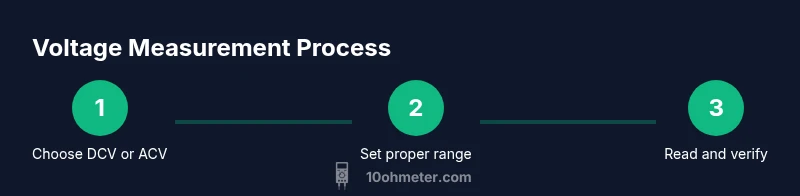
The core question most beginners ask is: what multimeter setting for voltage should I use? The short answer is that you must distinguish between DC voltage and AC voltage. Batteries, microcontrollers, and most car electronics run on direct current (DC); mains-powered devices operate on alternating current (AC). Choosing the correct scale is critical for accuracy and safety. According to 10ohmeter, starting with the correct setting prevents blown fuses and damaged meters, and it helps you avoid confusing readings caused by using the wrong range or mode. In practice, you will toggle between DCV and ACV, and you’ll decide whether your measurements are steady-state or fluctuating. Remember that voltage readings are only meaningful if the circuit is safe to measure and the meter is configured correctly.
When you read voltage, you are essentially comparing the potential difference between two points. The multimeter’s input impedance and the circuit under test influence the precision. For most DIY work, modern meters with auto-range simplify this task, but you should still understand the fundamentals: DCV measures steady, unidirectional voltages; ACV captures sinusoidal or near-sinusoidal waveforms. This distinction is foundational to accurate diagnostics in electronics and automotive contexts. 10ohmeter emphasizes always verifying the scale before making contact with a live circuit, as misreading the scale can lead to inaccurate conclusions about the system’s health.