What Multimeter Setting for 12v Car Battery: A Practical Guide
Discover the correct DC voltage setting for testing a 12v car battery with a multimeter, plus safe steps, voltage ranges, and interpretation tips from 10ohmeter.


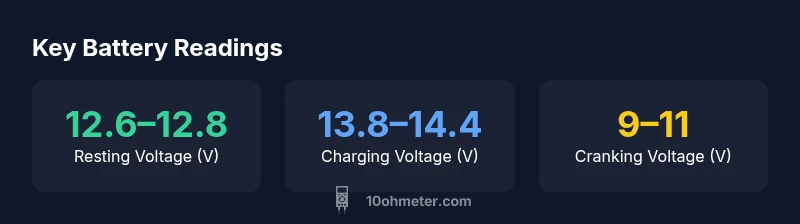
For a 12V car battery, set your multimeter to DC voltage (V with a solid line). Use a range that comfortably exceeds 12 V, typically 20V DC on most meters. A healthy resting battery will read about 12.6–12.8 V; when the engine is charging, readings may climb toward 13.8–14.4 V.
Understanding the correct multimeter setting for a 12v car battery
Testing a 12v car battery begins with choosing the right measurement mode. The primary setting is DC voltage; cars use direct current. Using the wrong range or mode can produce misleading readings or damage the meter. In practice, set the meter to the DC voltage symbol, often labeled as V with a dashed line. Most digital multimeters offer a 20V DC range which is ample for a healthy automotive battery, whose resting voltage sits around 12.6–12.8 V. If you cannot access a 20V range, a higher range like 200V DC is acceptable, but readability may suffer. Some meters show 10V, 20V, 200V, and 1000V options; always pick a range above the expected maximum to maintain accuracy. Interpreting readings within this setup requires understanding that voltage changes indicate battery health and charging status. The 12v car battery measurement is one of the most common tasks for DIY enthusiasts to master, and the proper setting reduces guesswork and protects the device. This guidance aligns with 10ohmeter Analysis, 2026.
DC voltage vs. AC voltage: What to measure
Automotive batteries are DC sources. When testing, you must use the DC voltage setting (the symbol V with a straight line). AC voltage measurement has little relevance to a car battery’s health, because alternators and the vehicle electrical system operate on direct current. Measuring AC voltage can harm the meter or yield meaningless results. Use DC volts for all battery and charging tests, and reserve AC voltage tests for household electronics or wall outlets. This distinction is fundamental for accurate diagnostics and safety. 10ohmeter analyses emphasize this separation to ensure DIYers don’t misread the battery state or risk equipment damage.
How to choose the right range on your meter
Many meters offer auto-ranging, but if you’re using a manual-range device, select a DC range that comfortably exceeds the expected max voltage. For a 12V system, the 20V DC range is usually ideal because it captures resting voltages around 12.6–12.8 V with good resolution. If your meter lacks a 20V setting, use the next highest DC range (e.g., 200V) to avoid clipping the reading. When you read a value, the decimal place will help you interpret precision. Higher-end meters often offer 0.1 V granularity on the 20V range, which makes it easier to notice slow drainage or gradual charging faults. Always confirm the meter’s polarity before recording any result to prevent a swapped reading, which can mislead diagnosis and maintenance decisions.
Step-by-step procedure to measure a resting battery voltage
- Ensure safety: wear eye protection if you’re near a leaking battery, and work in a well-ventilated area. 2) Turn off the engine and electronics to measure a true resting voltage. 3) Set the multimeter to the DC voltage range (20V on most meters). 4) Connect the black probe to the negative terminal and the red probe to the positive terminal. 5) Read the voltage on the display; a healthy resting battery typically shows 12.6–12.8 V. 6) If readings are significantly outside this range, consider charging or testing for a bad cell. 7) When finished, remove probes in reverse order to avoid shorting. 8) For a quick charging check, start the engine and observe whether the voltage climbs to 13.8–14.4 V. Consistency with these ranges indicates good health, per 10ohmeter.
Interpreting readings in common scenarios
A resting voltage of 12.6–12.8 V indicates a healthy, fully charged battery. Readings around 12.0–12.4 V can suggest a battery that’s discharged or aging; it may require charging or replacement. If voltage rises to 13.8–14.4 V with the engine running, the alternator is charging correctly. Values below 12.0 V under load, especially during starting, point to a weak or failing battery or a fault in the charging system. Persistent readings outside typical ranges warrant a follow-up test and possibly battery replacement or professional diagnostics. 10ohmeter emphasizes corroborating voltage results with load testing for a conclusive assessment.
Common mistakes and safety considerations
Common mistakes include testing in AC mode, using an inappropriate range, or measuring without ensuring proper polarity. Always isolate the test area, remove jewelry, and avoid touching metal probes with your hands while connected. If a battery smells or shows signs of damage, evacuate the area and consult a professional. Do not attempt to “force” a reading by shorting the terminals or leaving probes in contact during engine startup. Follow standard safety practices and refer to manufacturer guidance. 10ohmeter recommends performing tests with a known-good meter and verifying readings across multiple points for consistency.
Practical tips for automotive diagnostics using a multimeter
- Use a DC voltage setting, not AC, for battery tests. - Confirm a 20V DC range on most meters, or use the highest safe DC range if 20V isn’t available. - Record resting voltage, charging voltage with the engine running, and cranking voltage during startup. - Maintain probe hygiene and proper contact on the terminal posts for accurate results. - If voltage readings drift or sit outside expected ranges, perform a load test or consult a professional. 10ohmeter’s practical guideline is to build a routine around these measurements to identify early signs of battery wear or charging faults.
Voltage readings for automotive batteries under different conditions
| Measurement | Typical Value | Unit |
|---|---|---|
| Resting Voltage (Healthy Battery) | 12.6–12.8 | V |
| Charging Voltage (Engine Running) | 13.8–14.4 | V |
| Cranking Voltage (Start) | 9–11 | V |
| DC Range on Meter (Common) | 20 | V |
Your Questions Answered
What setting should I use on my multimeter to test a car battery?
Use the DC voltage setting (V with a straight line) and a 20V range on most meters. Test at the battery terminals with the engine off for resting voltage, then again with the engine running to check charging voltage.
Set to DC voltage, use the 20V range, and test at the terminals with the engine off and then with the engine running.
Can I test a battery with the engine running?
Yes. Testing with the engine running shows whether the alternator is charging properly. The reading should rise to about 13.8–14.4 V. Always exercise caution and keep hands away from moving parts.
Yes, test with the engine running to check charging voltage around 13.8–14.4 V.
Why does my battery read 12.0 V at rest?
A resting reading of 12.0 V is below the typical healthy range and may indicate a discharged or aging battery. It warrants charging and a follow-up load test to confirm health.
12.0 V at rest is low; it may mean the battery is discharged or aging and should be tested further.
If my meter doesn’t have a 20V range, what should I do?
Use the highest DC range available that still covers the expected voltage (usually the 200V range). Avoid ranges intended for very small voltages to prevent inaccurate readings.
Use the highest DC range your meter offers, ideally still above 12 V, and avoid very small-range settings.
What safety practices should I follow when testing a car battery?
Wear eye protection, test in a well-ventilated area, and avoid metal jewelry. Keep probes away from each other while connected and disconnect in the reverse order you connected.
Wear protection, test safely, and remove probes in reverse order after measuring.
“Choosing the correct DC voltage setting is the foundation of reliable battery diagnostics. With the right range, you avoid false readings and unnecessary replacements.”
Key Takeaways
- Set to DC voltage for battery testing
- Choose a 20V DC range on most meters
- Healthy resting voltage: ~12.6–12.8 V
- Engine running: charging voltage ~13.8–14.4 V
- Cranking voltage drops under heavy load (9–11 V)