120V AC Multimeter Settings: A Practical Guide for Beginners
Learn practical multimeter settings for 120V AC testing, safety tips, and step-by-step procedures to measure mains voltage confidently and accurately.


You will learn how to select the correct AC voltage settings on a digital multimeter to safely measure 120V mains, what each range means, how to verify readings, and how to avoid common misconfigurations. This practical guide covers safety considerations, measurement techniques, and troubleshooting tips for beginners and experienced hobbyists alike.
Why accurate measurements matter when measuring 120V mains
For DIY electronics and automotive work, the right multimeter settings for 120v are not just preferences — they determine safety and accuracy. According to 10ohmeter, using the correct AC voltage range and waveform awareness reduces the risk of arcing, device damage, and false readings. When you measure household mains, you are interfacing with energy at lethal potential, so precision starts with setup, not just technique. This primer explains why accuracy matters and how to approach it with discipline. In practical terms, you will build reliability into every reading by selecting the right range, enabling the meter’s true RMS mode when available, and checking the waveform before trusting the value. The goal is to avoid misreads that could mislead diagnostics or repair work, especially on critical circuits in homes and vehicles.
Safety first: protecting yourself and the equipment
Safety is non-negotiable when dealing with 120V AC mains. Before touching any probes, clean the work area and dry your hands. Use insulated gloves and safety glasses as basic protection, and keep metal jewelry away from test points. Inspect test leads for cracks or damaged insulation; replace them if in doubt. Always work with one hand behind your back or in a position that minimizes the chance of forming a path across your body. If you feel tired or distracted, pause and resume when ready. These precautions reduce the risk of electric shock, arc flash, and accidental short circuits.
Understanding AC voltage ranges and True RMS
AC voltage measurement on a multimeter can be deceptively simple, but the numbers you see depend on the meter’s range and its ability to interpret waveforms. The 120V mains in North America is nominally 120V RMS at 60 Hz, but real-world loads distort the waveform. A true RMS meter calculates the actual heating value of the waveform, giving a more accurate reading even when there are harmonics or non-sinusoidal shapes. Auto-range meters try to pick a suitable range automatically, while manual-range meters require you to pick a range that can accommodate the expected peak. For reliable mains work, choose a meter that offers true RMS and a comfortable VAC range, such as 200V or higher for most household circuits.
How to select the right meter and settings for 120V
Start with safety ratings and ruggedness—look for a meter with a good CAT rating for mains work and reliable AC voltage measurement (VAC). Set the meter to AC voltage mode (often labeled VAC or V~) and choose auto-range if you’re unsure; if you know the expected voltage, use a protective manual range that includes 120V. If your meter supports frequency measurement, enable Hz to confirm the supply is in the expected range (50 or 60 Hz). When probing live circuits, use the correct test leads, maintain contact only with insulated portions, and keep the other hand away from the circuit. If you’re testing a de-energized circuit, first verify it’s off and disconnected to avoid accidental shocks.
Reading AC signals: frequency, crest factor, and waveform awareness
Not all AC measurements are created equal. A clean sine wave gives stable VAC readings, but many loads draw current in pulses or distort the waveform. Frequency readouts help confirm the supply cadence (commonly 50 Hz or 60 Hz in residential systems). Crest factor indicates the ratio of peak to RMS values and can reveal measurement anomalies caused by transient spikes or poorly connected probes. When you observe a reading that seems high or unstable, recheck your connections, switch to a higher range if necessary, or test another outlet to compare results. In all cases, rely on the meter’s true RMS capability for best accuracy with non-ideal waveforms.
Common mistakes and how to avoid them
Weaker threads of error show up as misreading and unsafe practices. Using a DC voltage setting to measure AC mains yields meaningless results. Selecting a range that’s too low or leaving the meter in auto-range without verification can overload the meter or saturate the display. Using damaged leads, touching bare conductors, or measuring with wet hands increases risk. Units with poor insulation or degraded probes can also produce erroneous readings. To prevent these mistakes, always verify mode and range before touching the leads and perform a quick non-contact voltage check (if available) to confirm live status before making contact.
Interpreting readings and verifying accuracy
Interpreting 120V readings starts with context—know your meter’s tolerances and the load. A typical tolerance for a consumer-grade meter is a few percent, but consult the instruction sheet for exact numbers. When readings appear off, re-check placement: measure across the hot and neutral prongs, not to ground, and ensure probes are making good contact. Cross-check with another meter or test a known reference circuit if feasible. Document readings and conditions (outlet, load, wiring) to track changes over time. This practice improves confidence in diagnostics and supports safer repair decisions.
Maintenance, calibration, and safety practices for ongoing use
Regular maintenance keeps your tool trustworthy. Inspect batteries and fuse status, clean probes, and replace worn accessories. Keep the meter dry, store it in a padded case, and avoid exposure to extreme temperatures. Calibrate periodically if your meter provides calibration services or using a reference standard, following the manufacturer’s schedule. Always power down before connecting probes to avoid accidental short circuits, and retire a meter that shows persistent inaccuracy or damaged insulation. With routine care, your 120V testing becomes quicker, safer, and more reliable.
Quick-start cheat sheet for field testing 120V
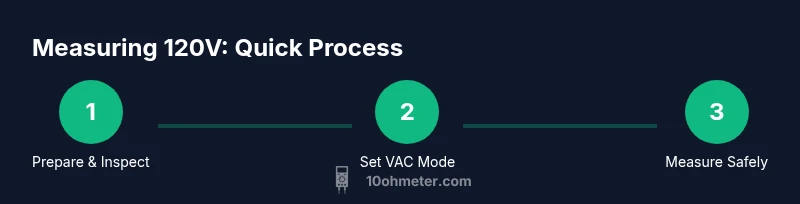
Before you begin: confirm you’re on VAC mode and that the range can accommodate at least 120V. Step 1: Plug in and power the outlet; Step 2: Attach probes, one in each slot, with dry hands; Step 3: Read the value, noting Hz if shown; Step 4: If the reading is unstable, switch to auto-range or a higher range and verify with a known reference. Step 5: When finished, disconnect safely and store accessories. This cheat sheet helps you get reliable results quickly on the job.
Tools & Materials
- Digital multimeter with AC voltage (VAC) setting(Prefer true RMS; auto-range recommended)
- Probe leads with insulated tips(Inspect for damage; replace if frayed)
- Insulated safety goggles and gloves(Wear when testing live circuits; ensure dry hands)
- Non-contact voltage tester (optional)(Helpful to confirm live status before contact)
- Dry, clean work surface and insulated mat(Keep area dry and free of conductive clutter)
Steps
Estimated time: 15-25 minutes
- 1
Inspect the equipment and workspace
Examine the multimeter, leads, and probes for wear. Ensure the work area is dry, clean, and free from liquids or metal objects that could create a short. If you notice damaged insulation or frayed leads, replace before proceeding.
Tip: Damaged leads can cause false readings or shock — replace immediately. - 2
Set the meter to VAC mode
Power on the meter and select the AC voltage setting (VAC or V~). If your device has auto-range, enable it; if not, be prepared to choose a high enough range to capture 120V without overload.
Tip: Auto-range minimizes guesswork, but confirm the selected range can accommodate expected peak voltages. - 3
Confirm the range or enable true RMS
If your meter supports true RMS, enable it to improve accuracy on non-sinusoidal loads. If you’re unsure about the waveform, start with auto-range and verify that the reading stabilizes.
Tip: True RMS is especially helpful with power supplies or dimmer-controlled circuits. - 4
Attach the probes with care
Connect the black probe to neutral/ground and the red probe to the hot conductor. Keep fingers away from the metal tips and avoid touching exposed conductors.
Tip: Use one hand to hold probes and keep the other away from live components. - 5
Take the measurement on a de-energized reference when possible
If practical, confirm the meter’s behavior on a known reference or plug a test outlet that you know is safe to measure first. This helps verify meter response before testing a real mains outlet.
Tip: Always de-energize when confirming equipment function if a safe reference is available. - 6
Measure the target outlet
With the outlet energized, place probes across hot and neutral. Read the VAC value and, if displayed, Hz to verify the mains frequency. Do not surpass the furthest input jack on the meter.
Tip: If the reading spikes, wait a moment and recheck to ensure a stable value. - 7
Cross-check and interpret
If your meter offers Hz, check that the frequency aligns with your local supply (typically 50 or 60 Hz). Compare the reading with a known reference when possible to confirm accuracy.
Tip: Consistency across multiple tests strengthens confidence in the measurement. - 8
Power down and store safely
Turn off the meter, remove probes, and store all components in a dry case. Inspect leads again and wipe surfaces to remove any stray conductive residue.
Tip: Proper storage slows wear and preserves accuracy for future measurements.
Your Questions Answered
Can I measure 120V directly from a standard wall outlet with a multimeter?
Yes, but only with proper precautions: use VAC mode, ensure the test leads are in good condition, and avoid touching exposed conductors.
Yes, you can measure a standard outlet, but prioritize safety: VAC mode, good leads, and no bare skin contact.
What does True RMS mean and why is it important for 120V measurements?
True RMS provides an accurate reading for non-sinusoidal waveforms. It matters when loads distort the waveform, ensuring the reading reflects true heating value rather than a simplified average.
True RMS gives an accurate voltage when the waveform is distorted by non-linear loads.
Why might my meter show OL or an overload reading?
OL usually means the voltage range is too low for the measured value. Switch to a higher VAC range or enable auto-range and re-measure.
OL means the range is too low; switch to a higher range and measure again.
Is it unsafe to measure live circuits for beginners?
Measuring live mains carries inherent risk. It should only be done with proper training, PPE, dry hands, and careful technique.
Live mains can be dangerous; only experienced users should measure and with proper safety gear.
What frequency should I expect on residential 120V testing?
Residential mains commonly run at about 60 Hz in many regions. If your meter shows Hz, ensure it aligns with your local supply.
Most outlets run around 60 Hz; check Hz if your meter shows it.
Should I calibrate my multimeter and how often?
Calibration needs depend on usage and manufacturer guidance. Refer to the manual and service intervals to verify accuracy, and replace if readings drift.
Calibration matters; follow the manual and service intervals to keep readings accurate.
Watch Video
Key Takeaways
- Know the VAC setting and range before touching mains.
- Use true RMS mode for non-ideal waveforms.
- Verify live status with PPE and safe techniques.
- Document readings and repeat tests for reliability.