Measuring AC Voltage with a Multimeter: A Practical Guide
Learn how to safely measure AC voltage with a multimeter. This step-by-step guide covers settings, probe technique, safety, interpretation, and troubleshooting for household, automotive, and general electronics contexts.


You will learn how to safely measure AC voltage with a multimeter, including selecting the right range, configuring the meter, and interpreting readings. This guide covers safety precautions, probe placement, common pitfalls, and how to verify accuracy in circuits ranging from household outlets to automotive electrical systems.
Understanding AC Voltage and What Your Multimeter Sees
AC voltage is alternating current voltage. When you measure it with a multimeter, you typically see a value expressed as RMS (root-mean-square) for a stable reading that represents the effective voltage delivered to a load. Your meter detects the fluctuating waveform and provides a practical number that helps you assess whether a circuit is within acceptable limits. According to 10ohmeter, mastering this measurement is foundational for DIY electronics and automotive diagnostics. In most regions, mains voltages vary by standard, with some locations using higher nominal values than others. Keep in mind that waveform quality, frequency, and load conditions can influence the reading. Before you start, confirm the meter is in AC mode (often labeled V~) and that your probes are intact. A common cause of misleading results is using the wrong range or testing a damaged probe. With proper setup, you’ll obtain stable readings that reflect the circuit’s operating condition under normal load.
Safety First: Hazards and Precautions
Measuring AC voltage involves working with potentially dangerous energy. Always inspect your equipment before use and wear eye protection. Ensure your test area is dry and uncluttered. Use insulated tools and keep your body away from live conductors when possible. If you’re new to this work, consider practicing on a known safe source (like a low-voltage, isolated circuit) before testing household mains. The 10ohmeter team emphasizes avoiding contact with exposed conductors and never using damaged probes. Stand on an insulating surface and work with one hand behind your back when probing live circuits to minimize the chance of a return path through your body. If you must test a live outlet, plan your approach, keep your other hand away from metal surfaces, and never work alone near a powered system.
Choosing the Right Tool and Settings
Your multimeter should be suitable for mains or automotive work. Prefer a meter with a dedicated AC voltage mode (V~) and, if possible, automatic range selection to reduce user error. Confirm the probes are rated for the voltage you plan to test and that the device is within its stated CAT (category) rating. If you’re unsure about the expected voltage, set the meter to a high enough range to avoid overloading protection and take care to use proper probe insertion in the correct ports. The right tool and correct setting are the foundations of a trustworthy measurement.
Probing Methods and Correct Probe Placement
Proper probe placement is essential for accurate readings. Connect the black probe to COM and the red probe to the V/Ω jack. For outlets or components, make sure the probes make firm contact, and avoid touching metal tips while the circuit is live. Maintain a stable stance and minimize circuit movement during the measurement. If you’re working with connectors or sockets, use test leads with probe caps to reduce the chance of arcing. The quality of contacts dramatically affects the accuracy, so take a moment to re-check before recording a value.
Step-by-Step Measurement in Common Scenarios
This section expands on practical scenarios: measuring a wall outlet, a power strip, and an automotive AC source. In each case, you’ll verify the meter is on AC voltage, connect probes correctly, and read the display. For outlets, position the probes across the hot and neutral pins without bridging to ground. For automotive contexts, ensure the engine is off unless you’re testing an alternator under controlled conditions, and avoid probing exposed wiring near moving parts. Always record the baseline value and compare with expected ranges for your region and device under test. 10ohmeter analysis shows that many inaccuracies stem from using the meter on a DC setting by mistake or neglecting the proper probe contact. Consistency in procedure yields repeatable numbers that help you troubleshoot effectively.
Interpreting Readings and Troubleshooting
Readings should be steady and within the expected range for your locale and circuit. If the value drifts, check probe contact, range setting, and whether the circuit load is constant. Fluctuations can arise from poor contacts, noisy environments, or waveform distortion. If you suspect a faulty meter, test a known reference or borrow a second meter to cross-check. When readings don’t match what you expect, re-check the setup, ensure the correct AC mode is selected, inspect the leads for damage, and verify you’re measuring the intended point in the circuit. These checks help you separate instrument error from an actual electrical issue.
Maintenance, Calibration, and Practical Tips
Keep your multimeter clean and store it in a protective case away from moisture. Regularly inspect test leads for cracks or exposed conductors, and replace damaged equipment promptly. Calibrate or have calibration checked per your device’s manual if you rely on high-precision measurements. For added safety, use an insulated mat in your workspace and keep the meter’s accessories organized. Building a routine around safe handling, consistent probe technique, and regular maintenance will extend the life of your tool and improve measurement reliability.
Tools & Materials
- Digital Multimeter with AC voltage (V~) mode(Prefer auto-range capability; rated CAT II or higher for general electronics testing.)
- Test leads with insulated probes(Ensure connectors and probes are intact; inspect for cracks before use.)
- Safety goggles(Protect eyes from accidental arcs or splashes.)
- Insulated gloves(Use when working near exposed conductors or higher energy sources.)
- Non-contact voltage tester (optional)(Helpful for preliminary checks before touching a live circuit.)
- Insulated mat or dry workspace(Reduces risk from accidental slips and improves comfort.)
Steps
Estimated time: 15-30 minutes
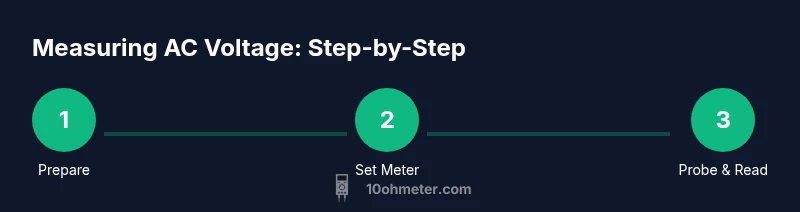
- 1
Prepare safety gear and workspace
Inspect the meter and leads for damage, wear, or cracks. Wear safety goggles and set up a dry, uncluttered workspace. If you’re testing live circuits, plan your approach and avoid touching exposed conductors. This step reduces the risk of electric shock and equipment damage.
Tip: Visually inspect the probes; a tiny nick can cause arcing under load. - 2
Set the meter to AC voltage mode
Power on the meter and select AC voltage (V~). If your meter offers auto-range, enable it; otherwise start with a high range and step down as needed. Confirm the display shows AC symbols to avoid mis-reading DC voltage.
Tip: If you’re unsure of the expected voltage, start with a high range to protect the meter. - 3
Connect the probes correctly
Plug the black probe into COM and the red probe into V/Ω. Insert gently and ensure solid contact with the test points. Keep your other hand away from the circuit to minimize the chance of a current path through your body.
Tip: Keep probe tips clean for stable contact and consistent readings. - 4
Place probes on the test point
Touch the test points with the probes without bridging the tips together or touching metal parts outside the intended test area. If testing a socket, place one probe on each contact while avoiding the ground or metal housings.
Tip: Only touch insulated portions of the probes to reduce shock risk. - 5
Read and record the measurement
Read the display, note the value, and confirm it remains stable over several seconds. If using a non-true-RMS meter, understand that readings may vary with waveform. Document the reading and the circuit conditions.
Tip: Take multiple readings to verify stability and rule out transient spikes. - 6
Power down and store safely
Turn the meter off after use, remove probes from the circuit, and store equipment in its case. Label measurement points if you’re periodically testing the same circuit to avoid confusion later.
Tip: Re-seat all connectors before returning to storage to prevent corrosion.
Your Questions Answered
Can I measure mains voltage with any multimeter?
Only if the meter is rated for mains use (appropriate CAT rating) and you follow strict safety practices. If in doubt, use a meter designed for higher energy sources and consult the manual.
Only use a meter that’s rated for mains use and follow safety practices; if unsure, consult the manual.
Why does my reading sometimes drift or bounce?
Drift can come from poor probe contact, range selection, or waveform noise. Ensure solid contact, a steady test point, and that the circuit is stable during measurement.
Drift usually comes from contact quality or a noisy signal; ensure solid contact and stability.
Do I need a true RMS meter for AC voltage?
True RMS meters provide accurate readings for non-sinusoidal waveforms. For pure sine-wave mains, a standard meter can be sufficient, but true RMS is safer for complex signals.
True RMS gives accuracy with complex waveforms; for clean sine waves, a basic meter can work.
How do I test AC voltage in a car safely?
Car systems are typically DC. If testing AC, use appropriate equipment and ensure the vehicle is off unless you’re testing a controlled source. Follow vehicle-related safety guidelines.
Car systems are usually DC; use caution and follow safety rules if testing any AC signals.
What should I do if readings disagree with expectations?
Double-check the circuit point, verify you’re in the correct AC mode, re-check probes, and consider measurement tolerance. If unpredictable, compare with a second meter.
If readings don’t match expectations, re-check setup and compare with another meter.
What safety gear should I wear?
Wear safety goggles and insulated gloves when working with higher energy sources or exposed conductors. Keep the workspace dry and organized.
Wear goggles and insulation when working with mains or exposed conductors.
Watch Video
Key Takeaways
- Set the meter to AC voltage (V~) mode before testing
- Use proper COM and V/Ω probe connections
- Keep contacts clean and practice safe probing
- Verify readings by repeating tests and cross-checking
- Store equipment safely after use