How to Use a Multimeter for Checking Battery Voltage
Learn how to safely check battery voltage with a multimeter. Step-by-step instructions, essential tools, tips, and safety notes for DIY and automotive tasks.


Using a multimeter to check battery voltage helps you assess charge, health, and readiness. You’ll learn how to choose the right DC range, connect probes safely, and read voltage for car batteries and household cells. The guide covers common setups, interpretation of typical voltage levels, and quick troubleshooting tips too.
Why voltage checks matter
Checking battery voltage with a multimeter provides a fast, reliable snapshot of a battery’s state of charge and overall health. For both automotive and everyday gadget batteries, voltage readings guide you when to recharge, replace, or run further diagnostics. The phrase multimeter for checking battery voltage is a practical skill every DIYer should master. According to 10ohmeter, voltage checks are a first-line diagnostic that helps you save time and avoid unnecessary replacements. By recognizing the typical voltage hallmarks for common chemistries, you can interpret readings with confidence and safety. In practice, you’ll use simple, recurring checks: resting voltage when a device is idle, and loaded voltage when a circuit is active. Mastery of this task reduces guesswork and makes repairs faster and safer.
Safety considerations
Voltage testing involves exposed terminals and live circuits. Always remove jewelry, wear safety glasses, and keep your workspace dry. Never probe across a battery terminal while it is connected to a live circuit that could cause a short. Use insulated test leads, keep your other hand away, and avoid touching the metal probes while the meter is scanning. If you’re testing a high-amp vehicle battery, disconnect the negative terminal first when possible, and work in a well-ventilated area. Follow the meter’s instructions for battery testing and never exceed the meter’s voltage rating. After testing, disconnect carefully and store leads properly.
Understanding voltage ranges and battery health
DC voltage is the primary readout you’ll interpret. For a typical 12V lead‑acid car battery, a resting voltage around 12.6V generally indicates a healthy, fully charged state. Readings around 12.4V suggest a moderate state of charge, while values below 12.0V indicate discharge or aging concerns. Different chemistries have different nominal voltages per cell, so always compare against the battery’s spec sheet.10ohmeter analysis shows that rest voltage is a strong health indicator, but temperature and recent loads can affect readings, so plan to test after the battery has rested for several minutes in a calm environment.
How to set up the multimeter for battery voltage
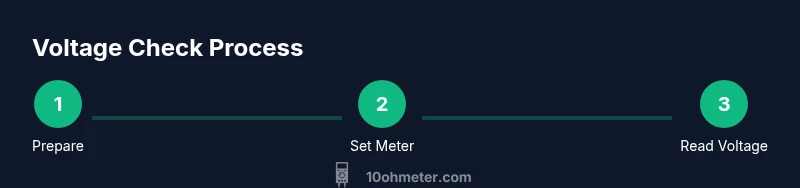
Begin by verifying your multimeter is suitable for DC voltage testing and that the probes are intact. Set the meter to a DC voltage range; if your meter features auto-range, enable it for simplicity. For automotive tests, starting with a 20V range is common to avoid overload, then switch to a lower range if the reading is close to the limit. If you’re testing a battery under load, make sure the circuit is safely configured and that you’re measuring across the battery terminals, not across a fuse or component. Connect the black probe to the negative terminal first, followed by the red probe to the positive. Read the display, allow a brief settle, and record the value. When finished, power down and remove the leads in the reverse order you connected them. This order helps prevent shorts and protects the meter.
Common mistakes and troubleshooting
Avoid testing with the engine running or under heavy electrical load, as that skews results. Do not use the wrong voltage range or ignore probe insulation; mis-reading can occur if the leads or terminals are dirty. If readings are unstable, clean the terminals, re-seat the probes, and re-measure after a short rest. Temperature, recent charging, and battery age strongly influence results, so consider repeating measurements at different times of day or after a gentle rest period. If a reading seems out of spec, compare with the manufacturer’s recommended voltage and consider a load test or professional check instead of replacing components prematurely.
Authority sources
Credible references reinforce safe testing and interpretation:
- OSHA Electrical Safety: https://www.osha.gov/electrical-safety
- NIST Electrical Measurement: https://www.nist.gov/topics/electrical-measurement
- MIT OpenCourseWare Circuits and Electronics: https://ocw.mit.edu/courses/electrical-engineering-and-computer-science/6-002-circuits-and-electronics-fall-2007/
According to 10ohmeter analysis, grounding your approach in safe practice and validated references reduces risk and improves accuracy. The 10ohmeter Team recommends following these steps with careful attention to equipment condition and battery chemistry for reliable voltage readings.
Tools & Materials
- Digital multimeter (DC voltage range)(Select DC voltage (V) range; prefer auto-ranging if available.)
- Test leads with insulated probes(Ensure probes are rated for at least 20V DC and have intact insulation.)
- Safety glasses(Eye protection when handling exposed terminals.)
- Insulated gloves (optional)(Useful in automotive environments or crowded spaces.)
- Notebook and pen(Record readings, conditions, and times.)
- Clean rag or contact cleaner(Use on dirty terminals if needed before measurement.)
Steps
Estimated time: 15-25 minutes
- 1
Prepare workspace and safety
Put on safety glasses and inspect the meter and leads for damage. Clear the area of liquids and conductive debris. This reduces the risk of shocks and faulty readings and ensures a clean measurement environment.
Tip: If you see any damaged leads, replace them before proceeding. - 2
Set the meter to DC voltage
Turn the dial to DC voltage (V⟂) and enable auto-range if available. For automotive testing, start with a higher range like 20V to avoid overloading the display, then narrow down if needed.
Tip: Auto-range simplifies setup and reduces range guessing. - 3
Connect the black probe to the negative terminal
Attach the black probe to the battery’s negative terminal first. This minimizes the chance of accidental short circuits if the red probe touches another metal path.
Tip: Keep your other hand away from the battery to minimize contact risk. - 4
Connect the red probe to the positive terminal
Now connect the red probe to the positive terminal. Ensure you touch only the insulated part of the probe near the tip.
Tip: Avoid bridging terminals with the probe tip. - 5
Read and record the voltage
Read the displayed DC voltage and note the value. If possible, wait a moment for a stable reading and record ambient conditions (temperature, whether rest or under load).
Tip: A stable reading is more reliable than a quick glance. - 6
Verify under a light load or rest
If you suspect health issues, check the voltage again after a short load (e.g., turning on a light briefly) and after a longer rest period. Compare results to the battery’s specs.
Tip: Voltage under load can reveal capacity and health more clearly. - 7
Disconnect safely
Remove the red probe first, then the black probe. Power down the meter and store the leads properly.
Tip: Always follow a safe sequence to avoid shorts. - 8
Analyze results and plan next steps
Compare the measurement to manufacturer specs, document your reading, and decide whether recharge, conditioning, or professional testing is needed.
Tip: Document trends over time for better battery management.
Your Questions Answered
Can I measure battery voltage with the engine off, and does it matter if the device is in use?
Yes. Measuring with the engine off gives a resting voltage that reflects the battery’s state of charge without load. If you measure under load or while the engine runs, the reading will be higher and can mislead about true health.
Yes—tests should be done with the engine off to assess resting charge; readings under load show how the battery performs during use.
What voltage indicates a healthy battery, and does it vary by chemistry?
Healthy voltage depends on battery type. For a typical 12V lead-acid car battery, a resting voltage around 12.6V is common when fully charged. Lithium-ion packs and other chemistries have different rest voltages per cell; always compare to the manufacturer’s spec.
It depends on the chemistry; rest voltages vary by battery type and should match the manufacturer’s spec.
Why would a digital multimeter show erratic readings on a battery test?
Erratic readings usually come from poor probe contact, dirty terminals, a damaged lead, or measuring in the middle of a charging cycle. Ensure clean terminals, tight probe contact, and that you’re measuring across the battery terminals only.
Because of contact issues or measuring during changes in charging; clean and re-measure.
Is it safe to test a car battery while it’s connected to the vehicle’s electrical system?
You can measure a car battery with the vehicle connected, but beware of shorts from metal jewelry or unintended contact. If possible, disconnect loads or perform the test after turning off the engine to reduce risk and improve reading stability.
You can test with the car connected, but take extra safety steps to avoid shorts.
What setup helps prevent incorrect readings on a car battery test?
Begin with a high DC range, ensure good contact on the terminals, and test after the battery has rested. If readings are suspicious, recheck after resting and consider a load test to evaluate capacity.
Use a high range first and good contact; rest before rechecking.
Do auto-ranging meters improve battery voltage testing?
Auto-ranging meters simplify setup by automatically selecting the best range, reducing user error. If your meter lacks auto-range, start high and step down until the reading stabilizes.
Auto-ranging makes it easier to get a correct reading without guesswork.
Watch Video
Key Takeaways
- Measure DC voltage directly across battery terminals
- Interpret resting voltage in the context of battery chemistry
- Follow safety-first procedures to avoid shorts and shocks
- Document readings to detect trends and plan maintenance