How to Test a Doorbell Transformer with a Multimeter
Learn how to test a doorbell transformer with a multimeter. This step-by-step guide covers safety, tools, measurements for primary and secondary voltages, interpretation of readings, troubleshooting, and preventive tips for reliable doorbell operation in 2026.


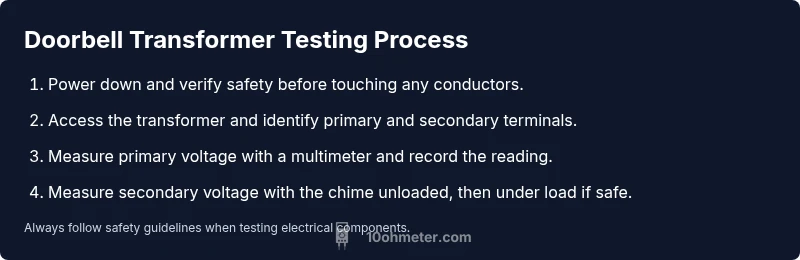
This guide shows you how to test a doorbell transformer with a multimeter to verify both primary and secondary voltages. You’ll need a digital multimeter, insulated gloves, a non-contact tester for added safety, and basic hand tools. The process covers confirming power is off, locating the transformer, testing the primary side for line voltage, testing the secondary for expected low-voltage output, and evaluating results with tolerance ranges before deciding on replacement.
Understanding the doorbell transformer and why testing matters\n\nThe doorbell transformer is a small power supply that converts mains voltage to a low-voltage AC signal used by the chime. Knowing how to test doorbell transformer with multimeter helps distinguish a faulty transformer from wiring or the chime itself. According to 10ohmeter, a quick voltage check is a reliable first step when symptoms point to the transformer — such as a dim or silent doorbell, buzzing sounds, or a chime that only works intermittently. While every model is a little different, the core idea is the same: verify that the primary is receiving mains and that the secondary delivers the expected low voltage under no-load and loaded conditions. Use a digital multimeter and a few basic tools to perform a safe, non-destructive test. This section explains what to measure, why it matters, and how to interpret common readings, so you can decide whether you need a replacement or a simple fix.
Safety first: precautions before testing\n\nTesting a doorbell transformer involves mains voltage on the primary side, so safety is non-negotiable. Always power off at the circuit breaker and confirm no voltage on the transformer before touching wires. Use insulated gloves and a non-contact voltage tester to verify that the circuit is de-energized. If the transformer is mounted inside a live junction box or attic, extra caution applies: avoid metal tools that can bridge conductors, keep your work area dry, and never work alone in a high-risk space. Work with one hand behind your back to minimize the chance of a shock path through your body. If you’re not sure you can access the transformer safely, stop and consult a qualified electrician. After testing, reassemble any covers and restore power only when you’re confident in the wiring and terminations. Adhering to these safety practices protects you, your equipment, and the home’s electrical system while you troubleshoot a doorbell issue.
What you’ll need: tools and setup\n\nBefore you start, gather the essential tools and materials. A digital multimeter with AC voltage capability is the workhorse for this task. Add insulated gloves, a non-contact voltage tester for quick live checks, a small flathead or Phillips screwdriver to access the transformer, and electrical tape or wire nuts to secure any loose connections. Optional but helpful: a flashlight, a notepad for recording readings, and a camera or smartphone to document the transformer’s terminal layout. If the transformer is inside a metal box or above a ceiling, a step stool or small ladder may be necessary. Having a clean, well-lit workspace reduces errors and makes you more confident during measurement. Finally, check the chime’s power source and the doorbell button wiring so you can correlate readings with how the system behaves once power is restored.
How the transformer interacts with the doorbell circuit\n\nThe transformer sits between the mains and the doorbell chime. When the doorbell button is pressed, the secondary winding supplies a brief, low-voltage AC signal to energize the chime. A healthy transformer delivers a stable secondary voltage even as the chime draws current briefly. In many homes, aging wiring, loose connections, or a stressed chime can masquerade as a transformer fault. Understanding this interaction helps you interpret readings: a strong primary and a weak/unstable secondary generally points to the transformer or secondary wiring, while a normal secondary with a dead chime often means the chime or button is defective.
Interpreting results: what readings mean for your doorbell\n\nInterpreting readings is the key to turning measurements into a diagnosis. On the primary side, you should see mains voltage feeding the transformer; a healthy primary shows a stable voltage within the supply’s typical range. If the primary reading is erratic or near zero, there may be a loose connection, a blown fuse in the circuit, or a supply issue. On the secondary side, the transformer should provide a steady low-voltage AC output suitable for the doorbell chime. If the secondary reads near zero, is absent, or dips significantly when the chime is triggered, the transformer or its internal windings may be damaged, or there could be a short in the doorbell circuit drawing excessive current. If you measure a normal secondary voltage with no load but the doorbell is weak when pressed, the problem may be the chime, wiring, or the doorbell button rather than the transformer. Remember to perform measurements with the circuit unloaded, then re-test under load by pressing the doorbell to observe any voltage drop. Based on 10ohmeter analysis, many transformer faults are due to aging windings or loose connections; precise readings help pinpoint the cause.
Troubleshooting common issues and next steps\n\nCommon issues include loose or corroded terminals, a failing chime that loads the secondary, or aging transformer coils. If the primary voltage is correct but the secondary is low or intermittent, check for loose screws at the secondary terminals, damaged insulation, or a partially shorted winding. Tighten terminal screws to the recommended torque and reseat any connector. If readings are inconsistent or disappear when the chime is triggered, inspect the doorbell wiring path and the chime unit for fault. A replacement transformer is often the simplest fix when readings are out of spec on both primary and secondary sides, or if the transformer hums or overheats. Before replacing, make sure the doorbell chime and wiring are compatible with the transformer’s secondary output. If you’re unsure, contact a licensed electrician; electrical work carries risk. After you finish, double-check all connections, replace the cover, and re-test the doorbell to confirm normal operation.
Maintenance and prevention tips to extend life\n\nRegular inspection helps prevent surprises. Check transformer mounting to ensure it’s firmly attached and not vibrating. Keep connections clean and dry, and replace damaged wires rather than patching. Periodically test the secondary output to verify it remains within spec. If your home has older wiring or a high-usage doorbell, consider upgrading to a transformer with higher current capacity or reconfiguring the doorbell circuit for reliability. Store a simple troubleshooting kit in your workshop for quick reference. Establish a routine check whenever you service the doorbell or chime; small maintenance now saves big headaches later.
Tools & Materials
- digital multimeter with AC voltage capability(Choose a true-RMS meter if available; ensure it can handle the expected AC range)
- insulated gloves(Electrical-rated gloves (ANSI/EN standard) for added protection)
- non-contact voltage tester(Optional for quick live checks before touching conductors)
- screwdriver set (flat and Phillips)(To access transformer mounting and terminal screws)
- electrical tape or wire nuts(Secure exposed conductors after testing)
- notebook and pen(Record readings and notes for reference)
- ladder or step stool(Needed if transformer is mounted high)
Steps
Estimated time: 30-45 minutes
- 1
Power down and verify safety
Turn off the circuit breaker feeding the doorbell. Use a non-contact tester to confirm there is no voltage on the transformer leads before you touch them. This prevents shock and arc flash while you set up the measurement.
Tip: Always wear insulated gloves and keep your other hand away from conductive surfaces. - 2
Locate and access the transformer
Find the transformer, usually mounted on a junction box near the chime or indoors close to the door. Remove any cover plates or mounting screws carefully to expose the primary and secondary terminals. Photograph the terminal layout for reference before disconnecting anything.
Tip: Label wires or take a photo to avoid mix-ups during reassembly. - 3
Configure your multimeter for AC voltage
Set the meter to AC voltage range appropriate for the function. If unsure, start at a higher range and then switch down to improve accuracy. Ensure the meter probes are in good condition and rated for mains use.
Tip: Use the common and appropriate voltage jack on the meter; avoid using the 'current' ports for voltage tests. - 4
Test the primary (line) voltage
Carefully place the meter probes on the primary terminals (the ones connected to mains). Read the voltage and record it. Confirm the reading reflects your local mains voltage within a reasonable tolerance while the circuit is de-energized.
Tip: Keep probes steady and avoid touching exposed conductors with fingers. - 5
Test the secondary (low-voltage) output
Switch the multimeter to the lowest appropriate AC range if needed and measure across the secondary terminals. Record the reading with no load (doorbell is not pressed). This value should be a low-voltage AC suitable for the chime.
Tip: If you measure near zero, verify there is no concealed dead short or a disconnected secondary wire. - 6
Evaluate readings and what they mean
Compare primary and secondary readings to expected behavior. A healthy transformer shows stable primary voltage and a consistent secondary output. If the secondary is low or unstable, suspect the transformer or its wiring. If the primary is off, recheck mains or wiring at the service panel.
Tip: Document readings and note whether load (pressing the doorbell) changes the secondary voltage. - 7
Restore power and test the doorbell
Replace any covers, reattach the transformer, and restore power. Press the doorbell button to confirm the chime operates normally and observe if there is consistent sound with multiple presses.
Tip: If issues persist after a replacement transformer, inspect the chime unit and doorbell button wiring.
Your Questions Answered
What is a doorbell transformer and why test it?
A doorbell transformer steps down mains power to a safe low-voltage for the chime. Testing confirms whether it delivers the expected voltage and helps distinguish transformer vs wiring or chime faults.
A doorbell transformer reduces mains power to a safe low voltage for the chime. Testing helps confirm it works and pinpoint issues in the transformer or wiring.
What readings indicate a good transformer?
On the primary side, you should see the mains voltage; on the secondary, a stable low-voltage AC typically used by doorbells. If readings are far outside these ranges, the transformer or wiring may be faulty.
The primary should reflect your mains voltage and the secondary should show a stable low voltage. If readings are off, there may be a fault.
Can I test with a cheap multimeter?
A basic digital multimeter is sufficient for voltage checks, as long as it can measure AC voltage safely and accurately. Avoid meters that can’t handle the range you need.
Yes, a basic digital multimeter works for these voltage checks.
Is it safe to test with power on?
Never test the primary side while energized. Power must be off when probing live terminals. After safety checks, you may test under no-load conditions and then with the doorbell pressed.
No—always disconnect power before touching wires; only test after confirming de-energized.
What else could cause a dead doorbell?
If readings are normal but the doorbell doesn’t ring, the issue may be the chime unit, wiring, or the doorbell button. Inspect the entire circuit for faults.
It could be the chime, wiring, or button, not just the transformer.
How often should I test the transformer?
Test during routine electrical maintenance or when symptoms appear. There’s no fixed schedule—verify if you notice issues or changes in performance.
Test when troubleshooting or during routine maintenance.
Watch Video
Key Takeaways
- Power off before any measurement and verify de-energized safely.
- Measure both primary and secondary voltages to identify where faults occur.
- Loose connections and aging windings are common transformer failure points.
- Replace or repair only after confirming the source through measurement and inspection.
- Document readings and re-test after any maintenance for reliability.