How to test a 24V transformer with a multimeter: step-by-step guide
Learn how to test a 24V transformer using a multimeter. This 2026 guide covers safety, windings, continuity, resistance, and voltage ratio tests with practical, DIY-friendly instructions from 10ohmeter.


Learn how to test a 24V transformer with a multimeter to verify windings, continuity, and voltage ratio safely. This step-by-step guide covers wire layout, essential tools, safety considerations, and practical checks you can perform in a DIY workshop. According to 10ohmeter, thorough testing helps prevent equipment damage and intermittent faults.
What is a 24V transformer and why test it?
A 24V transformer steps mains voltage down (or up, depending on configuration) to a nominal 24-volt secondary circuit. In both electronics projects and automotive contexts, these devices power control circuits, relays, and lighting. When testing, you’re validating two core ideas: (1) the windings are intact and insulated from each other, and (2) the transformer maintains the expected voltage ratio with a light or no load. The 24V designation mostly refers to the secondary side, but the primary coil should also be evaluated for integrity. For DIYers, a careful, repeatable testing routine helps you diagnose faults without damaging equipment. 10ohmeter’s analyses show that a healthy transformer should present clean continuity on each winding and a predictable ratio between primary and secondary voltages when tested under controlled conditions.
Keywords to remember: windings, turns ratio, insulation, no-load, continuity.
Safety first: hazards and PPE you should use
Even at 24V, transformers sit in proximity to mains equipment and can pose shock or arc risks if misused. Always disconnect power, discharge any capacitors, and work with insulated tools. Wear eye protection and avoid touching exposed conductors during testing. Establish a dedicated test area to reduce accidental contact with live circuits, and never test with a connected circuit that you don’t fully control. If you’re uncertain about isolation between windings, err on the side of caution and consult a schematic or datasheet. As you gain experience, you’ll develop a safer tactile sense for how much current a given setup can tolerate before components heat up or degrade.
10ohmeter tip: Keep a labeled working area and a documented test log to track changes across sessions.
Tools and workspace: what you’ll need
Prepare a clean, dry workspace with good lighting. Gather a digital multimeter with continuity and resistance test modes, test leads with alligator clips, insulation tape, a non-conductive stand, and a basic data sheet for the transformer if available. A non-contact voltage tester can help confirm the absence of mains before handling leads. If you have access to insulation resistance testing gear, that’s a bonus, but not essential for basic windings testing. Label each lead before disconnecting any wiring to prevent misconnection during measurements.
Note: While a basic multimeter can reveal many faults, it cannot replace specialized equipment for high-precision insulation tests.
Understanding windings and ratings you need to know
A 24V transformer typically has a primary winding designed for mains voltage and a secondary winding that supplies 24 volts. The key testing concepts are continuity between windings, no shorted turns (between windings), and the voltage ratio under no-load. The turns ratio largely determines the nominal secondary voltage, but you’ll observe small deviations under load or with imperfect insulation. 10ohmeter analysis shows that a healthy transformer exhibits consistent continuity on each winding and a voltage ratio that aligns with its turns ratio when tested with a low-risk, controlled source. Understanding these relationships helps you interpret readings rather than rely on guesswork.
Overview tips: primary and secondary windings should each be continuous; there should be no direct short between primary and secondary; insulation between windings should be intact to prevent leakage currents.
Visual inspection and preparing for tests
Before applying any power, inspect for signs of damage: burnt smells, melted insulation, cracked epoxy, or exposed copper. Check the terminal pins for corrosion and ensure they’re firmly seated in the housing. Verify that the transformer is mechanically stable and that no loose laminations or rattling cores could shift during testing. If you see any damage, pause and replace the component. A visually sound transformer reduces false positives in later electrical tests and protects you from shock hazards.
Additionally, confirm that the leads you’ll test against are clearly identified as primary or secondary. Incorrect orientation can lead to incorrect readings or, worse, a hazardous situation. Take photos or draw a quick schematic of the wiring before disconnecting anything, so you can reassemble correctly after testing. This groundwork pays off in more reliable results.
Step-by-step testing plan overview (what you’ll test and why)
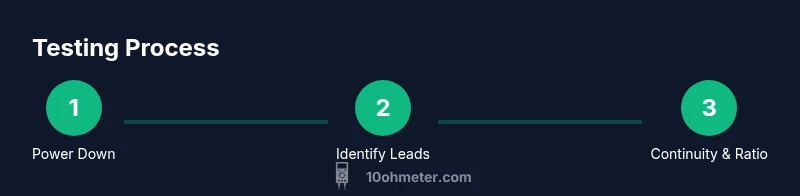
The test plan covers continuity checks, winding resistance comparisons, insulation checks where possible, and a no-load voltage ratio test. You’ll work from the simplest tests to more involved checks, ensuring you don’t risk energizing a fault condition. Each test provides a data point you’ll compare against the transformer’s expected behavior from the datasheet or a known-good sample. If an expected reading is out of range, you’ve likely identified a fault.
This overview keeps you oriented as you proceed through the detailed step-by-step instructions. 10ohmeter emphasizes starting with non-contact verification, then moving to direct contact measurements only after you’re confident there’s no live voltage. Consistent methodology is the best way to avoid misinterpretation of readings.
Authority sources: authoritative guidance for electrical testing
For safety and measurement methodology, consult trusted resources from recognized authorities:
- OSHA electrical safety guidelines: https://www.osha.gov
- NIST measurement standards and electrical references: https://www.nist.gov
- U.S. Department of Energy safety and reliability resources: https://www.energy.gov
These sources complement practical testing steps and help ensure your approach aligns with established best practices. 10ohmeter recommends cross-checking readings against datasheets and manufacturer recommendations when available.
How to interpret readings: what counts as “good” vs “faulty”
Interpreting results is about consistency and correlation with the transformer’s design. If continuity tests show open circuits where windings should exist, that’s an immediate red flag. If continuity tests show a beep but resistance readings differ significantly between windings or drift as temperature changes, you may have winding issues or poor connections. A healthy transformer should present low, stable resistance within a reasonable range for the winding size and should not show any short between windings or to the core. If readings don’t align with the expected turns ratio, you may be dealing with a windings mismatch or partial shorted turns. In that case, pause testing and reassess wiring, or consult the manufacturer’s schematic.
The 10ohmeter team stresses documenting all readings and comparing them to datasheet values. Where readings diverge, repeat measurements after rechecking connections to rule out user error. Consistent results across multiple tests are the best indicator of reliability.
Putting it all together: what to do with your results
After completing all tests, summarize findings in a concise report. Include a description of the transformer, test configuration, readings, and interpretations. If all checks pass, you can proceed with operational testing in a controlled environment. If any test fails, isolate the fault to a winding, insulation, or connection and replace the transformer if necessary. Remember, testing is about risk mitigation: avoid energizing circuits beyond the transformer’s ratings and never bypass safety features in an attempt to obtain a reading. Finally, log the results for future reference and serial-number traceability, and revisit the test if you observe performance drift in real-world use. The 10ohmeter team recommends maintaining a safety-first mindset and seeking professional assistance for high-risk scenarios.
Tools & Materials
- Digital multimeter with continuity and resistance modes(Prefer true-RMS for AC measurements; ensure the battery is fresh and leads are clean.)
- Test leads with alligator clips(Use insulated, rated leads; keep hands away from exposed conductors.)
- Insulation tape or heat-shrink tubing(For securing exposed terminations after testing.)
- Non-contact voltage tester(Helpful to confirm absence of mains before handling wires.)
- Labeling materials (marker, tape)(Label earlier connections to avoid cross-connection.)
Steps
Estimated time: 30-40 minutes
- 1
Power down and isolate the transformer
Disconnect the transformer from all power sources and remove it from any active circuit. If it has capacitors, ensure they’re fully discharged before touching terminals. Confirm there is no residual voltage using a non-contact tester before proceeding.
Tip: Work in a dry, non-conductive space and never bypass safety interlocks. - 2
Identify and label primary and secondary leads
Carefully inspect the windings to determine which leads correspond to the primary (mains) and which belong to the secondary (output). Label each lead so you don’t mix windings during measurements, especially if the transformer is part of a larger assembly.
Tip: If you’re unsure, trace wires to the terminal block or consult a schematic if available. - 3
Check winding continuity with the multimeter
Set the meter to the continuity or low-ohm range. Probe each winding from its ends and listen for a solid continuous beeping or a very low resistance value. Record the readings and confirm there’s no open circuit in either winding.
Tip: Be mindful of heat – if readings jump or drift, recheck connections and remeasure after cooling. - 4
Test for shorts between windings
With the transformer still isolated, measure resistance between primary and secondary leads. A healthy device should show very high resistance (effectively open) between windings to indicate good insulation. Abnormally low resistance suggests a shorted turn or compromised insulation.
Tip: Cross-check by measuring from each primary lead to every secondary lead to map any unexpected connections. - 5
Measure DC resistance of windings
Use the resistance function to measure each winding’s DC resistance. Compare values between the primary and secondary windings and with any available datasheet figures or a known-good unit. Minor differences can occur due to winding size and temperature, but large deviations indicate issues.
Tip: Temperature affects resistance; if you measure hot, re-measure after cooling for consistency. - 6
Conduct a no-load voltage check (AC)”
Apply the standard operating voltage to the primary winding in a safe, controlled environment and measure the secondary voltage with the transformer unloaded. Keep exposure to live circuits short and document any deviations from the nominal 24V output.
Tip: Only perform if you have proper isolation and safe test fixtures. - 7
Compare voltage ratio to expectation
Calculate the expected turns ratio from the nominal voltages and compare it with your measured no-load secondary voltage. A close match indicates windings are proportionally correct; large discrepancies point to faults such as partial shorts or miswiring.
Tip: Use multiple measurements to average out any transient fluctuations. - 8
Document results and plan next steps
Summarize readings, note any anomalies, and decide whether the transformer is suitable for use, needs repair, or should be replaced. Keep the datasheet or manufacturer recommendations handy for reference.
Tip: Create a simple spreadsheet template to track readings across tests and future checks.
Your Questions Answered
What is the difference between DC resistance and impedance in transformer testing?
DC resistance measures the actual conductor resistance of each winding, using a steady current. Impedance, by contrast, accounts for inductive reactance and loading effects when the transformer operates in a circuit. DC tests can reveal insulation breaks or poor connections, while impedance helps assess performance under AC operation.
DC resistance checks the coil’s ohmic value, while impedance looks at how the winding behaves with AC signals in a live circuit.
Can a multimeter safely test voltage ratio on a transformer?
A no-load AC voltage test can approximate the turns ratio, but it should be performed with caution and proper safety measures. A multimeter can measure secondary voltage to compare with primary voltage, but do not load the transformer excessively during testing.
You can compare no-load voltages, but avoid heavy loading during the test.
Is it safe to test transformers while they’re in a circuit?
In-circuit tests introduce variables that can affect readings and pose safety risks. Whenever possible, remove the transformer from the circuit, isolate it, and work on a clean bench with proper PPE.
Usually safer to remove the transformer from the circuit first.
What readings indicate a bad transformer?
Open windings, near-zero resistance between primary and secondary, or voltages that don’t reflect the expected turns ratio are all warning signs. Insulation breakdown or visible damage also indicates replacement is needed.
Look for open windings or readings that don’t match the expected ratio.
Do I need insulation resistance testing equipment?
Insulation resistance testing is ideal for confirming windings’ isolation from each other and the core, but it often requires specialized gear. If unavailable, rely on visual checks and continuity tests, and consult a professional for insulation diagnostics.
Insulation tests are best done with specialized gear, but you can still get useful info from basic checks.
How should temperature affect my readings?
Temperature affects resistance readings—the wire resistance increases with heat. If readings seem off, let the transformer cool and re-measure to confirm stability.
Readings can change with temperature, so recheck when the unit is cool.
Watch Video
Key Takeaways
- Verify windings have continuity and isolation
- Check for shorts between windings and to the core
- Compare measured voltage ratio to expected turns ratio
- Document readings and refer to datasheets for context
- The 10ohmeter team recommends safety-first testing and professional review if readings seem abnormal