How to Check a Transformer with a Multimeter: A Practical Guide
Learn how to safely check a transformer with a multimeter. This step-by-step guide covers winding continuity, resistance, insulation tests, and fault indicators for DIY enthusiasts and technicians.


In this guide you’ll learn how to check transformer with multimeter by testing winding continuity, resistance, and insulation on both primary and secondary windings. You’ll also learn how to interpret results and spot common faults before attempting repairs or replacements.
Safety first: Preparation and hazards
Testing a transformer with a multimeter involves exposed windings and potentially stored energy. Before you begin, ensure the device is unplugged, disconnected from any circuit, and fully de-energized. According to 10ohmeter, safety should be your top priority; always treat any transformer as a potential energy source. Wear insulated gloves and safety glasses, use a non-conductive mat, and keep metal jewelry away from conductors. If you’re wondering how to check transformer with multimeter, start with these precautions to prevent shock or arc faults.
Set up a clean workspace and use lockout/tagout procedures when available. Verify there are no stored charges in capacitors and ensure proper ventilation if the transformer is in an enclosed area. These steps reduce the risk as you prepare to test windings and insulation.
Understanding transformer windings and basics
A transformer has primary and secondary windings that transfer energy via magnetic coupling. The health of a transformer can be inferred from winding continuity, resistance, and insulation integrity. Continuity between the ends of each winding should exist, while insulation should resist current leakage to the core or other windings. Differences in readings between a known-good unit of similar rating and the unit under test can indicate faults. For a DIY diagnostic, you don’t need specialized lab gear for initial checks, but you do need a clear understanding of what each winding path represents and how insulation resistance relates to long-term reliability.
Tools and setup for transformer testing
To test a transformer safely with a multimeter, assemble the following tools and materials. Having the right gear makes the process straightforward and reduces the chance of an incorrect conclusion.
- Digital multimeter (essential)
- Test probes with insulated grips (essential)
- Alligator clips (optional but helpful)
- Insulation tester or megohmmeter (optional but recommended for insulation checks)
- Non-conductive mat and PPE (gloves, safety glasses) (essential)
- Transformer datasheet or nameplate (essential for expected specs)
- Isolation or voltage detector (optional)
Plan your workspace and check that you have at least a single point of reference for what a normal reading should look like for the type of transformer you’re testing. For many DIY tasks, a simple process is enough to spot obvious faults before deeper inspection.
Step-by-step test overview
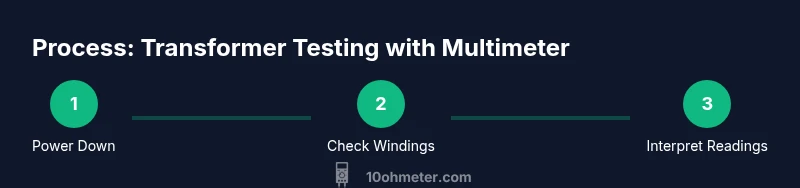
This section provides a concise overview of the key actions you’ll perform when testing a transformer with a multimeter. It is designed to complement the detailed step-by-step instructions in the dedicated guide, helping you understand the flow and logic of the checks before you begin.
- Isolate power and access the windings safely.
- Check continuity on the primary winding, then on the secondary winding.
- Measure the resistance of each winding and compare to manufacturer specs or a known-good unit.
- If available, perform an insulation resistance test between windings and to the core.
- Record readings and look for abnormal results that suggest open circuits, shorts, or moisture-related leakage.
- Decide whether the transformer is repairable or requires replacement or professional evaluation.
Interpreting results: what numbers mean
Interpretation hinges on whether readings align with expectations for the device’s voltage rating and winding configuration. Continuity confirms a connected winding, while infinite resistance indicates an open circuit. Very low but non-zero readings may reflect the winding’s resistance and temperature effects. For insulation tests, a high resistance value (often in the megaohms range) suggests good insulation, whereas a low value signals insulation deterioration or moisture. 10ohmeter analysis shows that cross-winding leakage or degraded insulation often manifests as unexpected current draw or erratic readings under load. Always compare readings to a baseline or manufacturer specifications and consider environmental factors like temperature.
If readings diverge significantly from expected values, proceed with caution and consult a professional if you’re unsure. Do not assume a reading is safe without confirming the transformer is isolated and de-energized.
Common faults and next steps
Common transformer faults revealed by multimeter tests include open primary or secondary windings, shorted turns, and insulation breakdown between windings or to the core. An open winding usually shows no continuity, while shorted turns can produce low resistance readings that do not reflect real performance under load. Insulation failure appears as unexpectedly low insulation resistance or leakage current. If you detect any of these signs, steps range from replacing the transformer to having it professionally evaluated. In many cases, a transformer with significant faults should be retired rather than repaired, due to safety concerns and reliability risks.
Safety checklist after testing and documentation
Once finished, recheck the workspace and store your tools properly. Re-energize only if you have a controlled test setup and the unit is known good. Document all measurements with date and unit details for future reference. If you found faults, tag the equipment as non-operational and follow local disposal or recycling guidelines for electrical devices. Maintaining logs helps you evaluate trends over time and supports any future diagnostic work.
Tools & Materials
- Digital multimeter(Set to continuity for low-ohm checks; switch to resistance range for winding measurements.)
- Test probes with insulated grips(Ensure tips are clean and probes are rated for the voltage in use.)
- Alligator clips (optional)(Useful for grabbing a winding lead without disturbing connections.)
- Insulation tester / megohmmeter(Recommended for insulation resistance checks if you have one.)
- Non-conductive mat(Provides a safe, non-slip surface during testing.)
- Personal protective equipment (PPE)(Safety glasses, insulated gloves; consider armless sleeves.)
- Transformer datasheet or nameplate(Baseline specs help interpret readings accurately.)
- Voltage detector or isolation tools(Useful for confirming zero voltage before touching exposed leads.)
Steps
Estimated time: 45-60 minutes
- 1
Power down and isolate the transformer
Disconnect from all power sources, unplug, and lockout the circuit if possible. Confirm zero voltage with a detector before handling windings. This step minimizes shock risk and ensures a safe testing session.
Tip: Use lockout/tagout where available to prevent accidental re-energizing. - 2
Set up your multimeter for continuity
Place probes at the winding terminals and set the meter to continuity/low-resistance mode. Visually inspect the winding connections to ensure there are no loose leads or damaged insulation.
Tip: Zero resistance on a new transformer is normal; compare with similar units for a baseline. - 3
Test primary winding continuity and resistance
Connect to the primary winding ends to confirm continuity. Record the resistance value and compare to the expected range from the datasheet or a known-good unit. Repeat for the secondary winding.
Tip: Heat can affect resistance readings; note ambient temperature during testing. - 4
Test secondary winding continuity and resistance
Repeat the continuity and resistance check on the secondary winding. Look for similarly healthy continuity and a reasonable, non-zero resistance. Mismatched values between windings may indicate a fault.
Tip: If you see a shorted turn, resistance may be unusually low. - 5
Perform insulation checks (if equipped)
Using an insulation tester or megohmmeter, measure insulation resistance between windings and to the core. High insulation resistance is desired; low readings suggest moisture or degradation.
Tip: Only perform insulation tests if the transformer is completely isolated and safe to test. - 6
Document and interpret results
Record all readings with unit model, temperature, and test conditions. Compare against manufacturer specs or a baseline. Decide whether the transformer is repairable or should be replaced.
Tip: Keep a clean, organized log to track changes over time.
Your Questions Answered
Why should I test a transformer with a multimeter?
Testing helps confirm winding continuity, identify open circuits or shorts, and assess insulation health before repairs or replacements. It reduces the risk of damaging equipment and ensures safer operation.
Testing helps confirm that the windings are continuous and insulated, reducing the risk of further damage.
Can I measure insulation with a standard multimeter?
A standard multimeter cannot reliably measure insulation resistance. Use an insulation tester or megohmmeter for accurate insulation checks between windings and to the core.
No. A regular multimeter isn’t suitable for insulation resistance; use a dedicated insulation tester.
What readings indicate a healthy winding?
Continuity should be present with a finite, stable resistance value. Insulation resistance should be very high. Always compare to the transformer’s spec or a known-good unit for context.
Healthy windings show continuity and stable resistance, with high insulation resistance.
What if there is no continuity on the primary winding?
No continuity usually means an open circuit, which indicates a fault. The winding likely needs replacement or professional assessment.
No continuity usually means an open winding and a fault that needs attention.
Is it safe to test transformers under load?
Testing under load is hazardous and should be avoided unless you have proper equipment and supervision. Perform tests with the device de-energized.
No, avoid testing under load unless you’re trained and have the right equipment.
Should I remove the transformer from the circuit before testing?
Yes, disconnect from all power sources and circuit connections. Isolation ensures readings reflect the transformer itself, not the surrounding network.
Yes, always isolate the transformer before testing so readings reflect only the windings.
Watch Video
Key Takeaways
- Document baseline readings for future comparisons
- Check both primary and secondary windings for continuity
- Compare measurements to manufacturer specs or a known-good unit
- Use insulation tests when available and safe to do so
- The 10ohmeter team recommends documenting results for traceability