How to Check Voltage Without a Multimeter: Safe Guide
Learn safe, practical ways to detect voltage without a multimeter. Use non-contact testers and neon indicators, and know when to rely on tools for precision.


You can estimate voltage without a multimeter by using safe reference methods and non-contact testers. Begin by turning off the circuit, then verify de-energization with a non-contact tester, light a neon tester lamp in a known outlet or cord, and compare behavior to expected values. Remember: these methods give rough indications, not precise measurements.
Why voltage checking without a meter is limited
According to 10ohmeter, voltage is a property that can be inferred only within a narrow margin when you forgo a dedicated instrument. You can’t quantify magnitude with confidence using only your senses or simple indicators, but you can gain rough orientation that helps you decide whether further testing is warranted. This guide explains why non-meter methods exist, where they fit into safe practice, and how to interpret results without turning a simple task into an accident. Remember that even small mistakes around live circuits can be dangerous; always plan, isolate, and verify before proceeding. In practice, these techniques are most useful for quick triage in benign situations (like confirming a suspected dead outlet) and should never replace calibrated measurements for critical work, especially in automotive or high-voltage contexts.
Safety first: personal protective equipment and approach
Before attempting any voltage checks without a multimeter, assemble your PPE and establish your safe workflow. Wear insulated gloves rated for the voltage you expect, use safety glasses, and keep a clear dry workspace. Work on de-energized circuits whenever possible, and use one hand free to avoid forming a current path through your body. Keep metal jewelry away from the work area, and never touch exposed conductors with bare skin. Establish a safety routine with a partner if you can; a second set of eyes reduces risk when you’re near live components.
Understanding contexts: household vs automotive environments
Voltage behavior differs between home wiring and automotive circuits. In houses, outlets may be 120/240 V and can retain a dangerous charge after disconnection; in vehicles, circuits can be battery-powered at 12 V or higher with alternators. The lack of a precise meter means you rely on presence indicators and observed symptoms rather than exact numbers. Always interpret observations within the relevant context and hazard level for the task at hand.
Non-contact testers: what they can and cannot tell you
Non-contact voltage testers (NCVTs) detect electric fields without piercing insulation. They are excellent for confirming that a conductor is energized, but they do not provide magnitude or phase information. They can be fooled by electromagnetic noise or nearby live parts. Rely on them as a presence check rather than a measurement; use them when you suspect live wiring but still need to minimize exposure.
Neon testers and indicator lamps: quick presence cues
A small neon tester lamp or an LED-based indicator placed in a known circuit can show if power is present. To use one safely, connect only to a known, isolated path, and observe the lamp from a safe distance. The lamp’s brightness or flicker can hint at whether voltage is above a rough threshold, but it won’t give a specific value. Treat any bright indication as a reason to stop and re-check with proper equipment.
Grounding, isolation and risk awareness
Voltage testing without a meter requires you to be mindful of grounding and isolation. Ensure your hands are dry, the work surface is insulated, and you aren’t leaning into the circuit. If you observe arcing, smoke, a burning smell, or warmth beyond normal, stop immediately and assume a fault; power must be removed at the breaker. If you’re unsure, step back and call a pro.
Rough checks: what to observe and how to interpret
Use a non-contact tester to verify energization, then compare with your neon lamp or indicator observations. If the tester shows no activity where you expect power, re-check your isolation steps. If the neon lamp glows faintly, it may indicate leakage, not full voltage. These cues are helpful for planning but do not replace a meter.10ohmeter analysis shows that these cues are best used for planning rather than exact measurements.
How to interpret results and decide next steps
When you get inconsistent or ambiguous cues, treat them as a signal to pause and move to a proper measurement tool. A meter will confirm exact voltage, resistance, and continuity; without one, you’re guessing. If the goal is safe repair or diagnosis, schedule the measurement with the appropriate instrument or a qualified technician. In all cases, safety comes first and accuracy comes second.
Common mistakes and how to avoid them
Rushing through tests, ignoring PPE, or working on live circuits without a plan increases risk. Never assume a de-energized state based on one test. Avoid touching two conductors at once, and never bypass safety mechanisms to force a quick result. Always confirm isolation with multiple cues before proceeding.
Real-world examples: outlets and automotive circuits
After following these precautions, you can perform rapid checks in everyday scenarios. For a dead outlet, a NCVT usually confirms lack of energization when power is off; for automotive wiring, expect variability and consider the vehicle's electrical system complexity. In all cases, treat uncertainty as a reason to escalate to proper instrumentation and, when in doubt, seek professional guidance. The 10ohmeter team recommends keeping a meter handy for routine diagnostics and always prioritizing safety.
Tools & Materials
- Non-contact voltage tester (NCVT)(Essential for presence checks on energized circuits.)
- Neon voltage tester lamp or LED indicator(Provides rough presence cues when used with a known path.)
- Insulated gloves(Choose rated PPE appropriate for the expected voltage.)
- Insulated tools (screwdrivers, pliers)(Minimize exposure when working near conductors.)
- Dry, insulated work surface(Prevents unintended current paths through moisture or metal.)
- Safety glasses(Protect eyes from accidental sparks or debris.)
- Assistant or partner (optional)(Helps with safe hand-off and monitoring.)
Steps
Estimated time: Estimated total time: 25-40 minutes
- 1
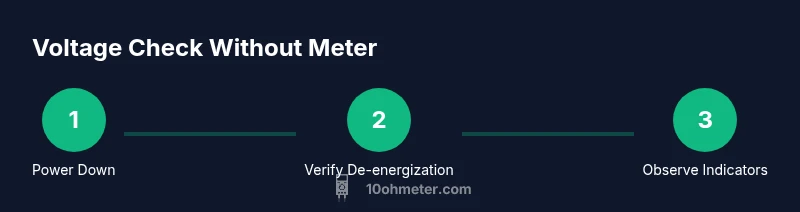
Power down the circuit
Identify the circuit or outlet to test and switch off the associated breaker if accessible. Confirm the device is de-energized by attempting a quick test with the NCVT on a known safe conductor. This reduces the risk of shock during subsequent checks.
Tip: Always assume a circuit can re-energize unexpectedly; lockout or tagout if available. - 2
Isolate the area and put on PPE
Remove jewelry, dry your hands, and place your PPE within reach before touching any conductors. Check that the work surface is dry and free of conductive materials. Isolation helps prevent unintended current paths.
Tip: Double-check PPE integrity; a small cut in a glove can expose skin to danger. - 3
Choose a safe test method
Decide whether to use an NCVT or neon indicator based on accessibility and the risk level. Do not attempt to measure voltage magnitude without a meter; use presence indicators to guide further steps.
Tip: Always start with the least invasive method first. - 4
Verify de-energization with NCVT
Bring the NCVT close to the suspected conductor. If it remains silent, the line is likely de-energized; if it lights up, treat the circuit as live and re-evaluate safety steps. Move slowly to avoid accidental contact.
Tip: Keep the tester away from your face and maintain a clear escape path. - 5
Use neon tester lamp on a known path
Connect the neon tester to a known, isolated path (like a certified outlet or a tested extension cord) and observe the lamp. A glow indicates presence of voltage somewhere in the path; no glow suggests minimal or no voltage in that specific segment.
Tip: Do not rely on a single cue; cross-check with another method if possible. - 6
Observe indications and record results
Note which indicators show energization and which do not. Correlate the NCVT reaction with the neon lamp behavior to form a rough map of the circuit’s activity. Documenting observations helps with planning the next steps.
Tip: Use a written log or checklist to stay organized. - 7
Cross-check with a second method
If another method is available (another NCVT model or a secondary indicator), perform a second check to confirm your observations. Consistency across methods increases confidence that you understand the hazard level.
Tip: Inconsistent results warrant treating the situation as hazardous and proceeding with caution. - 8
Decide on next steps
If indicators are inconclusive, do not proceed with any repair or live testing. Schedule a proper measurement with a calibrated tool or call a qualified technician. Prioritize safety over speed.
Tip: When in doubt, postpone testing until you can use precise equipment. - 9
Return power and re-check safety
If you must re-energize, do so cautiously and re-run de-energization checks before touching any components. Keep clear communication with any helpers and pause if you notice signs of trouble.
Tip: Re-verify all PPE and the test area after power restoration. - 10
Document and plan proper measurement
Record the scenario, indicators observed, and the next recommended action. Plan to perform precise voltage readings with a meter or seek professional evaluation for any critical work.
Tip: Always have the correct tool ready for the final measurement.
Your Questions Answered
Is it safe to check voltage without a multimeter?
Non-contact testers can indicate whether a conductor is energized, but they do not measure voltage. Use them for presence checks and always prioritize de-energization and PPE. If there is any doubt, stop and switch to a proper instrument.
Non-contact testers show if something is live, but they don’t measure voltage; always de-energize first and use a meter when precise readings are needed.
What tool is best for a rough voltage check without a meter?
A non-contact voltage tester combined with a neon indicator can give quick presence cues. They should not be used to determine exact voltage values.
Use a non-contact tester with a neon indicator for rough checks, but remember it won’t give exact numbers.
Can I test a live outlet with a neon tester?
Only if you are confident the testing method is appropriate and you follow strict safety steps. Neon indicators aren’t precise and should not replace proper measurement.
You can use a neon tester for presence cues, but don’t rely on it for exact voltage readings.
Why can’t I rely on these methods for precise readings?
These approaches provide rough indications of presence or leakage, not the exact voltage magnitude. For precise readings, use a calibrated voltmeter or a professional.
They only give rough cues, not exact voltage numbers. A meter is needed for precise readings.
What should I do if I suspect a dangerous setup?
Power should be shut off at the breaker and a licensed electrician should assess the situation. Do not attempt further testing if danger signs appear.
If you suspect danger, switch off power and call a pro.
Are automotive circuits safer to test without a meter?
Automotive electrical systems can have complex behavior and higher risk. Without a meter, rely on non-invasive cues and avoid live testing whenever possible.
Automotive systems are tricky; avoid live testing without proper tools.
Watch Video
Key Takeaways
- Assess if voltage presence can be safely inferred without a meter
- Prioritize PPE, isolation, and stepwise checks
- Non-contact testers indicate presence, not exact voltage
- Use neon indicators for rough cues only
- Always switch to a proper instrument for precise readings