How to Know If a Wire Is Live Without a Multimeter
Learn practical, non-meter methods to detect live wires without a multimeter using non-contact voltage testers, visual cues, and safe procedures. Includes tools, step-by-step actions, tips, and safety guidance for DIY electronics and automotive tasks.


To know if a wire is live without a multimeter, rely on non-contact voltage detection, visible insulation status, and careful observation of the circuit. Begin with a known live source to confirm your tester’s sensitivity, then test with non-contact devices on suspected conductors. Treat any exposed conductor as energized and observe strict safe-work practices at all times.
Understanding why wires can be live and how to think about safety
Electric power can be present in wires even when a device is off, due to backfeed, residual energy, capacitive coupling, or a fault. For DIY enthusiasts and technicians, the core principle is to assume any accessible conductor is energized until you prove otherwise. This mindset reduces the risk of shock, burns, and unintended contact. The goal of this guide is to teach reliable, non-meter methods to assess live status without introducing new hazards. In practice, you’ll combine observation, safe testing practices, and validated indicators to determine live status while maintaining a clear safety perimeter around the work area. Always plan your workflow with energy isolation in mind and prioritize personal protective equipment when needed.
Observable cues and safe testing mindset
Human senses alone are not a reliable live-status detector. Do not rely on color alone, sounds, or smells to judge voltage. Look for obvious signs of danger (damaged insulation, scorch marks, cracked conduit) and maintain a disciplined approach: keep one hand behind your back or in your pocket when probing, avoid jewelry, and work on a dry surface. When in doubt, treat conductors as live and step back to re-evaluate. A calm, methodical mindset reduces risk and helps you identify the safest path forward. Pair visual cues with proper tools to confirm live status, then re-check after moving to a new position to avoid missed voltages due to capacitance or hidden conductors.
Non-contact voltage detection: how it works and how to use it safely
Non-contact voltage testers (NCVTs) detect the electric field around energized conductors. They are the primary tool for checking live wires without direct contact. Before starting, verify the tester is functioning by testing it on a known live source. When scanning, hold the tester close to the conductor and keep your body away from the circuit. If the tester detects voltage, treat the wire as live and do not touch it directly. Remember that NCVTs can miss low-energy or shielded voltages; always test at multiple points when possible and combine results with safe work practices.
Alternative indicators you can trust (and their limits)
Beyond NCVTs, you can use several ancillary checks, but they should never replace a proper voltage detector or energy isolation. A visual inspection for damaged insulation or exposed conductors helps identify obvious hazards. In some cases, a properly trained technician may safely energize a circuit to verify readings with approved equipment, but this is not a substitute for energy isolation procedures. Avoid relying on sounds, heat, or smells as primary indicators; these cues are too unreliable for electrical safety. If you must rely on indirect indicators, document the conditions and proceed with extreme caution, using PPE and proper barriers. Always prioritize safe alternatives and de-energization whenever possible.
Practical checks you can perform with minimal tools
In the field, the safest approach is to de-energize the circuit and verify it is dead before touching any conductor. If de-energizing is not immediately possible, use an NCVT to scan suspected wires from a safe distance, repeatedly testing at different points along the wire. Maintain a dry, non-conductive work surface, wear eye protection, and keep the work area clear of water. Do not rely on DIY shortcuts or improvised methods that require direct contact with bare conductors. When in doubt, pause the task and re-evaluate the energy isolation plan.
Safety protocols and planning a safe work procedure
A solid safety plan starts with energy isolation. Turn off the circuit at the main panel or breaker and apply a lockout/tagout if available. Verify the area is dry and free of conductive liquids. Use PPE such as safety glasses and gloves, and keep tools that can create a path to ground away from the work area. Establish a clear boundary around the workspace and use barriers to prevent accidental contact. After completing the task, re-check the circuit, remove locks/tags, and restore power only after confirming all wires are secure.
Quick-reference checklist for field tasks
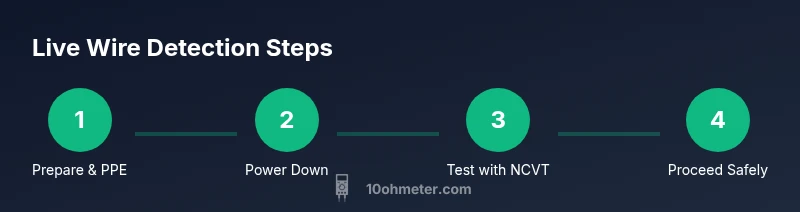
- Confirm you have a known live reference to test your NCVT.
- Power down the circuit and apply lockout/tagout whenever possible.
- Test the NCVT against a known live conductor before testing the suspected wire.
- Scan the target wire at multiple points, keeping your body away from the circuit.
- Treat any exposed conductor as live until confirmed dead by multiple checks.
- Wear appropriate PPE and keep the work area dry.
Tools & Materials
- Non-contact voltage tester (NCVT)(CAT II/III rated; test on a known live source to verify sensitivity before use)
- Safety goggles(Eye protection is essential when probing or testing near conductors)
- Insulated gloves(Optional for higher-risk tasks; ensure proper rating per local codes)
- Lockout/tagout kit(Use when available to physically isolate energy sources)
- Dry, insulated work surface or mat(Reduces the risk of accidental grounding and keeps the area dry)
- Safe lighting(A bright flashlight helps you see insulation conditions clearly)
Steps
Estimated time: 30-60 minutes
- 1
Prepare the work area and PPE
Clear the workspace of liquids and moisture. Put on safety goggles and keep a dry pair of hands ready. Ensure your feet are planted firmly on a non-conductive surface and arrange tools to minimize reaching around live components.
Tip: Use insulated footwear and a dry mat to reduce slip hazards. - 2
Identify the circuit and plan de-energization
Locate the correct breaker or disconnect for the circuit you’ll work on. If possible, switch off the power and lock out the source. Confirm that other devices on the same circuit won’t energize unexpectedly during your work.
Tip: Label breakers clearly and use a tagout system if available. - 3
Verify NCVT sensitivity with a known live
Before testing the suspect wire, test the NCVT on a conductor you know is live. This confirms the tester is functioning and correctly picking up voltage. If the tester does not respond to a known live source, replace batteries or try another unit.
Tip: Always verify the tester’s response against a trusted live reference. - 4
Scan the suspected wire with the NCVT
Hold the NCVT near the conductor, avoiding direct contact. Move slowly along the length and test at multiple points. If the tester indicates voltage, treat the wire as live and do not touch it directly.
Tip: Keep your body away from the conductor; use one hand behind your back when feasible. - 5
Check adjacent conductors and backfeed risks
Some wires near a live conductor can show induced voltage. Test adjacent wires carefully to map out which ones are truly energized. If you suspect backfeed or capacitive coupling, pause and reassess power isolation.
Tip: If in doubt, re-check the energy source or consult a qualified technician. - 6
Proceed with caution or pause the task
If any uncertainty remains, pause work and re-evaluate the safety plan. Do not proceed with direct contact until you have a clear dead-status confirmation.
Tip: When in doubt, stop and re-verify with your NCVT and a safe method. - 7
Re-verify after repositioning or adjustments
If you move wires or components, re-check the live status at the new position. Wires can shift or become re-energized due to circuit changes.
Tip: Run a final pass with the NCVT to ensure no live sections were missed. - 8
Document energy isolation and restore power
Record which breakers were opened and ensure all locks/tags remain until work is finished. After validating that the area is safe, restore power and re-test the circuit.
Tip: Remove all locks only after confirming all tasks are complete. - 9
Clean up and confirm safety post-work
Replace tools, dispose of any protective gear appropriately, and perform a final NCVT check on the entire area before turning off the work area.
Tip: Leave a safety note for anyone else who might service the circuit later. - 10
Review and learn for next time
Reflect on what worked well and where reading errors occurred. Update your safety plan and keep a running checklist for future tasks.
Tip: Update your checklist after every job to improve safety and efficiency.
Your Questions Answered
Can you reliably tell a live wire without a meter?
No single sensory cue is reliable. Use a non-contact voltage tester and energy isolation steps as the primary methods, and verify with multiple checks before proceeding.
No. You should rely on a non-contact voltage tester and proper energy isolation, and verify with several checks before you work on anything.
What is the safest method to know if a wire is live?
The safest method is to de-energize the circuit, use a calibrated non-contact voltage tester to confirm dead status, and then proceed with PPE and safe-work practices.
De-energize the circuit, use a validated non-contact tester, and follow safety gear and procedures.
Is a neon screwdriver or similar tool a safe method?
Neon testers can indicate voltage but carry greater shock risk and are considered outdated by many professionals. They should not replace a proper non-contact tester and energy isolation.
Neon testers aren’t ideal; they pose shocks risk and don’t replace proper isolation and a non-contact tester.
What signs indicate a wire might be live?
Visible damage, unusual warmth, or a buzzing from the device can indicate hazards, but do not rely on these signs alone. Always test with a proper detector and isolate power.
Look for damage or buzzing, but don’t rely on those signs alone; test with a detector and isolate power.
What should I do if I cannot isolate power safely?
If you cannot safely isolate energy, pause work and seek qualified help. Do not touch any conductors, and use barriers to prevent accidental contact.
If you can't safely isolate power, stop and ask for professional help.
Do I need PPE when checking wires without a meter?
Yes. Wear eye protection and insulated gloves when working near potentially energized conductors, and ensure the area is dry and free from conductive liquids.
Yes—protect your eyes and hands and keep the area dry when checking wires near conductors.
Watch Video
Key Takeaways
- Always treat exposed conductors as live until proven safe.
- Use a validated non-contact voltage tester for non-contact checks.
- De-energize and lock out energy sources whenever feasible.
- Test the tester on a known live reference before use.
- Document the energy isolation steps and re-check after adjustments.