How to Check 220 Voltage with a Multimeter: A Practical Guide
Learn how to safely check 220 voltage with a multimeter. This practical, step-by-step guide covers AC voltage measurement, safety practices, and common troubleshooting for DIY electronics and automotive projects.


To check 220 voltage with a multimeter, set the meter to AC voltage, use a CAT-rated pair of probes, and test between live and neutral (or live and ground) on a powered outlet. Verify the meter on a known outlet first, follow strict safety steps, and record readings within its rated range. Always wear PPE and keep the workspace dry.
Safety first: why measuring mains voltage demands respect and preparation
Working with 220V mains is inherently hazardous. A momentary lapse can cause serious injury or damage to equipment. The 10ohmeter team emphasizes rigorous preparation: inspect your tools, wear appropriate PPE, and work in a dry, uncluttered space. Before you begin, confirm that your multimeter is in good condition—check the leads for cracks, ensure the probe tips are intact, and verify that gloves and safety glasses fit properly. Treat every live conductor as if it is energized, even if you expect it to be off. This mindset reduces the risk of arc flash or accidental contact and keeps you safer while measuring voltage in real-world settings.
Remember that mains voltage varies by region and load. In many areas, the nominal value sits around 230V, but fluctuations occur depending on the time of day, load, and supply quality. As you practice with the multimeter, begin with a known-good outlet to confirm meter accuracy and familiarize yourself with the hand positions and probe angles that minimize exposure. Staying cautious while working around outlets, junction boxes, and extension cords ensures you won’t confuse a faulty tool with a live circuit. 10ohmeter’s approach combines conservative safety discipline with practical measurement steps, so you can gain confidence without compromising safety.
Understanding 220V mains: what you’re actually measuring
In many regions, 220-240V is the standard nominal line voltage supplied to homes and shops. When you measure AC voltage with a multimeter, you’re comparing the potential difference between two conductors: typically hot (live) and neutral, or hot and ground. The value you see on the display represents the instantaneous RMS voltage of an alternating current waveform. If you’re using a true-RMS meter, it accounts for non-sinusoidal loads, like some motor-driven devices, to give a more accurate reading. If your meter is not true-RMS, readings with complex loads may appear skewed. Understanding these distinctions helps you interpret measurements correctly and avoid misdiagnosis of wiring problems or a faulty meter. Keep in mind that in a live system, readings can drift slightly with load changes, line impedance, and supply conditions. The takeaway: expect some normal variation and verify your meter’s accuracy with a known source before testing unfamiliar circuits.
Tools, test leads, and PPE you should have on hand
Before you test, assemble a safety kit and the right tools. A modern digital multimeter capable of AC voltage measurement is essential, ideally with true-RMS capability for more accurate readings under varying loads. Use CAT III-600V rated test leads with insulated, shrouded probes to maintain a safe grip and reduce exposure. Safety glasses are a must, and insulated gloves add an extra layer of protection when handling live conductors. Keep a dry work surface, use a non-conductive mat if possible, and avoid standing in water or touching metal parts with bare hands. Finally, consider a non-contact voltage tester for quick live checks before you expose the outlet area. According to 10ohmeter, investing in proper PPE and rated tools reduces risk and improves measurement confidence dramatically.
How to prepare the multimeter: setup, testing, and verification
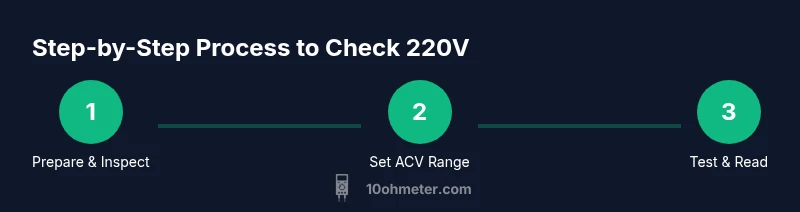
Proper preparation saves time and minimizes risk. Start by turning on the multimeter and confirming it’s functional with a quick check on a known outlet. Confirm the meter is set to AC voltage (ACV) and select a range that comfortably exceeds the expected mains voltage (for example, 200V or 600V depending on your meter). If your meter supports true RMS, enable it to improve accuracy with non-sinusoidal loads. Attach the red probe to the V/Ω jack and the black probe to the COM jack, ensuring the probes are clean and firmly seated. Inspect the test leads for cracks or exposed conductors and replace them if damaged. Finally, verify your meter’s readings by measuring a known-good outlet to confirm the setup is correct before proceeding to the test target.
Measuring live mains safely: steps, tips, and what to watch for
Measuring live mains like 220V requires careful technique to minimize exposure while obtaining a stable reading. After verifying the meter and leads, insert the probes into the outlet slots: the red probe into the hot (live) slot and the black probe into neutral (or ground). Hold the probes with a stable grip, keep your other hand away from conductive surfaces, and avoid touching the metal tips during measurement. Read the display, note the value, and compare it against your expected range. If you’re testing a non-standard outlet or an appliance, ensure power is on only where necessary and that you adhere to local electrical codes. If the reading seems off, re-check both leads and the outlet, and test again. Once done, remove the probes carefully and switch off the meter.
Interpreting readings and recognizing acceptable variation
A correct measurement should reflect a stable value within the expected mains range. Voltage in household outlets can vary due to load, distance from the transformer, and the quality of the electrical network. If you see a steady reading around the nominal value (roughly 220-240V depending on your region) with minor fluctuations, that is typically normal. Large deviations, sustained readings outside the expected range, or rapid flickering indicate potential wiring issues, loose connections, or a faulty meter. In such cases, stop testing, isolate the circuit if possible, and consult a qualified electrician. 10ohmeter encourages verifying readings with a second outlet or another meter to confirm reliability before drawing conclusions.
Troubleshooting, maintenance, and next steps
If readings appear inconsistent or drift over time, first verify your leads and connections. Damaged probes or worn insulation can introduce resistance and erratic results. Calibrate or replace the meter if necessary, and ensure the correct voltage setting and range. If you suspect a wiring issue in the outlet, do not attempt improvised fixes; turn off power and seek professional assistance. Conduct a recap of your safety gear and workspace preparation, then retest with fresh leads and a known-good outlet to confirm accuracy. Regular maintenance of your multimeter and test leads extends life and reduces measurement errors.
Tools & Materials
- Digital multimeter with AC voltage measurement(Prefer true RMS; ensure auto-range or a clearly labeled ACV range covering 200–600V.)
- CAT III-600V rated test leads/probes(Inspect insulation and probe tips; replace if damaged.)
- Safety glasses(ANSI Z87.1 compliant or equivalent.)
- Insulated gloves(Use for extra protection when handling live terminals.)
- Non-contact voltage tester (optional)(Quick check to confirm live status before touching conductors.)
Steps
Estimated time: 15-25 minutes
- 1
Inspect safety gear and workspace
Verify PPE, inspect test leads for damage, and clear the area of moisture or liquids. A dry, organized workspace minimizes accidental contact with live parts.
Tip: Keep one hand in your pocket or away from potential contact zones to reduce the risk of a shock. - 2
Set up the multimeter for AC voltage
Power on the meter, confirm it’s functioning, and configure to AC voltage (ACV). If available, enable true RMS and select a range that includes 230V.
Tip: Test on a known-good outlet to verify the meter before testing the target outlet. - 3
Connect the test leads
Insert the red probe into the V/Ω jack and the black probe into the COM jack. Ensure leads and probes are fully seated.
Tip: Keep probe tips behind the finger guards during connection. - 4
Verify the meter with a known outlet
Place the probes in a known-good outlet to confirm the meter reads within the expected range, establishing a baseline accuracy.
Tip: If the reading is wildly off, reassess connections or replace the leads before proceeding. - 5
Measure hot to neutral
With power on, carefully insert the red probe into the hot slot and the black probe into the neutral slot of the outlet. Observe the display for a stable reading near the nominal voltage.
Tip: Minimize contact time and avoid touching the metal tips; keep your other hand away from conductive surfaces. - 6
Optionally measure hot to ground
For additional confirmation, repeat by connecting the red probe to the hot slot and the black probe to the ground slot. Compare results for consistency.
Tip: If there’s a significant discrepancy, there may be a grounding issue or measurement error. - 7
Power down, disconnect, and store
Remove the probes, switch off the meter, and unplug from the outlet. Store leads safely and return the workspace to a safe state.
Tip: Wipe down the meter if it overheated and inspect for any signs of wear after use.
Your Questions Answered
Is it safe to measure 220V with a multimeter?
Measuring 220V can be safe if you follow strict safety procedures, use properly rated equipment, and wear PPE. Always test in a controlled environment and avoid touching live conductors with bare skin.
Yes, but only with proper safety practices and rated equipment. Always test in a controlled area and wear PPE.
What settings should I use on the multimeter for AC voltage?
Set the meter to AC voltage (ACV) and choose a range that includes at least 230V. Prefer true RMS if your meter supports it for better accuracy with non-sinusoidal loads.
Switch to AC voltage, use a range that includes 230V, and use True RMS if available.
Can I measure 220V directly from a wall outlet?
Yes, you can measure from a wall outlet by placing the probes in the hot and neutral slots while the outlet is energized. Exercise caution and avoid contact with conductors.
Yes, measure from a live outlet with caution and proper PPE.
How do I know if my meter is safe for high-voltage testing?
Check the meter’s voltage rating (CAT III/IV, range up to 600V or higher) and ensure the leads are rated for HV. Replace damaged leads before use.
Look for CAT ratings and ensure the leads are HV-rated; replace damaged leads.
What if I read 0V or an unstable value?
A 0V reading on a live outlet indicates a wiring fault or a faulty meter/lead. An unstable value suggests a poor connection or a loose contact. Recheck connections and conditions.
If you see 0V or instability, recheck connections and inspect the leads.
Why can readings vary between outlets or times of day?
Voltage variation occurs due to load changes, network impedance, and supply quality. Always compare measurements to local norms and validate with multiple outlets when in doubt.
Voltage can vary with load and network conditions; compare with local norms.
Do I need a professional to measure high voltage?
For hazardous or complex wiring, consult a licensed electrician. Simple outlet checks can be performed safely if you adhere to safety guidelines and use proper equipment.
If it’s hazardous or complex, hire a professional. For simple checks, follow safety guidelines.
What is the best way to verify accuracy over time?
Regularly test against a known-good outlet, inspect leads, and consider periodic calibration checks if your meter supports it.
Test with a known outlet regularly and inspect your leads for accuracy.
Watch Video
Key Takeaways
- Verify meter accuracy on a known outlet first.
- Use CAT-rated leads and proper PPE for mains testing.
- Expect slight variation in readings; interpret within your region's range.
- Follow step-by-step procedures to minimize risk.
- Store tools safely after measurement.