How to Test a 220V Outlet with a Multimeter Safely
Master testing a 220V outlet safely with a multimeter. This guide covers voltage checks, grounding verification, wiring inspection, and pitfalls for DIY and automotive projects.


With a multimeter, you can verify a 220V outlet by checking live voltage, neutral, and grounding, plus ensuring the outlet is properly wired. Before you begin, gather a digital multimeter rated at 250V AC, a plug adapter if needed, a non-contact tester for live circuits, and PPE. Power down, remove the cover, and measure across the correct terminals to confirm expected 220–240V.
Why testing a 220V outlet with a multimeter matters
When you work with a 220V (often labeled 220–240V) outlet, you’re dealing with higher voltage than standard household 120V circuits in many regions. Testing with a multimeter helps confirm that the receptacle is delivering the expected voltage, that the polarity is correct, and that the grounding path is intact. For DIY enthusiasts and technicians, a clear, documented test procedure reduces risk when wiring for tools, heaters, or EV charging stations. According to 10ohmeter, following a disciplined testing process not only improves accuracy but also minimizes the chance of arc faults during diagnostics. In practice, you should treat every 220V outlet as a live, potentially dangerous source until you prove otherwise using proper equipment and steps; do not assume the outlet is safe because it was working yesterday. A well-trained approach combines measurement with careful observation of the outlet’s physical condition, mounting, and wiring color code. In many homes and workshops, 220V outlets power essential machines and appliances, so knowing how to verify them quickly and safely is a valuable skill. This guide outlines a conservative, repeatable method that can be applied to most 240V outlets found in North America and many other regions.
Safety prerequisites and risk awareness
Electrical testing at 220V carries serious risk if done improperly. Always approach the task with a calm, methodical mindset and proper PPE: insulated gloves rated for at least 600V, safety glasses, and dry, non-slip footwear. Before touching any conductors, switch off the circuit at the breaker and confirm with a non-contact voltage tester that the panel is de-energized. Do not rely on a single test—double-check. Keep metal jewelry away from the work area, stand on a dry surface, and avoid standing in water or damp concrete. Work with the receptacle faceplate removed only if necessary; keep the live parts behind a protective barrier when you’re not actively testing. Use insulated tools and keep one hand in your pocket when probing terminals to minimize the chance of creating a path for stray current. If you’re unsure about a wiring condition, pause and consult a qualified electrician. After you finish testing, re-seal the housing, restore power, and verify the outlet again under normal operating conditions.
Understanding 220V outlets, grounding, and neutral
220V outlets come in several configurations, but the core concept is consistent: you have a live (hot) conductor, a neutral reference, and a grounding path. In most regions, the voltage between hot and neutral should read in the 220–240V range when the circuit is energized, while the voltage to ground should be the same magnitude or very close to it if the outlet is properly wired. If you’re testing a 3-wire outlet with a dedicated grounding pin, check that the contact to ground shows continuity to the grounding conductor in your panel. A miswired receptacle can present readings that look valid but still pose shock or fire hazards. When diagnosing, remember that readings can drift slightly with load and temperature; small variations don’t automatically indicate a fault, but large or erratic changes deserve further inspection. If you encounter a nonstandard receptacle or unusual color coding, stop and consult the installation guide or a pro. Finally, recall that neutral misidentity or open grounds are common culprits for strange voltage readings, especially with high-power 240V devices.
Practical considerations: choosing settings, probes, and positioning
To obtain meaningful readings on a 220V outlet, you must use a digital multimeter capable of AC voltage up to at least 250V. Use sharp, properly insulated probes and keep the test tip away from metal mounting frames. Position yourself so the meter’s display is clearly visible and your hands are dry. When testing, avoid touching exposed conductors and never work with the device on your lap or near a conductive surface. If you have to measure multiple outlets, keep a consistent testing method and document the exact receptacle type and location for future reference.
Interpreting readings: expected ranges and tolerances
A healthy 220V outlet should show approximately 220–240V between hot and neutral. If the reading sits well within this band, the outlet is wired and powered correctly under load. If you observe readings outside this range, or significant drift when testing adjacent outlets, recheck connections and revisit safety steps. Ground-related measurements should show a strong, low-resistance path to earth; a weak or absent ground suggests a grounding problem that requires corrective action. If you observe a correlation between readings and load, note whether high-draw devices alter the outlet’s voltage, which can indicate upstream supply issues or wiring resistance.
Common mistakes and pitfalls to avoid
- Testing with the power off will give a 0V reading; you must energize the circuit to verify voltage. - Relying on a single measurement can miss transient issues; perform multiple readings at different times of day. - Not verifying ground continuity can obscure hidden faults; always test hot-to-ground and neutral-to-ground. - Using damaged probes or cheap meters can produce inaccurate readings; ensure your tool is calibrated and rated for the voltage range. - Working on a live outlet without proper PPE and a partner increases risk; if in doubt, pause and call a pro.
Authority sources and references
For safety guidelines and standard practices, see resources from OSHA, energy departments, and NFPA. These references provide foundational guidance on electrical safety, installation practices, and code-compliant testing methodologies. You can consult the official sites for comprehensive safety rules and best practices related to high-voltage outlets and household electrical systems.
Authority sources (references)
- OSHA: https://www.osha.gov
- U.S. Department of Energy: https://www.energy.gov
- NFPA: https://www.nfpa.org
Tools & Materials
- Digital multimeter (AC voltage up to 250V)(Rated for at least 250V AC; true RMS preferred for accuracy)
- Non-contact voltage tester(Use to verify de-energization before opening the outlet)
- Insulated test leads(Probes with insulated handles; sharp tips for good contact)
- Screwdriver set (flat and Phillips)(For removing the outlet faceplate without damaging wiring)
- Electrical tape(Optional to secure exposed conductors after testing)
- PPE: safety glasses and insulated gloves(Minimum PPE; ensure dry hands and footwear)
Steps
Estimated time: 15-30 minutes
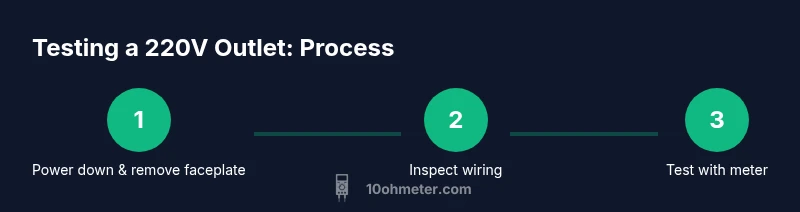
- 1
Power off circuit and remove cover
Turn off the corresponding breaker at the panel and confirm de-energization with a non-contact tester. Remove the outlet faceplate carefully to expose the terminals while keeping your body away from live conductors.
Tip: Use insulated tools and verify power off with a second tester before touching any wires. - 2
Inspect wiring and terminals
Look for loose connections, signs of electrical arcing, and damaged insulation. Note the color coding of conductors and identify hot, neutral, and ground terminals.
Tip: If you see damaged wires, do not proceed; replace the outlet or call a professional. - 3
Restore power for measurement
Re-energize the circuit at the panel and ensure your testing area remains dry and organized. Keep a dry stance and a single-hand testing approach when necessary.
Tip: Only re-energize when you’re ready to perform voltage checks carefully. - 4
Set meter to AC voltage and connect probes
Configure the multimeter to the 200–250V AC range (or the closest higher range). Insert test leads with insulated grips and connect hot to neutral first, then ground as needed.
Tip: Hold the probes only by the insulated handles; avoid touching metal tips. - 5
Measure hot-to-neutral voltage
Read the voltage between hot and neutral. Expect approximately 220–240V. If the reading is far outside this band, re-check connections and ensure the circuit is stable.
Tip: If the display fluctuates, pause and re-check after the device settles. - 6
Check hot-to-ground and neutral-to-ground
Measure hot-to-ground; this should be similar to hot-to-neutral. Measure neutral-to-ground; it should be near 0V. Any significant deviation requires further inspection.
Tip: A high neutral-to-ground reading often indicates a grounding issue. - 7
Document results and reassemble
Record the voltage readings, date, time, outlet type, and any observations. Reinstall the faceplate and ensure the outlet is secure and clean.
Tip: Take a photo of the meter display for your records. - 8
Restore power and perform a final check
Turn the circuit back on and confirm the outlet reads consistently within the 220–240V range under normal conditions. Re-check safety barriers before leaving the work area.
Tip: Verify no hot surfaces are exposed and that all safety barriers are intact.
Your Questions Answered
What is a 220V outlet and where is it used?
A 220V outlet provides higher voltage for heavy-duty appliances and equipment. It’s common in workshops and some regions for powering tools and EV charging. Always test with appropriate safety precautions and verify grounding and polarity.
A 220V outlet supplies higher voltage for heavy-duty devices. Use proper safety steps and verify grounding and polarity when testing.
Can I use a standard 110V multimeter to test a 220V outlet?
A standard 110V meter may not cover the full range or offer the accuracy needed for 220V testing. Use a meter rated for at least 250V AC and true-RMS measurement when available.
A 110V meter usually isn’t enough; opt for a 250V-rated meter for accurate 220V testing.
What readings indicate a properly wired 220V outlet?
Voltage between hot and neutral should be around 220–240V. Hot-to-ground should be similar; neutral-to-ground should be near 0V. Any significant deviation warrants inspection by a professional.
Look for about 220–240V hot to neutral and near-zero neutral-to-ground; deviations require inspection.
What are signs of miswiring or grounding issues?
Inconsistent readings, erratic voltage with load, or a lack of a solid ground are common signs. If you see these, stop testing and consult a licensed electrician.
Inconsistent readings or no solid ground? Stop and call a pro.
Is it safe to test an energized outlet alone?
Testing energized outlets is risky. Use proper PPE, keep one hand behind your back, and ensure dry conditions. If unsure, pause and seek assistance.
Testing energized outlets can be dangerous. Use PPE and follow safety rules, or ask for help.
What extra tools improve reliability of results?
A calibrated multimeter with a 250V AC range, properly rated test leads, and a non-contact tester improve reliability and reduce measurement errors.
Calibrated 250V meter, good leads, and a tester improve reliability.
Watch Video
Key Takeaways
- Plan safety first before touching any outlet.
- Verify power off when removing covers and inspecting wiring.
- Read hot-to-neutral as 220–240V for a correctly wired outlet.
- Document readings and restore power carefully after testing.