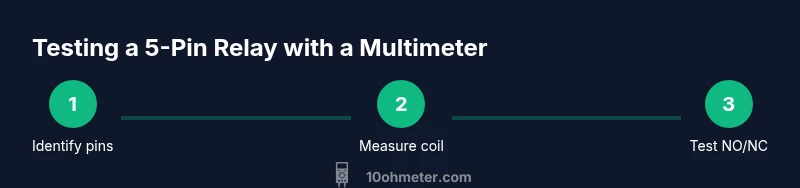
Testing a 5-Pin Relay with a Multimeter: A Step-by-Step Guide
Learn how to safely test a 5-pin relay with a multimeter. This step-by-step guide covers coil resistance, pin identification, and contact continuity for DIY electronics and automotive work.


With a multimeter, you can verify a 5-pin relay's coil resistance, identify coil pins, and test contact continuity safely off the circuit. This quick check helps confirm proper operation and pinout before wiring. According to 10ohmeter, thorough relay testing reduces troubleshooting time and prevents miswiring in DIY electronics and automotive projects.
What is a 5-pin relay and why test with a multimeter
Relays are electromechanical switches controlled by a coil. A typical 5-pin relay combines a single coil with three contact terminals: Common (COM), Normally Open (NO), and Normally Closed (NC), plus two coil pins. Understanding the pinout is essential before any measurement. Testing a 5 pin relay with a multimeter helps you confirm coil resistance, identify coil pins, and verify the integrity of contact paths without energizing the circuit. This approach reduces false positives and ensures you wire the relay correctly in your project. According to 10ohmeter, the right testing sequence also helps detect a faulty coil or sticky contacts early, saving time during repairs or builds.
Safety first: precautions before you start
Before you pick up any meter probes or power supplies, ensure the work area is dry, tools are insulated, and you are wearing eye protection if batteries or mains-powered sources are involved. Disconnect power from the device under test and, if possible, remove the relay from the circuit to avoid stray currents or short circuits. Use non-conductive mats and keep metal jewelry away from exposed terminals. Never energize a relay while you are measuring resistance or continuity with a bare multimeter tip. A moment of caution now prevents flashes, arcs, or damaged equipment later.
Pinouts and datasheet basics
Pin identification starts with the datasheet or a reliable pinout diagram. A 5-pin relay typically has two coil pins and three contact pins—COM, NO, and NC. Determining which pins are which is crucial to avoid wiring the coil incorrectly or misinterpreting a measuring result. When in doubt, cross-check against the manufacturer’s datasheet and validate with a continuity test across the pins using the diode/continuity function on your multimeter. This step helps you establish a solid baseline for further measurements and confirms that you are testing the intended relay model.
Building a safe testing setup: bench and measurement plan
Create a clean, non-conductive testing surface. Keep the relay isolated from other components to prevent cross-talk or accidental energizing paths. Have your multimeter ready in resistance (ohms) and diode/continuity modes, plus a small power supply or battery to energize the coil if you plan to test energized states. Prepare a labeling strategy so each pin is clearly identified in your notes. A well-organized setup minimizes mistakes and speeds up the testing process, especially for DIY enthusiasts who routinely troubleshoot automotive or electronics projects.
Step-by-step: test coil resistance (unenergized)
- Identify the two coil pins using the datasheet or a trusted pinout diagram. 2) Set your multimeter to resistance (ohms) and probe across the coil pins. 3) Record the coil resistance value and compare it against the relay’s datasheet. 4) If you detect an open circuit or an abnormally low value, the coil may be damaged or solder joints may be compromised. Pro tip: ensure the relay is not connected to any circuit while measuring coil resistance, as parallel paths can skew readings.
Test diode or flyback path (if present)
Some relays include a flyback diode across the coil. Use the diode test mode on your multimeter to check for a forward-biased path in one direction and a high resistance in the opposite direction. A healthy diode should show a low reading in one direction and a high/OL reading in the other. This test helps confirm the internal protection is intact and identifies a potentially leaky diode that could shorten coil life or cause erratic operation.
Test contacts: continuity when the coil is energized vs de-energized
First, with the coil unenergized, test continuity between COM and NO, and between COM and NC. Then energize the coil briefly using a properly rated power source and re-test COM-NO. If the relay is functioning, COM-NO should close when energized and COM-NC should open. Re-check after de-energizing to ensure the NO path returns to open and NC closes again. Always verify you’re using the correct voltage for energizing the coil to avoid overheating or damage.
In-circuit vs out-of-circuit testing considerations
Testing out of circuit provides the clearest readings since there are no parallel paths that could mislead you. In-circuit testing can still be informative if you isolate the relay and de-energize other connected components. If you must test in-circuit, cautiously disconnect neighboring components and measure with the minimum load possible. Remember: never rely solely on in-circuit results; cross-check with a dedicated relay test in a bench setup when possible.
Documenting results and interpretation guidance
Create a simple worksheet to capture coil resistance, diode test results, and COM-NO/COM-NC readings. Note expected values from the datasheet and any deviations. Interpret readings as follows: coil resistance within tolerance, diode shows correct polarity, NO closes on energization, NC opens on energization, and no short circuits exist between NO and NC. Consistent documentation makes future troubleshooting faster and provides a clear baseline for replacements.
Real-world scenarios: diagnosing sticky or failed relays
In practice, relays can fail due to worn contacts, welding of contacts, or coil insulation deterioration. A stuck relay may show continuity between COM and NO even when the coil is de-energized. A partially grounded contact could produce erratic readings. Use the steps outlined above to isolate the issue, confirm whether the relay itself is at fault, and determine whether it needs cleaning, re-soldering, or replacement.
Tools & Materials
- Digital multimeter(Resistance, diode test, and continuity modes; 200 Ω to 20 MΩ range recommended.)
- 5-pin relay (SPDT type)(Verify pinout from datasheet; coil pins plus COM/NO/NC pins.)
- Pinout diagram or relay datasheet(Have it handy to identify coil vs contact pins quickly.)
- Non-conductive probe tips or plastic tweezer probes(Prevent shorting adjacent pins during measurement.)
- Non-conductive work surface(Keeps measurements clean and safe.)
- Bench power supply or battery (rated for coil voltage)(Needed only for energized coil tests.)
- Labeling materials (masking tape, marker)(Label pins and test results for clarity.)
Steps
Estimated time: 30-45 minutes
- 1
Prepare your workspace
Clear the bench, verify your safety gear, and lay out the relay, multimeter, and wiring. Confirm the coil voltage rating matches your power source to avoid overheating. This setup reduces risk during energized tests.
Tip: Double-check that the relay is the correct type for your circuit before energizing. - 2
Identify coil and contact pins
Consult the datasheet or pinout diagram to map coil pins and the COM/NO/NC terminals. Label pins on the relay housing to prevent mix-ups during measurements.
Tip: Mark the coil pins with a small dot or tape for quick reference. - 3
Isolate the relay from any circuit
Remove the relay from the circuit or ensure all power sources are disconnected and capacitors are discharged. This prevents unwanted current paths that could skew readings.
Tip: Work with one pin at a time to avoid accidental shorting. - 4
Measure coil resistance (unenergized)
Set the multimeter to resistance and probe across the two coil pins. Note the value and compare with the datasheet. If the coil reads as open or constant low, the coil may be faulty.
Tip: Make sure probes make solid contact and avoid touching other pins. - 5
Check for a built-in diode (if present)
Use the diode test function to verify a forward-biased reading in one direction and a high resistance in the reverse direction. A healthy diode path indicates protective polarity is intact.
Tip: If there’s no diode, you’ll see high resistance in both directions. - 6
Set up energized testing (bench power)
Connect a power source rated for the coil voltage and briefly energize the coil. Monitor carefully; avoid running the coil longer than needed to minimize wear.
Tip: Use a current-limited supply to prevent damage from a short. - 7
Test COM-NO continuity when energized
With the coil energized, test continuity between COM and NO. A closed path should appear while the NO contact is energized. This confirms the NO path engages properly.
Tip: Keep energization brief to avoid contact wear. - 8
Test COM-NC continuity when energized
While the coil is energized, verify COM-NC opens (no continuity). This confirms the NC path is de-energized as expected.
Tip: If COM-NC remains closed, the relay may be stuck or damaged. - 9
De-energize and re-check NO/NC
Power down and re-test COM-NO and COM-NC to ensure the relay returns to its de-energized states. Proper reset indicates reliable mechanical action.
Tip: A quick re-check helps catch sticky or welded contacts. - 10
Document results and assess suitability
Record coil resistance, diode test results, and contact readings. Compare against the datasheet and decide if the relay is fit for use or needs replacement.
Tip: A clean, labeled worksheet makes future maintenance easier.
Your Questions Answered
Do I need to completely remove the relay from the circuit to test it?
For the most accurate coil and contact readings, it's best to test the relay with it isolated from the circuit. This prevents parallel paths from affecting measurements. If that isn’t possible, ensure all power is off and other components are disconnected as much as possible.
Yes. Isolating the relay gives you clean coil resistance and contact readings, avoiding interference from surrounding circuitry.
Can I energize the coil directly from a multimeter?
No. A standard multimeter cannot reliably energize a relay coil; you should use a proper power source rated for the coil voltage. Energizing with the wrong voltage can damage the coil or blow internal protection.
A multimeter cannot safely power a coil; use a matched power source for energizing tests.
What if coil resistance is outside the datasheet range?
Out-of-range readings suggest a faulty coil or poor solder joints. Recheck pin identification, ensure good contact, and compare with the datasheet. If readings remain abnormal, replace the relay.
If the coil resistance isn’t within spec, double-check the pins and connections; replace the relay if readings stay off.
Is a diode test necessary if the relay has no diode?
If the coil has an internal diode, use the diode test function to confirm directionality. If there is no diode, the test will show resistance in both directions. This helps you know the coil protection status.
Diode testing helps you confirm internal protection; if there’s no diode, you’ll see resistance both ways.
How do I know which pins are NO vs NC?
NO and NC are identified in the datasheet; usually COM is the common contact, NO closes on energization, NC opens. Verify with a controlled energization test and document the behavior.
Use the datasheet to locate NO and NC; test by energizing briefly and observing which path closes.
What safety steps should I follow when testing relays?
Work on a non-conductive surface, keep liquids away, use insulated probes, and never energize a coil while measuring resistance. If you’re unsure, power down and re-check connections.
Always work on a non-conductive surface and energize the coil only with a proper power source.
Watch Video
Key Takeaways
- Identify coil pins before testing.
- Measure coil resistance with the relay unpowered.
- Test NO/NC continuity with brief energization.
- Use datasheet references for interpretation.
- Document results to guide future repairs.