How to test a 4-pin relay with a multimeter
A practical, step-by-step guide to testing a four-pin relay using a multimeter. Learn coil resistance checks, NO/NC continuity tests, and how to verify operation with safe energizing. Ideal for DIYers and technicians working on electronics and automotive projects.


Learn how to test a 4-pin relay with a multimeter by verifying coil resistance, checking NO/NC continuity, and confirming operation when energized. This method applies to most SPST/SPDT 4-pin relays and uses only a basic DMM, probe leads, and a safe power source. Follow the step-by-step instructions below to obtain reliable results without damaging the relay or surrounding circuitry.
Understanding four-pin relays and what you’ll test
A four-pin relay usually combines a small coil with a single switch contact pair (either NO/COM or NC/COM). The coil drives the internal switch, so you can verify both the coil and the switch behavior with a multimeter. When the coil is de-energized, the contact arrangement should show one state (NO open, NC closed). When you energize the coil with its rated voltage, the NO and NC states should switch accordingly. According to 10ohmeter, starting with a coil resistance check gives you a quick health check and helps distinguish a bad coil from a stuck contact. Always consult the relay’s datasheet for exact pinout and ratings, as 4-pin relays can vary in configuration.
In practice, you’ll identify which pins are the coil, which are the common (COM), and which are the normally closed (NC) and normally open (NO) contacts. Knowing the pinout is essential before applying power or performing continuity tests. If the relay is part of a larger circuit, remove or isolate it when possible to avoid measuring across other components.
Safety first: prepare and power down
Testing relays requires handling live circuitry carefully. Power must be completely disconnected before you touch test leads or connect the multimeter. If you’ll energize the coil to observe switching, use a power supply that matches the relay coil voltage and limit current to be within safe limits. Use insulated probes and keep hands away from exposed conductors. A simple rule of thumb: treat every relay as a live component until you confirm it’s isolated.
Tools and test setup you’ll need
- Digital multimeter (preferably auto-ranging) with resistance, continuity, and diode test modes
- Test leads with insulated probes (red and black)
- A 4-pin relay to test (coil rated for voltages you have available)
- Safe low-voltage power source or battery that matches the coil rating
- Optional: alligator clip leads for easier access to pins
Having a clean, clutter-free work area helps prevent mix-ups between coil and contact pins. Label wires or use a small diagram for the relay’s pinout before you start.
Pin identification: coil vs contacts
On a typical 4-pin relay, two pins belong to the coil and the remaining two belong to the contact pair. If you’re unsure, start with a cold, unpowered state and measure resistance across the two pins you suspect to be the coil. A finite, low resistance indicates coil pins; an open circuit or infinite resistance suggests you’ve identified the wrong pair. If you have access to the datasheet, cross-check pin numbers and labeling. The coil pins should show a measurable resistance that’s consistent with the coil’s voltage rating.
Testing results interpretation: what you’re looking for
In the de-energized state, the COM-NO path should be open and the COM-NC path should be closed (no continuity between COM and NO; continuity between COM and NC). When you energize the coil with the rated voltage, the COM-NO path should close and the COM-NC path should open. If you observe no change when energizing, the relay is likely faulty or the coil is not receiving voltage.
Practical tips and common pitfalls
- Always power down before switching between resistance and continuity tests to avoid heating or damaging the coil.
- If you see a short between coil and contacts, the relay is bad or there’s a wiring error in your setup.
- Use the relay in a low-stress test configuration initially, then verify with the actual circuit once you have confirmed basic operation.
- If the coil resistance reads as a near-zero or infinite value, replace the relay rather than forcing operation in a circuit.
Real-world testing scenario: sequencing checks
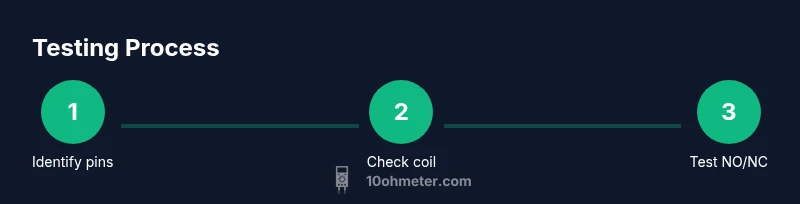
A reliable test sequence is coil resistance first, then NO/NC checks with the coil de-energized, followed by energizing the coil to confirm switching. Finally, re-check to ensure no unintended shorts or leakage paths exist. Document your measurements so you can compare with new relays of the same type in future projects.
Tools & Materials
- Digital multimeter (preferably auto-ranging)(Must support resistance, continuity, and diode tests)
- Test leads with probes(Insulated tips; ensure sharp tips for good contact)
- 4-pin relay under test(Coil rated for voltage you can safely supply)
- Safe low-voltage power source(Use current-limiting or a bench supply within coil rating)
- Alligator clip leads (optional)( Helpful for holding pins steady during testing)
- Magnifier or loupe (optional)(Helpful for precise pin identification)
Steps
Estimated time: Estimated total time: 25-40 minutes
- 1
Identify coil and contact pins
Visually inspect the relay and use the datasheet or a continuity check to distinguish coil pins from switch pins. Label the coil pins so you don’t energize the coil accidentally during resistance tests.
Tip: If unsure, begin with the coil pins by measuring resistance across two suspected pairs; the coil should show a finite resistance on the DMM. - 2
Set multimeter to resistance mode
Configure the DMM to the ohms range. If your meter has auto-range, it will select an appropriate scale. Ensure the relay is unpowered before touching any pins.
Tip: Avoid touching both probes at the same time to prevent shorting adjacent pins. - 3
Measure coil resistance
With the relay unpowered, place probes on the two coil pins. Record the resistance value and compare it to the expected range given in the datasheet. A silent, stable reading indicates the coil is intact.
Tip: If you don’t have the datasheet, compare to a similar relay from the same family as a rough reference. - 4
Test COM-NO continuity (unenergized)
Place the probes on the common pin and the normally open pin. There should be no continuity (open circuit) when the coil is not energized. If there is continuity, the contact is likely welded or stuck.
Tip: Rotate the relay slightly if you’re unsure of pin alignment to avoid mis-reading. - 5
Test COM-NC continuity (unenergized)
Between COM and NC, you should see continuity when the coil is de-energized. If you do not, the NC path may be damaged or misidentified. This step confirms the default state of the switch.
Tip: Be careful not to short COM to other terminals while testing. - 6
Energize the coil safely
Connect the coil pins to the rated coil voltage using your power source. Keep current limited and monitor for any overheating. Do this only after confirming pinout and ensuring a clear, safe setup.
Tip: Never exceed the coil rating; use a controlled supply to avoid damaging the relay. - 7
Test NO/NC with energized coil
With the coil energized, re-test COM-NO and COM-NC. NO should now be connected to COM, and NC should open. A correct swap confirms the relay action is working.
Tip: Power off before switching between checks to avoid arcing across contacts. - 8
Check isolation and potential shorts
Measure resistance between coil pins and contact pins to ensure there’s no unintended short or leakage. The readings should indicate high resistance or open circuit, indicating proper isolation.
Tip: A near-zero reading between coil and contacts indicates a faulty relay. - 9
Re-check de-energized state
Once the coil is de-energized, re-check COM-NO and COM-NC to ensure the relay returns to its default state. This confirms mechanical reliability after energization.
Tip: Cycle energize/de-energize a few times to verify consistent behavior. - 10
Document results
Record coil resistance, NO/NC continuity results, and any abnormalities. This documentation makes future testing faster and helps you compare against new relays of the same type.
Tip: Keep a photo or sketch of the pinout for quick reference in future projects.
Your Questions Answered
What is the difference between NO and NC in a relay?
Normally Open (NO) will be open when the coil is de-energized and close when energized. Normally Closed (NC) is closed when de-energized and opens when energized. The COM terminal is the common side that connects to either NO or NC depending on the coil state.
NO means the circuit closes when the coil is on, NC means it opens. COM connects to whichever contact is active.
Can I test a relay without removing it from the circuit?
Testing in-circuit is possible but tricky; other components can affect readings. If possible, remove the relay or isolate the circuit to get clean measurements of coil resistance and contact behavior.
You can test in-circuit, but it’s easier and safer to remove the relay so your readings aren’t influenced by other parts.
What readings indicate a good coil?
A functional coil will show a finite resistance on the multimeter within the coil’s rated range. If the reading is infinite (open circuit) or near zero (shorted coil), the relay coil is likely bad.
A healthy coil has a measurable resistance; infinite or almost zero readings usually mean a faulty coil.
Why is it important to de-energize before testing?
De-energizing avoids arcing, protects the multimeter and relay contacts, and prevents accidental energizing that could harm you or the circuit.
Always de-energize to stay safe and get accurate readings.
What tools do I need to test a relay safely?
You’ll need a digital multimeter, test leads, the relay, and a safe power source that matches the coil rating. Optional clip leads help for pin access.
A multimeter, test leads, and a properly-rated coil power source are enough to start.
What should I do if the relay still doesn’t switch after tests?
If readings indicate issues or the switch does not operate, the relay is likely defective. Replace it and re-test the circuit. Re-check wiring and board traces to rule out other failures.
If it still won’t switch after testing, it’s probably defective. Replace it and verify the surrounding circuit.
Watch Video
Key Takeaways
- Identify coil vs. contact pins before testing.
- De-energized tests establish baseline NO/NC behavior.
- Energize the coil only with rated voltage and safe current limits.
- NO closes and NC opens when the coil is energized.
- Document results for future relay checks.