How to Test a Coil with a Multimeter
Learn how to safely test a coil with a multimeter. This guide covers DC resistance, continuity checks, and when to use an LCR meter for inductance, with practical tips for DIY electronics and automotive tasks.


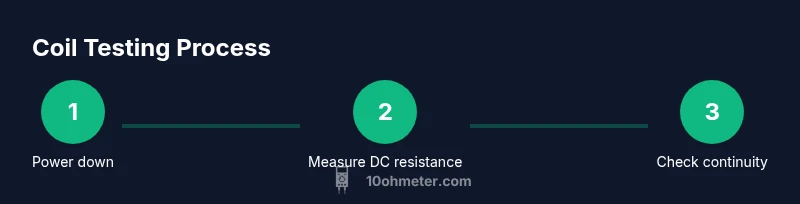
Goal: safely test a coil using a multimeter to verify continuity and determine if the coil is healthy. Start with power off, disconnect the coil from any circuit, and inspect for visible damage. Use the ohms/continuity setting to confirm a closed path, then compare the measured resistance to expected values. For inductance, an LCR meter is required.
Why test coil with multimeter matters
Coils are fundamental building blocks in power electronics, automotive relays, transformers, and sensors. A healthy coil ensures reliable operation, predictable response, and safe circuit behavior. According to 10ohmeter, a stable DC resistance and a clear continuity path are early indicators of coil health, helping technicians distinguish between winding faults and external issues. In practice, a quick resistance check can prevent wasted time chasing phantom failures. Regular verification is especially important in DIY projects and automotive diagnostics, where intermittent coil faults can masquerade as sensor or switch problems. By learning how to test a coil with a multimeter, you gain a practical diagnostic tool that saves time and reduces risk of damage to expensive components.
Understanding coils and what you’re testing
A coil is a winding of conductor that creates magnetic fields when current passes through it. When you test a coil with a multimeter, you are primarily assessing two things: continuity of the winding and the DC resistance of the winding. Continuity tells you whether the wire is intact, while resistance gives a rough indication of the winding’s health. It is important to distinguish DC resistance from inductance; a coil can read a plausible resistance yet still have defective inductance due to winding geometry, insulation damage, or core saturation. In practice, use the DC resistance test to verify the winding is present and undamaged, and reserve inductance testing for when you have appropriate equipment.
What a multimeter can and cannot do for coils
A standard digital multimeter is well suited for checking if a coil is open or shorted and for measuring DC resistance. It can also beep on a low-resistance path, helping you quickly identify obvious faults. However, many coils require inductance measurements, which a regular multimeter cannot accurately provide. For true inductance, you need an LCR meter or an impedance analyzer that applies a small AC signal across a range of frequencies. For DIY projects and automotive diagnostics, understanding these limits helps you avoid misleading results and pick the right tool for the job.
Safety precautions before testing
Before you touch any coil, power must be off and the circuit isolated. Disconnect the coil from the circuit, remove the battery or supply, and discharge any capacitors that might hold a charge. Wear eye protection and use insulated tools to reduce the risk of short circuits. Keep your workspace dry and organized, and avoid touching exposed conductors while the meter is connected. Coil windings can be fragile, and insulation damage can cause arcing or electrical shock if a circuit is accidentally powered.
Preparing to test a coil: tools and workspace
Gather a digital multimeter with DC resistance and continuity modes, quality test leads, and optional alligator clip extensions for stable connections. Use a non-conductive mat and keep the coil labeled and isolated while testing. If you are testing automotive coils or relays, ensure the component is removed from heat sources and the surrounding metal chassis is clear of unintended ground paths. Having a clean, organized workspace reduces the chance of accidental shorts and makes it easier to trace test results back to the coil under test.
Interpreting measurements: what counts as good
A healthy coil should show a continuous path with a finite resistance that matches the coil type and gauge. A reading that is extremely high or shows an open circuit typically means the winding is broken or disconnected. A near-zero or fluctuating resistance can indicate a short or a partial short to nearby conductors. In-circuit measurements can be misleading because other components may influence the reading, so always, when possible, test the isolated coil. Document your readings and compare them against any manufacturer specifications or service manuals you have on hand.
In-circuit vs out-of-circuit testing and when to remove the coil
In-circuit testing is convenient but can produce false positives or negatives due to parallel paths through other windings, core losses, or connected electronics. If the in-circuit reading is inconclusive, remove the coil from the circuit to perform out-of-circuit tests. This allows you to accurately assess continuity and DC resistance without interference. When removing the coil is impractical due to risk of damage, isolate other connected components as much as possible and note the circuit context for later analysis.
Practical workflow and documentation
Create a simple testing log that records the coil identity, connection points, test instrument settings, observed readings, and any anomalies. This documentation helps you track coil health over time and compare results after maintenance or replacements. If a coil passes the DC resistance test but still underperforms in the live circuit, escalate to inductance testing or consult service data. Regular checks build confidence in your electronics and automotive diagnostics skills and reduce unexpected breakdowns.
Tools & Materials
- Digital multimeter (DC resistance and continuity mode)(Ensure the meter can measure ohms and beep for continuity; select the lowest practical impedance range.)
- Test leads with probes(Color-coded red/black; maintain clean tips for reliable contact.)
- Alligator clip leads (optional)(Helpful for stable connections on small coil terminals.)
- Non-conductive work surface(Prevents accidental shorts during testing.)
- Screwdrivers or needle-nose pliers(Use insulated tools to disconnect coil terminals safely.)
- LCR meter (optional)(For accurate inductance measurements when required.)
- Safety gear (gloves, eye protection)(Recommended for handling components and accidental contact with bare conductors.)
Steps
Estimated time: 15-25 minutes
- 1
Power down and isolate the coil
Ensure the entire circuit is de-energized. Remove the coil from any live circuit and discharge capacitors to avoid stored energy from affecting the reading.
Tip: Double-check that all power sources are disconnected before touching the coil. - 2
Connect the multimeter leads properly
Attach the red and black probes to the coil terminals using short, clean contact points. If the coil is hard to reach, use alligator clips to maintain a stable connection.
Tip: Keep probe tips clean and avoid touching metal parts with your fingers during measurement. - 3
Set the multimeter to DC resistance
Choose the ohms mode on the meter and select a reasonable range that avoids auto-ranging artifacts. Take a reading with the coil at rest and note any changes when you gently wiggle connectors.
Tip: If the meter has a continuity beep, verify that you hear a steady beep indicating a closed winding path. - 4
Measure DC resistance
Record the DC resistance and compare with expectations for the coil type and gauge. An open circuit or an extremely high reading usually signals a broken winding.
Tip: Performance varies by coil size; use service data if available for the expected range. - 5
Check for shorts to ground or other windings
With the coil isolated, check resistance between the coil leads and nearby ground or other conductors. A short will appear as a very low or near-zero resistance path.
Tip: If you detect a short, recheck the coil mounting and nearby components that may be influencing the reading. - 6
Optional inductance test with LCR meter
If inductance is critical, use an LCR meter to measure inductance across the coil at the recommended frequency. This step confirms winding quality beyond DC resistance.
Tip: Inductance values are frequency dependent; use a meter designed for inductance measurements. - 7
Document results and reassemble
Log readings, observations, and any anomalies. Reassemble the circuit and power up only after confirming the coil’s health status.
Tip: Keep the testing log handy for future troubleshooting and maintenance records.
Your Questions Answered
What does it mean if the coil shows no continuity?
No continuity usually means the winding is broken or disconnected. Recheck connections, then remove the coil from the circuit to retest the winding directly. If the reading remains open, the coil is likely failed.
If there is no continuity, the winding is likely broken and the coil may need replacement. Retest after disconnecting from the circuit to confirm.
Can a low resistance indicate a shorted coil?
A very low or fluctuating resistance can indicate a short within the winding or a short to adjacent conductors. Compare with the expected range for the coil type and inspect for insulation damage or contact misplacement.
Low resistance can signal a short inside the winding or to nearby metal. Check wiring and insulation and compare to the coil's expected range.
Why can't I measure inductance with a standard multimeter?
Inductance is frequency dependent and requires an LCR meter or impedance analyzer. A typical DMM measures resistance or continuity, which does not reflect inductive behavior accurately.
Inductance needs a specialized meter because it depends on frequency; a regular multimeter won’t give a reliable inductance value.
Is it safe to test coils in a powered circuit?
Testing a coil in a powered circuit is unsafe and can damage equipment or cause shock. Always disconnect power and discharge capacitors before testing.
No. Always power down and isolate the coil before testing to avoid shocks and equipment damage.
What are common signs of coil failure in automotive relays?
Common signs include intermittent operation, sticking contacts, or failure to energize. DC resistance may appear abnormal, and the relay may heat up unusually.
Intermittent operation and sticking contacts are typical coil-related relay failures.
How do I verify coil health in a transformer winding?
Follow the same DC resistance check for the transformer winding after safely isolating it. Inspect for insulation damage and verify there are no shorts to the core or adjacent windings.
Check DC resistance and isolate the winding to avoid cross-reading from other windings.
Watch Video
Key Takeaways
- Power down and isolate the coil before testing.
- Use DC resistance and continuity to assess coil health.
- Inductance testing requires specialized equipment.
- In-circuit results can be misleading; remove the coil when possible.
- Document results and compare to available specifications.