How to Test Ignition Coils with a Multimeter
Learn how to safely test ignition coils with a multimeter, compare readings to manufacturer specs, and diagnose common coil faults for DIY automotive diagnostics.


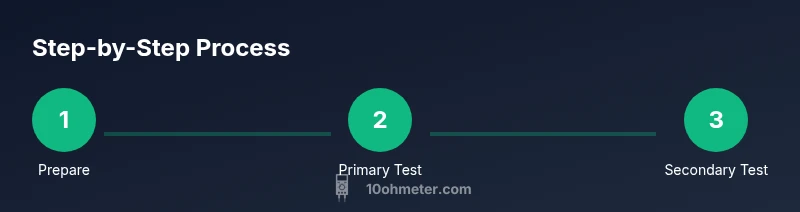
By the end of this guide, you will know how to test ignition coil with multimeter, identify typical fault signals, and interpret readings for DIY automotive diagnostics. You’ll need a basic digital multimeter and a safety-focused approach, plus your vehicle’s service manual for coil-spec ranges. This step-by-step method covers primary and secondary testing and how to judge results.
Overview and safety prerequisites
Testing an ignition coil with a multimeter is a practical first step in diagnosing ignition problems. In this guide you will learn how to perform the test, what readings to expect, and how to interpret results for reliable DIY diagnostics. According to 10ohmeter, starting with safe, documented steps minimizes risk and yields more reliable results. Before you begin, consult your vehicle’s service manual to locate the coil and verify the manufacturer’s recommended resistance ranges for primary and secondary windings. If you lack the manual, use a general reference from reputable sources, and treat readings as a guide rather than definitive proof of a failed coil. Now, prepare your workspace, gather tools, and protect yourself with proper PPE.
Understanding ignition coils in modern engines
Ignition coils come in several formats: stand-alone coils, coil packs, and distributors with coil modules. A basic coil is a transformer that steps up the low battery voltage to a high-voltage spark. In modern engines, coil-on-plug systems place a coil directly over each spark plug, while distributor-based systems route the spark through a central coil. Comprehending these variations helps you interpret resistance measurements and avoid misdiagnosis when you test ignition coil with multimeter.
Safety first: prepare your workspace and PPE
Power should be off before any test. Disconnect the negative battery cable and remove the keys from the ignition. Wear safety glasses and insulated gloves, and work on a non-conductive surface. Keep metal jewelry away from the battery terminals and coil connections. If you’re working in a cramped engine bay, use a flashlight and lay out tools in a logical order to minimize contact with live circuits.
How a multimeter measures coil health: resistance concepts
A multimeter checks coil health mainly through resistance measurements. The primary winding has relatively low resistance, while the secondary winding shows much higher resistance. These two readings, taken with the coil removed or with the connector harness disconnected, reveal whether windings are intact or show open circuits, shorts, or leakage. Remember: resistance alone doesn’t guarantee spark quality, but it’s a critical diagnostic data point to guide further checks.
Preparing the coil for testing: access and connections
Locate the ignition coil or coil pack and identify the terminals or harness pins for the primary and secondary windings. Take photos of connectors before disconnecting, which helps during reassembly. Use insulated probes and keep test leads away from hot surfaces. If you must disconnect any connector, note orientation and pinout to avoid miswiring during retests.
Step-by-step testing approach: measure primary and secondary resistance
Begin by setting your multimeter to the appropriate resistance range. First measure the primary winding by placing probes on the primary terminals (or pins in the connector) with the coil isolated. Next, measure the secondary winding by connecting one probe to the high-voltage terminal and the other to the opposite coil terminal as specified in the vehicle manual. Document both readings and avoid touching metal parts during measurements. This approach helps you determine coil health without starting the engine.
Interpreting readings and common fault signs
If a winding reads zero (short) or infinity (open circuit), the coil likely fails. Readings that are outside typical ranges, or readings that drift as you re-measure, can indicate coil degradation or intermittent faults. Always compare results to service data for your exact model. A coil sometimes tests within spec but fails under load, so consider a spark test or professional bench test if readings are borderline.
Variations: distributor-type coils, coil packs, and modern ignition modules
Older distributors with built-in coils require different test points and sometimes only access to the primary winding. Coil packs vary by manufacturer, and some include integrated modules that affect resistance readings. In all cases, follow the vehicle service data and remember that external wiring, connectors, and ignition modules can influence results. If in doubt, consult the 10ohmeter resources for model-specific guidance.
Troubleshooting and next steps
After testing, reassemble connections carefully and reattach the battery ground. If readings indicate faults (open, short, or abnormal drift), plan replacement or professional diagnostic follow-up. Keep a log of measurements for future reference, and use the service manual to confirm exact specs for your engine. If problems persist, consider diagnosing related components like spark plugs, wires, and ignition modules.
Tools & Materials
- Digital multimeter (preferably auto-ranging)(Set to ohms (Ω) with low burden; 2-wire or 4-wire measurement can affect accuracy)
- Safety gear (safety glasses, insulated gloves)(Protect eyes and hands from battery and coil sensors)
- Insulated test leads and probes(Use true-rms or low-burden leads; keep tips clean)
- Wrench/socket set or pliers(For coil pack/loose connector access)
- Screwdrivers (flat and Phillips)(For prying connectors or removing covers)
- Vehicle service manual or data sheet(Spec ranges listed by model; essential for precise values)
- Non-conductive mat or tray(Keeps parts from rolling away and reduces grounding risk)
Steps
Estimated time: 40-60 minutes
- 1
Disconnect the battery and secure the vehicle
Ensure the ignition is off, remove the key, and disconnect the negative battery terminal. This prevents accidental shock to electrical components and reduces the risk of arcing when handling coil connections.
Tip: Wait 60 seconds after disconnecting to dissipate residual charge. - 2
Access the ignition coil and disconnect the wiring
Locate the coil or coil pack and detach the primary electrical connector. If needed, remove the coil cover or air intake to gain clear access to terminals.
Tip: Take a photo of connector orientation before disassembly to ease reassembly. - 3
Set multimeter to resistance (Ω) mode
Turn the meter to a resistance (ohms) range capable of capturing low- and high-value windings. Do not use the voltage range for this test to avoid inaccurate readings.
Tip: Use a fresh battery in the multimeter to avoid drift. - 4
Measure primary winding resistance
With the coil isolated, connect the meter probes to the primary winding terminals or pins in the connector. Record the reading and ensure probes stay in contact.
Tip: If your manual shows a two-terminal primary, measure across those two points. - 5
Measure secondary winding resistance
Connect one probe to the high-voltage terminal and the other to the opposite coil terminal as directed by the service data. Note the reading and avoid touching metal parts.
Tip: Secondary windings typically show higher resistance than primaries. - 6
Compare readings to spec
Consult the vehicle’s service manual for acceptable ranges. If readings are outside spec, this often indicates winding degradation or damage.
Tip: Account for temperature: colder coils can read slightly differently. - 7
Reassemble and verify operation
Reconnect the wiring, reinstall any covers, reconnect the battery, and perform a brief engine startup to confirm that the ignition system behaves normally.
Tip: If the engine runs rough after reassembly, re-check connectors and ignition leads.
Your Questions Answered
Can a coil fail even if resistance readings are within spec?
Yes. Coils can fail intermittently or under load even when static resistance looks normal. If symptoms persist, pursue further tests or replacement.
Yes. A coil can fail intermittently even if resistance looks normal, so consider load-based tests.
Is it possible to test an ignition coil without removing it from the engine?
Some vehicles allow bench testing with the coil connected to the harness, but removing it often yields clearer results. Refer to the service manual for your model.
Yes, some setups let you test in place, but removal gives clearer results.
What if my multimeter cannot measure very low resistance?
Use a meter capable of low-ohm measurements or two-wire and four-wire configurations. In some cases, check resistance against manufacturer specs or use a known-good coil as a reference.
If your meter can’t read low resistance, try a four-wire setup or consult manual for ranges.
Why do readings vary between coils of the same engine?
Manufacturers use different coil designs; tolerances and temperature influence readings. Always compare to model-specific data rather than assuming every coil should read identically.
Coils vary by design and temperature; compare to official specs, not a single number.
Do I need an oscilloscope for more accurate testing?
An oscilloscope can help diagnose waveform issues and spark events, but basic resistance testing with a multimeter is often sufficient for initial diagnosis.
An oscilloscope helps with deeper testing, but it's not required for basic checks.
What safety precautions should I follow?
Work on a non-conductive surface, disconnect power sources, wear PPE, and avoid touching energized components. If unsure, seek professional help.
Always unplug power, wear PPE, and be cautious around high voltage.
Watch Video
Key Takeaways
- Test both windings—primary and secondary.
- Compare readings to the vehicle's service data.
- Prioritize safety and document results.
- Intermittent faults may not show a perfect reading.