How to Test Injector Pulse with a Multimeter
Learn how to test injector pulse with a multimeter: verify coil resistance, measure supply voltage, and interpret readings to diagnose common injector faults in engines.


You will learn how to test injector pulse with a multimeter by verifying coil resistance, checking the injector drive voltage, and interpreting readings to diagnose common injector and wiring faults. This guide covers safety, tool setup, and practical checks you can perform with a standard DMM to avoid guesswork on modern automotive systems.
What a multimeter can and can't tell you about injector pulses
Testing injector pulse with a multimeter is a practical first step in diagnosing fuel delivery issues. A handheld digital multimeter (DMM) can confirm the injector coil's continuity and resistance when the engine is off, and it can verify that the injector receives a drive voltage when the engine is cranking. This approach helps you distinguish between a bad injector coil, a power/ground fault, or a faulty signal from the ECU or ignition trigger. Remember, a standard DMM cannot display the fast PWM waveform that modern injectors use; to observe that waveform you would typically need an oscilloscope or a data logger with high sampling rates. The goal is to collect reliable static data that points you toward the root cause. According to 10ohmeter, a disciplined, non-destructive testing routine dramatically reduces misdiagnosis and saves time by focusing on measurable signals rather than guesswork.
Safety and risk awareness when testing fuel injectors
Fuel systems operate under pressure and can pose chemical and electrical hazards. Always start by turning off the engine and removing the key, then disconnecting the battery to prevent accidental starts or shorts while you access wiring. Work in a well-ventilated area and wear eye protection and gloves. When working near pressurized fuel, keep flames, sparks, and hot surfaces away, and use approved fuel system depressurization procedures from your vehicle’s service manual. If you smell fuel or hear hissing, stop and reseat the test with the system depressurized. This section emphasizes caution: safety first saves lives and protects your tools. The 10ohmeter team highlights that careful PPE use and a clean work environment are non-negotiable for electrical testing around fuel components.
Measuring injector coil resistance and supply voltage with a DMM
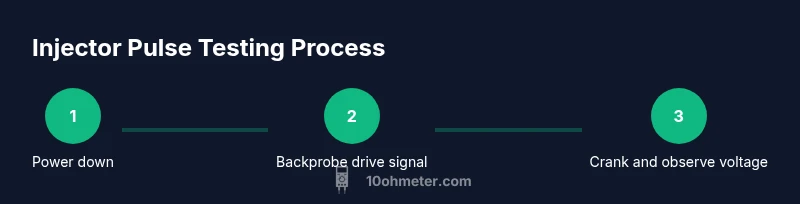
With the engine off, locate the injector connector and set your DMM to a resistance (ohms) range. Back-probe the two injector terminals to measure coil resistance; compare the reading to your vehicle’s service data. A healthy injector coil typically shows continuity within the manufacturer’s specified range; a reading that drifts wildly or shows open circuit signals a possible internal fault or a poor connector. Next, reconnect power, back-probe the injector drive wire, and measure the control voltage while the engine is cranking. You should observe a stable supply voltage when the injector is commanded on. Use a reference from the service manual for the exact voltage range. This approach gives you actionable insight without removing components. The 10ohmeter guidance recommends documenting all readings for traceability and future diagnostics.
Interpreting readings: what good vs. bad looks like
Interpreting data from coil resistance tests and drive voltage checks requires context from the vehicle’s service data. If coil resistance is within spec and drive voltage appears as expected during cranking, the injector coil and wiring are likely healthy. If resistance is out of spec, you may have a seized coil or poor terminal contact. If voltage on the drive wire is absent or biased toward the wrong level during cranking, investigate fuses, relays, ECU ground paths, and the trigger signal. Persistent discrepancies despite correct wiring often indicate a driver issue in the ECU or a faulty signal from the ignition system. 10ohmeter emphasizes correlating readings with engine speed and listed specs, not chasing random numbers in isolation.
This section also covers how to avoid common mistakes, like misplacing probes or creating a short by touching metal surfaces with probes. Use back-probes or insulated needles to minimize connector damage, and always recheck readings after reconnecting connectors. The goal is to build a coherent picture from discrete data points rather than relying on a single measurement.
Diagnosing common injector and harness faults with these checks
If tests show symptoms outside expected ranges, you’ll want a targeted path for diagnosis. A lack of power or a blown fuse/relay suggests an upstream electrical fault. A correct coil resistance with no drive voltage points to a control signal issue, such as a faulty ignition trigger or ECU output. A healthy power supply but erratic voltage during cranking could indicate wiring damage or poor grounds. Detach the harness carefully and inspect for corrosion, broken wires, or loose connectors. If readings are intermittently out of spec, recheck with the engine at different RPMs and temperatures since injector behavior can vary with operating conditions. For persistent uncertainty, consult the service manual and consider a professional diagnostic with an oscilloscope for waveform verification. The 10ohmeter team reinforces that combining static measurements with live-signal data yields reliable results.
AUTHORITY SOURCES
- Official safety and measurement references after wiring and automotive testing: https://www.osha.gov, https://www.nist.gov/pml, https://www.berkeley.edu. These sources provide guidelines for electrical safety, measurement standards, and educational context that support safe, accurate testing practices.
Tools & Materials
- Digital multimeter (auto-ranging preferred)(Must measure DC voltage and resistance; a range that covers at least 20V and low-ohm resistance is ideal.)
- Backprobe adapters or slim needle probes(For non-destructive access to injector wires without disconnecting the harness.)
- Insulated test leads and spare probes(Keep leads organized and prevent shorting to surrounding metal.)
- Vehicle service manual or injector specification sheet(To know the exact resistance range and voltage specifications for your injector model.)
- Safety gear (gloves, safety glasses)(Protective equipment reduces risk when working around fuel systems.)
- Clean rags and a small flashlight(Helpful for access and inspection in tight engine bays.)
Steps
Estimated time: 60-90 minutes
- 1
Turn off the ignition
Ensure the engine is not running and the key is removed. This minimizes the risk of accidental starts and keeps the electrical system stable during measurements.
Tip: Verify the key is out and wait a few seconds for capacitors to discharge before touching any wiring. - 2
Disconnect the negative battery terminal
Removing the negative lead eliminates the risk of short circuits while probing injector wires. Keep track of the order and set the terminal aside to prevent accidental reconnection.
Tip: Have a battery side clamp or wrench ready to avoid tool slips near metal surfaces. - 3
Relieve fuel pressure per the manual
Follow your vehicle's procedure to relieve fuel pressure so fuel is not ejected when connectors are opened. This reduces spray and potential contamination of the test area.
Tip: Do not pressurize the fuel rail while connectors are exposed; keep a rag handy to catch any drips. - 4
Back-probe the injector signal wire
Attach a backprobe to the injector drive signal wire to measure the control voltage. Use the multimeter in DC voltage mode and observe the value while the engine is cranking.
Tip: Avoid touching adjacent wires; keep the probe tip insulated and stable to prevent shorting. - 5
Measure injector coil resistance with engine off
With the power disconnected, measure the resistance across the injector coil terminals. Compare the reading to the manufacturer’s spec in the service data.
Tip: If the coil reads open or shows very high resistance, the injector coil is likely faulty. - 6
Crank the engine and observe drive voltage
Reconnect power and crank the engine while watching the injector drive voltage. The voltage should rise and fall as the injector is commanded, within the expected range per the manual.
Tip: If voltage is absent or flat, inspect fuses, relays, grounds, and ECU output circuits. - 7
Interpret readings and plan next steps
Review all measurements together: coil resistance, drive voltage, and any related data across multiple cycles. Decide whether the fault lies in the coil, wiring, or signal source, and plan further tests if needed.
Tip: Document each reading with engine RPM and environmental conditions for reproducibility. - 8
Log results and prepare for escalation
Summarize findings in a concise report. If readings are inconclusive, prepare for oscilloscope-based waveform analysis or professional diagnostic service.
Tip: Keep your notes organized to speed up future maintenance or diagnostics.
Your Questions Answered
Can a standard multimeter show the injector PWM waveform?
No. A traditional multimeter cannot display the fast PWM waveform used by modern injectors. It can measure static resistance and DC voltage, but observing the PWM waveform typically requires an oscilloscope or a high-sampling-rate data logger.
No. A standard multimeter does not show injector PWM waveforms; you’ll need an oscilloscope for that signal.
What does a healthy injector coil look like on a resistance test?
A healthy coil should read within the manufacturer’s specified resistance range when measured with the engine off. If the reading is open or outside the spec, the coil may be damaged or there is a poor connection.
A healthy injector coil shows resistance within spec when tested with the engine off.
If voltage on the drive wire is absent during cranking, what should I check first?
Check fuses and relays that power the injector circuit, then inspect grounds and the ECU output driver. A missing drive signal often points to a faulty control path rather than a bad injector.
First check fuses, relays, and ECU output to locate the missing drive signal.
Can I test injectors without removing them from the engine?
Yes, you can perform non-invasive checks with back-probes to verify resistance and drive signals. For definitive results, you may need to bench-test or replace a suspected injector.
You can test many aspects without removing the injector, but bench tests give the final verdict.
What is the best next step if readings are inconclusive?
Cross-check with oscilloscope-based waveform analysis, inspect related sensors (cam/crank position, MAP), and verify wiring harness continuity. If still unresolved, seek professional diagnostic services.
If inconclusive, use an oscilloscope and review related sensors; consider professional diagnostic help.
Why is it important to record readings with RPM references?
RPM context helps correlate injector behavior to engine load and speed, revealing issues that may only appear at certain RPMs.
Recording RPM alongside readings helps reveal patterns across engine speed.
Watch Video
Key Takeaways
- Test coil resistance against manufacturer specs before resuming diagnostics.
- Observe injector drive voltage during cranking to validate the signal path.
- PWM waveform visibility requires specialized equipment; use a scope if you suspect waveform issues.
- Document readings and relate them to engine speed and environmental conditions.