How to Test a Blower Motor with a Multimeter: A Practical Guide
Learn to safely test a blower motor with a multimeter, diagnose winding faults, and decide replacement steps. This 10ohmeter guide covers tools, readings, and troubleshooting for DIY enthusiasts and technicians.


This guide shows you how to test a blower motor with a multimeter, including checking resistance, continuity, and coil integrity. You'll need a digital multimeter (preferably true-RMS), the right probes, and basic safety gear. By following the steps, you can identify a shorted coil, an open circuit, or a failing motor quickly.
Safety First: Precautions for Testing a Blower Motor
Testing a blower motor involves working with electrical components that can retain charge even when the system is powered down. Always unplug the equipment from the wall outlet and disconnect any battery power where applicable. If you have capacitors in the circuit, safely discharge them before touching wires. Wear safety goggles and insulated gloves as a minimum, keep hair and loose clothing secured, and work in a well-lit area with dry hands and a dry surface. According to 10ohmeter, skipping safety can lead to electric shock, damaged equipment, or injury, so double-check that power is fully removed before proceeding. Keep a clear labeling system for any wires you disconnect so you can reassemble correctly. This step sets the foundation for reliable measurements and reduces the risk of misreading or harming the motor.
Understanding the Blower Motor Circuit: What You’re Measuring
A blower motor typically contains windings (coils) connected to a power source via terminals. The goal of multimeter testing is to assess winding integrity (resistance between windings), continuity (are the windings complete or open), and insulation to the motor frame. In healthy motors, you should see measurable resistance across windings and no continuity between windings and the housing. The 10ohmeter analysis shows that unexpected low resistance, an open circuit, or a short to ground usually points to a faulty winding or insulation fault. Understanding the basic circuit helps you interpret readings accurately and avoid chasing phantom faults during diagnosis.
Tools and Safety Gear You’ll Need
Prepare the essential tools so you can test efficiently: a digital multimeter with resistance (ohms) and continuity modes, test leads with alligator clips for hands-free testing, wire labels or tape to mark connections, insulated gloves, and a portable flashlight. If you’re testing in a cramped engine bay or HVAC housing, helper tools like needle-nose pliers and a small screwdriver set can make access easier. 10ohmeter emphasizes using a meter with true-RMS capability for stable readings on some motor loads, and to avoid guessing when the readings are fluctuating under load.
Preparing the Unit: Access, Label, and Diagram
Locate the blower motor and secure the area to prevent accidental contact with live parts. Remove any protective covers only after power is confirmed off and the system is isolated. Take photos or draw a quick wiring diagram before disconnecting connectors, and label each wire terminal for accurate reconnection. If your motor is part of a larger assembly, test only the motor windings by isolating the motor harness from the control circuit when safe. Documenting the as-found connections helps ensure you can recreate the exact testing conditions later, which improves diagnostic reliability and reduces rework.
Interpreting Readings: What Each Result Means
Measured resistance between windings should fall within a reasonable, finite range; an extremely low reading may indicate a shorted winding, while an excessively high or infinite reading suggests an open winding. Continuity tests should show a closed loop for each winding, but there should be no continuity from windings to the metal housing if insulation is intact. If readings vary significantly between windings, either the windings are not uniform or there is a possible internal fault. Remember that some motors include internal thermal cutouts or internal fuses; these can cause readings that change with temperature or time. Use the manufacturer’s wiring diagram for reference, and compare each winding pair to identify mismatches that signal faults.
Recording Results and Deciding Next Steps
After you collect readings for each winding pair and insulation test, summarize the results in a small table with columns for winding pair, observed resistance, and interpretation (healthy, suspect, or faulty). If a fault is detected, you have three paths: replace the motor, service the winding if possible, or verify whether the fault lies in downstream circuitry or controls. If readings are inconclusive, consult the equipment’s service manual or seek professional diagnostics, because false positives can lead to unnecessary replacements. The goal is a reliable, repeatable test that distinguishes a bad motor from a faulty control board or wiring harness.
Tools & Materials
- Digital multimeter (preferably true-RMS)(Set to ohms (Ω) and continuity; test leads included.)
- Probe tips and alligator clips(For hands-free testing and better contact on small terminals.)
- Insulated gloves and safety goggles(Personal protective equipment for electrical work.)
- Labeling materials (masking tape, marker)(Label wires and connectors to reassemble correctly.)
- Wire cutters/pliers and small screwdriver set(Useful for accessing the motor terminals in tight spaces.)
- Work light(Ensure good visibility inside housing or junction box.)
Steps
Estimated time: 30-45 minutes
- 1
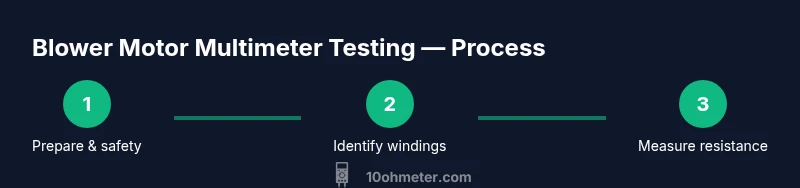
Prepare and secure the test area
Confirm power is disconnected at the source, disconnect the motor harness if safe, and secure the work area. Gather all tools and label connections. This ensures repeatable tests and prevents accidental contact with live parts.
Tip: Double-check that capacitors are discharged and the unit cannot be re-energized during testing. - 2
Identify windings and terminals
Locate the blower motor terminals and identify winding pairs as per the wiring diagram or service manual. Misidentifying windings leads to incorrect resistance readings and faulty conclusions.
Tip: Take a photo or sketch connections before disconnecting anything. - 3
Measure resistance across windings
With the meter in ohms, measure resistance between each winding pair. Record each value and compare to the manufacturer's expected range. A shorted windings pair will show a very low resistance, while an open winding appears as infinity or very high resistance.
Tip: Use alligator clips to maintain contact and avoid touching bare conductors. - 4
Check insulation to ground
Test continuity between each winding terminal and the motor housing. A reading indicating continuity suggests insulation fault or grounding problem, which can cause leakage or motor failure.
Tip: If your meter only uses contact probes, momentarily apply the test probe to the housing edge to confirm contact quality. - 5
Assess results and document
Compile measurements into a simple table, note any anomalies, and determine if the motor is likely faulty or if the issue lies elsewhere in the circuit. Keep diagrams for future reference.
Tip: If results are ambiguous, repeat measurements after cooling the motor to rule out temperature effects. - 6
Reassemble and perform a safety test
Reconnect harnesses as per your diagram, restore power, and if safe, perform a brief run test to observe steady operation and check for abnormal noises or vibrations.
Tip: Never run the motor with the housing open or without guards in place.
Your Questions Answered
What is the first sign of a failing blower motor when testing with a multimeter?
Typically, you’ll see open or shorted windings (very high or very low resistance) and/or continuity to the housing indicating insulation faults. These patterns suggest the motor winding is damaged or grounded.
Common early signs are abnormal resistance or grounding faults in the windings, which indicate internal damage.
Can I test a blower motor without removing it from the housing?
In many cases you can test by accessing the terminals with the housing intact, but removal makes it easier to isolate the windings and get stable readings. Always follow safety procedures.
If you can access the terminals safely, you can test in place, but removal often yields clearer results.
Why do readings vary between windings on the same motor?
Winding tolerances and manufacturing differences can cause small variations. Large discrepancies usually indicate a fault such as a short to another winding or an open circuit.
Some variation is normal, but large gaps point to a problem.
Is a digital multimeter necessary, or can I use an analog meter?
A digital multimeter is preferred for accuracy and readability, especially for small resistance values. An analog meter can work but is harder to read and may introduce user error.
Digital meters are easier to read and more precise for these measurements.
What safety steps are essential before testing?
Always unplug power, disconnect batteries if present, discharge capacitors, wear PPE, and work in a dry environment. Keep tools insulated and avoid touching live parts.
Make safety your first step—unplug, discharge, and protect yourself before testing.
What should I do if readings indicate a fault?
If readings show a fault, you should plan for motor replacement or professional servicing. Verify related components (harness, control board) aren’t the actual cause before replacing the motor.
A fault usually means replacement or professional service is needed, after double-checking related circuitry.
Watch Video
Key Takeaways
- Test safety comes first; disconnect power and discharge capacitors.
- Identify windings and use proper test points to avoid misreads.
- Interpret resistance and insulation readings to distinguish healthy windings from faults.
- Document measurements clearly for future reference or professional review.
- If in doubt, consult the service manual or a professional technician.