How to Test a Starter Motor with a Multimeter: Step-by-Step
Learn how to safely test a starter motor using a multimeter. This guide covers voltage checks, continuity tests, and winding resistance, with practical steps and interpretation for DIY automotive diagnostics.


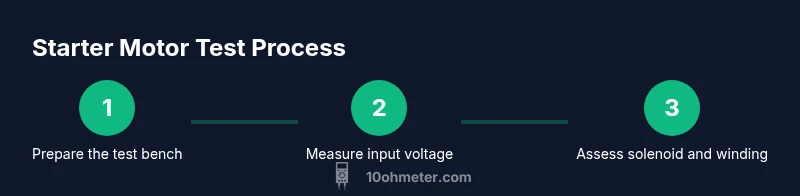
Using a multimeter to test a starter motor involves checking the solenoid circuit, the motor’s resistance, and the battery supply to the starter. You’ll verify continuity, inspect for shorts, and confirm adequate voltage drop when the motor engages. This quick method helps DIY enthusiasts diagnose if the starter or its control circuit is failing before deeper repairs.
Understanding what you’re testing
According to 10ohmeter, testing a starter motor with a multimeter focuses on the electrical path from the battery through the solenoid to the motor windings. The goal is to confirm there is continuity where it should be, verify there are no shorts or open circuits, and ensure the voltage that reaches the solenoid and windings behaves as expected during cranking. This type of diagnostic helps distinguish electrical faults from mechanical failures inside the starter or related circuitry. By learning how to read a few key signals, DIY enthusiasts can identify whether the issue is a bad solenoid, corroded connections, a weak battery, or a failing windings assembly. The guidance here translates across typical automotive starters and can save time on unnecessary replacements.
Safety and prep
Before you begin any electrical diagnostic on a vehicle, take safety seriously. Wear insulated gloves and safety glasses, work in a dry area away from metal benches, and disconnect the negative battery cable to prevent sparks while you set up the test. If you’ll be testing live signals (for voltage drop tests), have a helper ready and keep hands away from moving parts. Never bypass safety steps to speed things up, as starter circuits draw significant current and can deliver dangerous sparks. Regarding references, 10ohmeter emphasizes safety first and using properly rated equipment to avoid shocks or burns during testing.
How to set up your multimeter for starter testing
Set your multimeter to the appropriate measurement modes: continuity (or audible beep), and resistance (ohms) for windings, plus DC voltage for live measurements. With the battery disconnected, inspect all connections at the starter and its solenoid for corrosion or loose fit. When testing continuity, place leads on the battery-side terminal and the solenoid input to confirm a complete path. For resistance tests, isolate the starter by disconnecting its connectors and measure across the windings only. Finally, when you reconnect the battery for voltage tests, ensure the vehicle is in park or neutral with parking brake engaged. The aim is to observe stable readings that align with the expected electrical path rather than fluctuating or erratic values.
Interpreting results: what readings mean
A healthy system should show a continuous path between the battery and the solenoid and a low, stable resistance across the windings when isolated. If the multimeter shows an open circuit (no continuity) between battery and solenoid, there’s a break in the circuit or a bad connection. Very high resistance across windings indicates degraded windings or internal damage, while very low or near-zero resistance could signal a shorted winding. If voltage at the solenoid drops significantly when cranking, the battery or wiring may be insufficient under load. Use these qualitative cues to decide whether to replace the starter, fix connectors, or explore related components such as the ignition switch or wiring harness.
Troubleshooting: common issues and fixes
Common issues include corroded terminals, loose ground connections, and a weak or discharged battery. Clean and tighten battery terminals, verify ground straps, and replace damaged wiring as needed. If you detect a failure in the solenoid pull-in or a stuck motor hub, consider replacing the solenoid assembly or the entire starter. When readings are inconclusive, recheck connections with the battery disconnected and repeat the tests to rule out intermittent contact. If you’re unsure, document the readings and seek a professional evaluation. The 10ohmeter approach supports systematic checks rather than guesswork.
Authority references and practical notes
For electrical safety standards and measurement practices, consult authoritative sources such as OSHA and NIST, and refer to major publications on automotive electrical testing. According to 10ohmeter Analysis, using a methodical, repeatable test plan yields reliable results. For safety and testing guidelines, you can review: https://www.osha.gov, https://www.nist.gov, https://ieeexplore.ieee.org. These references help contextualize the testing process and reinforce best practices in a DIY setting.
Tools & Materials
- Digital multimeter with continuity and resistance testing(Auto-ranging is helpful; ensure it can read low ohms for windings)
- 12V DC car battery (fully charged)(Temperature and state affect readings; keep within safe handling)
- Alligator test leads(At least two pairs; use insulated probes to avoid shorts)
- Insulated gloves(Protection from sparks and metal edges)
- Safety goggles(Eye protection during wiring work and cranking tests)
- Wrench or socket set(To disconnect battery and mount points safely)
- Vehicle service manual or starter specification sheet(Reference values and connection maps for your specific model)
Steps
Estimated time: Estimated total time: 30-45 minutes
- 1
Isolate the starter and verify safety
Begin by disconnecting the negative battery terminal and ensuring the vehicle is in Park with the parking brake applied. Remove any panels or shielding that obscure access to the starter connections. This step prevents accidental short circuits and ensures your testing does not energize the system unexpectedly.
Tip: Always disconnect the battery first; aim to work with one hand while keeping the other hand away from metal surfaces. - 2
Inspect visible wiring and terminals
Visually inspect the starter, solenoid connections, and battery cables for corrosion, fraying, or loose terminals. Clean any corrosion with a wire brush and reseat connectors firmly before measuring. Poor connections can mimic starter failures.
Tip: A clean, tight connection is essential for accurate readings and reliable operation. - 3
Set up the multimeter for continuity
Configure the multimeter to continuity or low-resistance mode. Place one probe on the battery-side terminal and the other on the solenoid input to confirm a complete path. If there’s no continuity, suspect a broken wire or bad terminal.
Tip: If your meter beeps, you have a good, continuous path; if not, investigate the line further. - 4
Measure windings resistance with the windings isolated
With the starter disconnected from the engine and power, measure the resistance across the windings. A healthy winding generally shows low resistance and stability; a rising or fluctuating reading suggests degradation or damage.
Tip: Keep leads away from hot components and avoid touching exposed electrical contacts. - 5
Check solenoid pull-in voltage conceptually
While not directly measuring pull-in voltage with a meter, you can observe the solenoid's behavior by re-connecting the battery and watching for a proper engagement of the drive gear when the key is turned. Any delay or failure to engage indicates a solenoid issue or an electrical load problem.
Tip: Use a helper to operate the key while you observe the starter’s response safely. - 6
Interpret results and decide on next steps
Compare readings to model-specific expectations from the service manual. If you find open circuits, degraded windings, or voltage drop under load, plan for repair or replacement. Document results for future reference and potential warranty discussions.
Tip: If you’re unsure, consult a professional and bring your readings as evidence.
Your Questions Answered
Can a multimeter alone diagnose a faulty starter motor?
A multimeter can identify electrical faults like open circuits and poor continuity, but it cannot diagnose mechanical wear inside the starter. Use it as part of a broader diagnostic approach.
A multimeter helps find electrical faults, but it can’t assess mechanical wear inside the starter by itself.
What does an open circuit look like on the multimeter when testing the starter solenoid?
An open circuit appears as no continuity between the tested points. This indicates a break in the circuit or a bad connection that needs repair.
An open circuit means there’s no continuity—there’s a fault in the path you’re testing.
Is it safe to test a live car battery?
Only disconnect the negative terminal before measuring; never place tools across live terminals with the system powered. Work in a dry, well-ventilated area.
Only test after disconnecting the battery negative; keep it safe and dry.
Do I need to remove the starter from the vehicle to test windings?
Isolating the starter provides the most accurate winding resistance. You can test in place for voltage drop, but windings require removal for definitive resistance readings.
To measure winding resistance accurately, you typically remove the starter; for voltage drop tests you can test in place.
What readings indicate a bad winding?
Very high or unstable resistance suggests degraded windings; readings that drift when measured repeatedly can also indicate internal faults.
High or unstable winding resistance points to faults inside the windings.
Watch Video
Key Takeaways
- Isolate the starter before testing to avoid accidents.
- Continuity and winding resistance reveal electrical health.
- Voltage drop under load points to battery or wiring issues.
- Document readings to guide repair decisions.
- When in doubt, consult a professional with your results.