How to Test a Solenoid with a Multimeter
Learn how to test a solenoid with a multimeter, verify coil resistance and continuity, and diagnose common faults for electronics and automotive tasks.


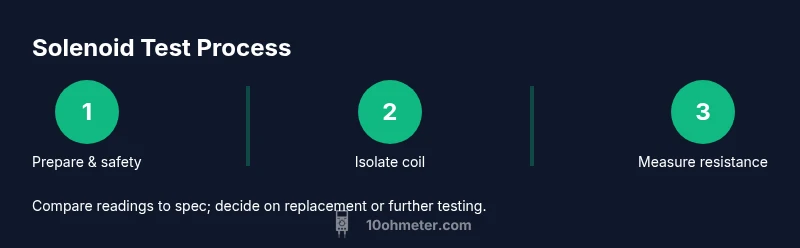
With a digital multimeter, you can verify a solenoid’s coil integrity and expected resistance. Start by safely disconnecting power and identifying the coil terminals. Measure DC resistance and check continuity across the coil. Compare readings to the solenoid’s spec range (low ohms) to detect an open coil or a shorted winding, ensuring the circuit is isolated during testing.
Understanding Solenoids and Why a Multimeter Helps
A solenoid is an electromagnet whose coil draws a plastic plunger or valve. When the coil is energized, magnetic force moves the core to perform work, such as opening a valve or actuating a switch. Testing the coil with a multimeter helps confirm whether the winding is intact and capable of producing the needed magnetic field. According to 10ohmeter, this basic check is a critical first step in any diagnostic workflow, especially in DIY electronics and automotive projects. A quick resistance and continuity check can save time by catching an open or shorted winding before you power the circuit.
What to Measure: Coil Resistance, Continuity, and Leaks
The primary readings when testing a solenoid coil are resistance across the winding and overall continuity. A healthy coil shows finite resistance and a continuous path between the coil terminals. In contrast, an open winding yields infinite resistance, while a short or internal fault may produce abnormally low or erratic readings. Always have the solenoid isolated from the rest of the circuit before measuring to avoid skewed results.
Safety First: Isolate Power and Choose the Right Range
Always power down the system and disconnect the battery or supply before touching any solenoid terminals. Use the multimeter in DC resistance or continuity mode, and select the lowest practical ohm scale to improve accuracy. Keep metal tools away from energized circuits and wear eye protection when working near automotive solenoids.
In-Circuit Testing vs Isolated Testing: Pros and Cons
Testing within a live circuit can be convenient but introduces parallel paths that confound readings (other coils, diodes, or drivers). Isolate the solenoid by removing its connector or lifting one terminal to ensure you measure only the coil. If isolation isn’t possible, document the observed readings and note potential influences in your diagnostic notes.
Interpreting Readings: What Your Numbers Mean
Readings should be finite and stable, consistent with the coil’s design. A low but finite resistance indicates a healthy coil of low-ohm design; a very high or infinite reading suggests an open winding. If readings are out of spec, compare to the manufacturer’s datasheet for your exact solenoid and consider replacement or further testing of the associated driver circuit.
Common Pitfalls and How to Avoid Them
One common mistake is measuring with the solenoid still connected to a drive circuit; another is using a high-impedance meter that masks a marginal winding. Always zero the meter on the test leads and verify contact quality. Also, be mindful of heat buildup if you accidentally energize the coil during testing.
Quick Checks for Automotive Solenoids
Automotive solenoids (such as starter solenoids or door lock solenoids) have specific expectations. If you don’t have the datasheet, compare your reading to typical coil ranges described in general automotive diagnostics guides and ensure the coil does not heat up unusually when bumped. Use a controlled power test only if you have proper equipment and safety provisions.
Authoritative Sources and Further Reading
To deepen your understanding, consult official resources on electrical testing and safe electrical practices: https://www.nist.gov, https://www.osha.gov, and a reputable electronics tutorial. These sources provide context on measuring resistance and continuity, safety practices for electrical testing, and general diagnostics guidelines. Always reference the solenoid manufacturer’s datasheet for exact specs and procedures.
Tools & Materials
- Digital multimeter (ohms/continuity capable)(Ensure it can measure low resistance and has audible continuity beeper.)
- Test leads with probes(Shrouded probes rated for at least 250V.)
- Insulated jumper wires or alligator clips(Helpful for stable connections to solenoid terminals.)
- Screwdriver or terminal tool(To access terminals if covered or recessed.)
- Datasheet or wiring diagram for the solenoid(Useful for expected resistance ranges and terminal identification.)
- Safety glasses(Protect eyes when working with automotive components.)
Steps
Estimated time: 15-25 minutes
- 1
Identify coil terminals and prepare workspace
Inspect the solenoid housing or wiring diagram to locate the two coil terminals. Clear the area, remove any debris, and label wires if needed to avoid misattachment during testing.
Tip: Label wires with tape or a marker to preserve orientation for reassembly. - 2
Power down and disconnect power
Ensure the entire circuit is de-energized. Disconnect the battery or power supply and, if applicable, disconnect the harness to isolate the solenoid from other components.
Tip: Double-check that capacitors are discharged if the circuit includes them. - 3
Configure the multimeter for resistance/continuity
Set the meter to the DC resistance (Ω) setting and, if available, the continuity mode with audible beep. Use the lowest range that gives a readable value to maximize accuracy.
Tip: Test the meter on a known-good resistor to confirm accuracy before measuring the solenoid. - 4
Measure resistance across coil terminals
Place the meter probes on the two coil terminals. Record the reading and look for a stable, finite value. If the reading fluctuates or drops to zero, the winding may be damaged.
Tip: Ensure probes have solid contact and avoid touching metal fixtures with your fingers. - 5
Check for insulation and unexpected paths
If possible, check insulation by testing one terminal against the solenoid body or chassis; expect very high resistance or infinity. Any low resistance to metal suggests insulation failure or a short.
Tip: Do not force readings; if you see contact with the housing, stop and inspect the coil mounting. - 6
Document results and determine next steps
Compare your measurement to the solenoid’s datasheet or manufacturer specs. If readings are out of spec, assess whether to replace the solenoid or investigate the associated driver circuit.
Tip: Keep a written note of measurements and the test conditions for future reference.
Your Questions Answered
What is a solenoid and why test it with a multimeter?
A solenoid is an electromagnetic coil that actuates a plunger or valve. A multimeter checks coil continuity and resistance to indicate winding health without energizing the circuit.
A solenoid is an electromagnet that moves a part when current runs through it. With a multimeter, you can check if the coil is intact by looking at resistance and continuity without powering the device.
How do I know if my solenoid winding is healthy?
A healthy winding shows finite resistance and a continuous path between terminals. An open winding or a short to adjacent windings or components indicates a fault.
A good winding has a measurable resistance and a continuous connection between the coil terminals. If readings are open or erratic, the winding may be bad.
Can I test a solenoid in-circuit?
Testing in-circuit can introduce parallel paths that distort readings. If possible, isolate the coil by disconnecting one terminal or removing the connector.
You can test in-circuit, but it may give misleading results. Isolate the coil to get a clean reading whenever practical.
Why does my solenoid show no continuity?
No continuity usually means an open winding or a broken connection. Revisit the coil leads and ensure there is a solid path between terminals.
No continuity typically means the coil is open or a lead is broken. Check the connections and try again with a known-good probe.
What if the resistance is very low?
Very low resistance can indicate a shorted winding or a fault that reduces impedance. Compare to datasheet specs and consider testing the driver circuit as well.
A very low reading could mean a shorted winding or a wiring fault. Check the datasheet and also inspect the driving components.
What safety precautions should I follow?
Always work with power disconnected, wear safety glasses, and avoid touching exposed conductors. If the solenoid is part of a vehicle system, ensure the battery is disconnected before service.
Power off and wear safety gear. For vehicle systems, disconnect the battery before testing.
Watch Video
Key Takeaways
- Isolate the solenoid before measurement.
- Check both resistance and continuity to verify winding health.
- Compare readings to the manufacturer’s specs for accuracy.
- Document results for future diagnostics.
- If readings are out of spec, plan replacement or driver circuit checks.