How to Use a Digital Clamp Multimeter: A Practical Guide for DIY Techs
Master safe techniques for electronics and automotive tasks with a digital clamp multimeter. This 1800-word guide covers current, voltage, resistance, and continuity testing, plus safety, maintenance, and troubleshooting.


This guide shows you how to safely use a digital clamp multimeter to measure current without breaking a circuit, plus how to check voltage, resistance, and continuity. You’ll learn to select the correct mode, interpret readings, and avoid common mistakes in both electronics and automotive contexts. By the end, you’ll be able to troubleshoot circuits confidently.
What is a digital clamp multimeter and why it's useful
A digital clamp multimeter, also called a clamp meter, measures current by clamping around a conductor without opening the circuit. It can also test voltage, resistance, and continuity when used with test leads. For DIY enthusiasts and technicians, a clamp meter is invaluable for automotive diagnostics, electrical repairs, and electronics projects. According to 10ohmeter, understanding the clamp's core concepts and safe operating practices lays the foundation for reliable readings and safer work habits.
The clamp portion detects the magnetic field produced by current in the conductor; the meter converts that field into an amperage value. True-RMS models provide more accurate readings with non-sinusoidal waveforms. Note that some meters measure AC and/or DC current depending on the model. Before powering up, inspect the battery, test leads, and the jaw for any damage, and read the manual for recommended ranges.
In this guide you’ll see practical steps, common pitfalls, and real-world examples to help you use your digital clamp multimeter confidently in electronics and automotive tasks.
Getting started safely: essential precautions
Safety is the foundation of accurate measurements. Start by turning off equipment when measuring resistance or continuity, and only clamp around a single conductor when measuring current. Wear eye protection if dealing with high-current circuits, and keep liquids away from the meter. Do not exceed the meter’s rated current range. If you’re unsure about a live circuit, test in stages and use non-contact voltage sensors to verify lack of voltage before you touch anything. Proper grounding and work on insulated surfaces reduce the risk of shock.
Always store your meter with the jaws closed and the battery removed if long-term idle periods are expected. Regularly verify the test leads for insulation wear, and replace damaged leads immediately to prevent false readings or electric shock. By following these safety steps, you’ll minimize risk and improve measurement reliability.
Understanding the display and measurement modes
Modern digital clamp meters show readings on a clear LCD or OLED screen. Familiarize yourself with the display indicators: the clamp jaw icon for current, voltage symbols for voltage mode, and a continuity icon when testing conductors. Some meters offer auto-range, which automatically selects the appropriate scale; others require you to set a range manually. True-RMS meters calculate the effective voltage or current of non-sinusoidal signals, which is especially useful in automotive and switching power supply contexts. When switching modes, allow a brief settling time after selecting a new range to let the reading stabilize.
Measuring current with the clamp: AC vs DC and best practices
To measure current, open the clamp jaw and center the conductor, then close the jaw fully. Ensure only one conductor passes through the jaw to avoid erroneous results. For AC current, ensure the meter is set to AC mode; for DC current, use DC mode if available. In many cases, auto-range is sufficient, but if you know your expected current, manual range selection can reduce noise and improve stability. Remember that the clamp only measures the current in the conductor within the jaw, so clamp around a single wire rather than a bundle or a whole cable assembly.
If you’re measuring current in automotive circuits, place the clamp around a single wire at the battery cable or a known power lead. Be mindful of heat and high ambient temperatures that can drift readings; allow the circuit to stabilize after connection before recording values.
Measuring voltage, resistance, and continuity with test leads
Voltage tests require the meter’s probes to be placed across the component or point in the circuit you’re assessing. Ensure the circuit is within the meter’s voltage rating and that all safety protocols are followed; clamp meters often use the same probes as standard DMMs for voltage testing. For resistance and continuity, power must be off to avoid damaging the meter or circuit. Touch the probes to the two ends of the component to measure resistance, or bridge a continuity test by listening for a buzzer or viewing a continuity symbol on the display. A small amount of probe contact resistance is normal, so compare readings to literature or measured baselines when possible.
Always start with the highest practical current or voltage range to reduce the risk of overload and then dial down if needed. Keep metal parts away from the probes to prevent short circuits during testing. Clean, dry hands and clean insulation on leads minimize the chance of arcing or accidental shorts.
Practical tips for automotive testing and troubleshooting
In automotive diagnostics, a clamp meter is especially helpful for checking alternators, battery discharge, and wiring harness health. Clamp around the main alternator output cable to see charging current, or clamp around the battery’s DC lead to measure charge and discharge currents. Use voltage mode to verify resting battery voltage and after starting the engine to see the alternator’s behavior. For quick checks, a non-contact voltage detector can verify that a circuit is live before you connect probes. In all cases, record readings and compare them to OEM specifications or known-good baselines.
When measuring under load, wait for readings to stabilize and note any fluctuations that could indicate a problem such as parasitic drain, a faulty diode, or a failing alternator. If readings are unexpected, re-check the conductor being tested, verify the mode, and re-test with fresh batteries and leads. Documenting your setup will help you reproduce results later for maintenance or warranty purposes.
Choosing the right model and maintaining accuracy
Start by defining your primary use: electronics, automotive, or both. If you work with reactive loads or pulsed signals, prefer a true-RMS model for accurate readings. Auto-ranging can simplify operation for beginners, while manual ranges give you tighter control in seasoned hands. Check the jaw design—some clamps have a wider opening for larger cables but may be less precise on very thin conductors. Factors such as display readability, battery life, data hold, and additional features like temperature compensation or diode testing can guide your choice.
Keep your meter calibrated by checking it against known references or a trusted calibration service. Store it in a protective case to protect the jaw and display from damage. Regularly inspect test leads for cracks or exposed conductors, and replace them at the first sign of wear. When transporting, avoid dropping the meter or exposing it to moisture or extreme temperatures that could affect accuracy.
Common mistakes and how to avoid them
A few frequent errors can skew results: clamping around multiple wires, choosing the wrong measurement mode, or testing with power on when inspecting resistance or continuity. Don’t assume auto-range will always resolve borderline readings; if a reading seems unstable, try a higher or lower range. Using damaged leads or dirty contacts can introduce noise; clean contacts and replace worn accessories. Finally, never measure current in a high-energy circuit without proper PPE and adherence to your safety plan. Small mistakes compound quickly in automotive contexts where currents can spike unexpectedly.
How to maintain and extend the life of your clamp meter
Like any precision instrument, your clamp meter benefits from regular maintenance. Keep the device dry and away from dust. Replace dead batteries promptly and avoid battery leakage by using high-quality alkaline or lithium cells. Store the meter in its pouch when not in use and keep test leads organized to prevent tangling. Periodically check for firmware or software updates if your model supports them, and review the user manual for recommended maintenance intervals. If the device experiences a hard drop or obvious damage, have it serviced before resuming use.
Tools & Materials
- Digital clamp multimeter (true RMS preferred)(Ensure it supports AC and DC current and has auto-range or a wide manual range.)
- Test leads with insulated probes(Check insulation and replace worn leads. Keep leads dry and clean.)
- Battery(s) for the meter(Fresh batteries to ensure accurate readings; spare batteries recommended.)
- Non-contact voltage tester (optional)(Useful for quick live checks before touching circuitry.)
- Insulated gloves and safety glasses(Personal protective equipment for higher-energy or automotive work.)
- Calibrated reference or calibration certificate (optional)(For formal calibration needs beyond routine checks.)
- Small screwdriver for range adjustments(Only if your model requires manual range changes.)
Steps
Estimated time: 40-60 minutes
- 1
Prepare and inspect
Power on the meter and inspect the jaw, leads, and batteries. Confirm the mode is correct for the test you plan (AC/DC current, voltage, resistance, etc.). This initial check prevents misreads and ensures safe operation.
Tip: Double-check the safety rating and read the manual before connecting probes. - 2
Choose the correct current mode
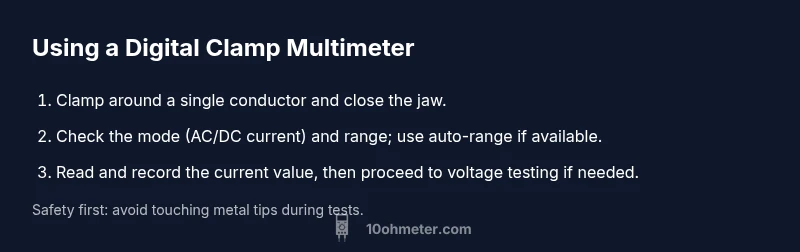
If measuring current, decide on AC or DC mode. Use auto-range if available, or set an appropriate high range to avoid saturating the reading. Stabilize the meter after switching modes before recording.
Tip: If you’re unsure of the expected current, start with a high range and step down as readings settle. - 3
Clamp around a single conductor
Open the jaw and place it around only one conductor. Close the jaw completely to ensure an accurate magnetic coupling. Avoid including a bundle of wires, which can yield an averaged or incorrect value.
Tip: Ensure the conductor isn’t in contact with the jaw edges to prevent shorts. - 4
Read and record the current
Read the displayed current value and confirm the unit (A or mA). If the reading seems unstable, wait 1–2 seconds for it to settle and recheck.
Tip: If possible, take multiple readings and average them for reliability. - 5
Measure voltage with test leads
Switch to voltage mode and connect the probes across the component or circuit point. Ensure you’re within the meter’s voltage rating and that the circuit is safe to probe.
Tip: Use proper probe contact and avoid touching metal tips during measurements. - 6
Test resistance and continuity
Power down the circuit before measuring resistance. Place leads across the component to determine resistance or use the continuity mode to verify a circuit is closed.
Tip: A brief beep or display indicator confirms continuity; note resistance values against specs. - 7
Automotive testing basics
When testing a car electrical system, clamp the main supply wires and verify readings with engine running and off as needed. Check the battery, alternator, and ground paths, and compare values to service documentation.
Tip: Keep metal tools away from hot surfaces and moving parts; work in a well-ventilated area. - 8
Wrap up and maintain
Turn off the meter, detangle leads, and store in a protective case. Note any anomalies and plan follow-up tests if readings deviate from expected ranges.
Tip: Record baseline readings for future diagnostics.
Your Questions Answered
What is a digital clamp multimeter and what can it measure?
A digital clamp multimeter uses a hinged jaw to measure current by magnetic field interaction and can also test voltage, resistance, and continuity with test leads. It’s useful for electronics work and automotive diagnostics.
A clamp meter measures current without breaking the circuit and can also test voltage, resistance, and continuity.
Can I measure current without breaking the circuit?
Yes. Clamp around a single conductor to measure current without disconnecting the circuit. Do not clamp around multiple wires or around a live terminal where it’s unsafe.
Yes, you can clamp around a single conductor to measure current safely.
Are clamp meters safe for automotive testing?
Yes, with proper safety precautions. Keep hands and tools away from hot or moving parts, and follow the meter’s manual for automotive use, especially when the engine is running.
Clamp meters can be used for cars, but follow safety rules and the manual.
What is true RMS and why does it matter?
True RMS meters measure the effective value of non-sinusoidal waveforms, providing more accurate current and voltage readings in real-world circuits that are not pure sine waves.
True RMS gives accurate readings for non-sine waveforms.
How do I zero or calibrate a clamp meter?
Many meters auto-zero or require simple calibration checks using a known reference. Refer to the user manual for model-specific steps.
Some meters auto-zero; others need a reference check per the manual.
What limits should I observe when using a clamp meter?
Follow the meter’s current and voltage ranges, clamp around a single conductor, avoid magnetic interference, and never measure in hazardous environments without proper PPE.
Stick to the limits and use proper PPE in risky settings.
Watch Video
Key Takeaways
- Clamp around a single conductor for accuracy
- Use true RMS for non-sinusoidal signals
- Always follow safety protocols to avoid shocks
- Verify readings across multiple modes if in doubt
- Store and maintain leads and the meter for longevity