How to Test a Capacitor with a Multimeter
Learn how to test a capacitor with a multimeter safely and effectively. This guide covers capacitor types, meter settings, and practical steps for accurate results in electronics and automotive tasks. Includes safety tips, interpretation of readings, and common fault signs.


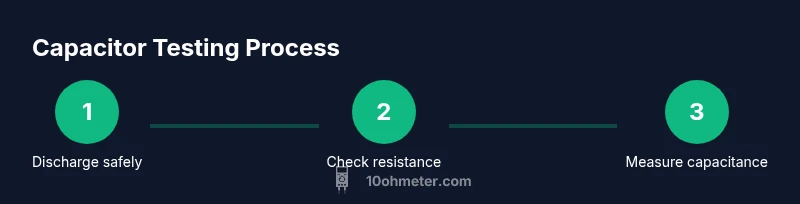
Yes—testing a capacitor with a multimeter is doable. Safely discharge the part, check for a short with resistance mode, and measure capacitance only if your meter has a capacitance function. If leakage is suspected, verify behavior out-of-circuit. See our detailed steps.
How to test a capacitor with a multimeter: what you’ll verify
Testing a capacitor with a multimeter is a practical skill for DIY electronics and automotive diagnostics. The process focuses on three core checks: short-circuit resistance to confirm the part isn’t internally grounded, capacitance measurement where the meter supports it to verify nominal value, and leakage or discharge behavior to gauge health over time. The 10ohmeter team emphasizes that results depend on capacitor type (ceramic, electrolytic, film) and circuit context. In many cases, you’ll perform these checks out of circuit to reduce interference, especially when measuring capacitance. Keep safety in mind and follow discharge procedures before handling any capacitor, especially high-voltage or large-value types.
Understanding why you test capacitors in the first place
Capacitors wear out from heat, voltage stress, and aging, which can alter their capacitance, increase leakage, or create short paths. By testing with a multimeter, you can identify obvious faults before they cause larger issues in a circuit. For in-vehicle electronics or home projects, a quick capacitance and resistance check helps you decide whether a component should be replaced or reworked. Remember that a capacitor can read close to its nominal value in-circuit even if it’s failing under load. Always compare against datasheet tolerances or the original specification to interpret readings accurately.
Safety and discharge: the foundation of reliable results
Discharging a capacitor is mandatory to avoid shocks or damaged equipment. Use a resistor with insulated leads (for example, 1 kΩ to 10 kΩ, 0.5–1 W) to bleed the charge safely. Never short the terminals with metal tools, which can cause sparks or damage the meter. When you work, wear eye protection and ensure your workspace is dry and free of conductive liquids. Before measuring, set the meter on the correct range and confirm the leads are in the right ports. Safe practice minimizes the risk of injury and protects your measurement integrity.
Meter options: resistance, capacitance, and ESR (if available)
A basic multimeter can measure resistance to check for shorts and continuity, while newer models may offer a dedicated capacitance mode. If your meter includes ESR or LCR functionality, you can extend testing to leakage and equivalent series resistance. When using capacitance mode, connect the leads across the capacitor after discharging and removing it from the circuit if necessary. If the capacitor is outside the meter’s measurable range or your meter lacks capacitance mode, you’ll need an external LCR meter or a bridge-style tester for more precise results. Remember to consult the meter’s manual for proper lead placement and safety warnings.
In-circuit vs. out-of-circuit testing: which approach to choose
Testing in circuit can reveal how a capacitor behaves within the full assembly, but parasitic components may skew readings. Out-of-circuit testing eliminates these variables and provides a cleaner capacitance value. When testing in circuit, isolate one leg of the capacitor carefully or lift a leg from a PCB to reduce interaction with other components. Compare in-circuit results to out-of-circuit measurements to distinguish component fault from circuit influence. If you see large deviations between the two, plan for removal and a more controlled test.
Interpreting readings: healthy vs. failing capacitors
A healthy capacitor typically shows a stable capacitance value within tolerance and does not sag excessively when a voltage is applied briefly (in a controlled test). A reading of near-zero resistance indicates a short; infinite resistance suggests an open circuit. A capacitance value far from the nominal rating or large leakage current on discharge are signs of degradation. Electrolytic capacitors may show polarity-marked resilience, but leaking or bulging bodies are clear failure indicators. Use datasheet tolerances as your guide and look for sudden changes after repeated tests.
Practical workflow for your toolbox: quick reference steps
- Discharge safely with a resistor and confirm no residual charge. - If measuring capacitance, use capacitance mode or a dedicated LCR meter. - Check resistance to detect a short; note any sudden drops or near-zero values. - Lift one leg if testing in-circuit to reduce interference. - Compare measurements to datasheet tolerances and note any deviations for replacement decisions. - Document results with date, part value, and circuit context for future maintenance. This practical workflow keeps testing repeatable and reliable.
Tools & Materials
- Digital multimeter with capacitance mode(Capacitance range appropriate for expected values (e.g., 1 nF to 100 μF).)
- Alligator leads and test probes(Insulated, rated for your meter’s voltage and current.)
- Discharge tool or resistor(1 kΩ–10 kΩ, 0.5–1 W, used for safe discharge.)
- Insulating gloves and safety glasses(Especially when testing electrolytics or high-voltage circuits.)
- Small screwdriver set (insulated)(For disconnecting components or lifting a leg on a PCB.)
- External LCR meter (optional)(Useful if your multimeter lacks capacitance or ESR testing.)
Steps
Estimated time: 20-40 minutes
- 1
Power down and discharge safely
Ensure the circuit is powered off. Use a resistor to discharge the capacitor by placing it across the leads for 5–30 seconds, depending on value. This prevents shocks and protects the meter from voltage surges.
Tip: Never short directly with a metal tool; it can cause sparks and damage the capacitor. - 2
Isolate the capacitor from the circuit
If possible, remove one lead of the capacitor from the circuit or lift a leg on the PCB to avoid parallel paths. This reduces interference from nearby components during measurement.
Tip: Mark the orientation of polarized capacitors before removal to avoid reversal on reassembly. - 3
Check for a short with resistance mode
Set the meter to the resistance/continuity range. Connect leads to the capacitor leads. A stable, low resistance indicates a short; a rising resistance towards infinity indicates an open. Note any unusual behavior.
Tip: Hold leads steady and avoid bending during measurement to prevent false readings. - 4
Measure capacitance if your meter supports it
Move to the capacitance mode and connect leads again. Read the value and compare with the capacitor’s nominal value and tolerance. If the value is wildly outside tolerance or unreads, the capacitor may be failed.
Tip: Ensure you’re within the meter’s capacitance range for accurate results. - 5
Optionally test ESR and leakage
If your meter has ESR or LCR features, test for leakage by measuring ESR and observing any drift in capacitance under small voltage. High ESR or rapid capacitance drop under test indicates degradation.
Tip: ESR readings are particularly important for electrolytics; normalize measurements for temperature. - 6
Document and interpret results
Record nominal value, measured capacitance, resistance, ESR (if available), and any circuit context. Compare against datasheet tolerances and decide on replacement or re-test.
Tip: Keep a consistent testing protocol for future maintenance checks.
Your Questions Answered
Can all multimeters test capacitance?
No. Only meters with a capacitance function or an external LCR meter can read capacitance directly. If your meter lacks this feature, you won’t see a reliable capacitance value and should use an LCR bridge for accurate results.
Not all multimeters have a capacitance function. Use a meter with that feature or an external LCR bridge for precise capacitance readings.
What does it mean if a capacitor tests as open?
An open result usually indicates the capacitor is damaged or has failed, showing infinite resistance and no measurable capacitance in most cases. Replacement is typically required.
An open test usually means the capacitor is damaged and should be replaced.
Why might readings vary when testing in circuit vs out of circuit?
In-circuit readings can be influenced by nearby components like resistors or other capacitors, giving skewed values. Removing a leg or testing out-of-circuit provides a cleaner, more accurate assessment.
In-circuit tests can be affected by other parts; test out-of-circuit for accuracy.
How should I discharge a capacitor safely?
Always discharge with a resistor across the leads, not a direct short. A resistor in the 1 kΩ–10 kΩ range allows a controlled bleed without causing arcing or damage.
Discharge safely with a resistor, not a direct short.
Can electrolytic capacitors be tested with a multimeter?
Yes, but readings are more limited and may be approximate. Discharge safely, test resistance for shorts, and use capacitance or ESR testing if available. Visual inspection for bulging or leaking is also important.
You can test electrolytics, but readings are approximate; inspect for signs of damage.
Watch Video
Key Takeaways
- Discharge safely before testing any capacitor.
- Use capacitance mode if your meter supports it; otherwise, use a trusted external meter.
- Differentiate between in-circuit and out-of-circuit results for accuracy.
- Interpret readings against datasheet tolerances and replace faulty parts.
- Document results for future maintenance and diagnostics.