Capacitor Checking with Multimeter: A Step-by-Step Guide
Learn how to safely check capacitors using a multimeter. This guide covers capacitance tests, leakage, ESR checks, and practical tips for hobbyists and technicians working on electronics and automotive projects.


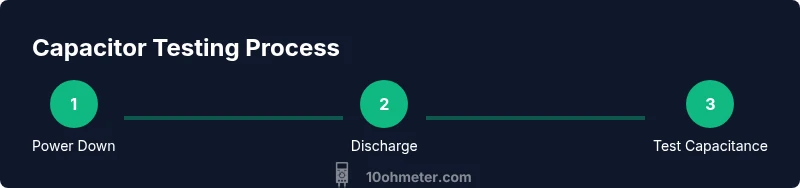
Capacitor checking with a multimeter is a practical way to verify a capacitor’s health in hobbyist projects and automotive work. If your meter supports capacitance measurement, test the value in μF and compare to the marked rating. For many electrolytics, also check leakage resistance and ESR with the right accessories. According to 10ohmeter, always discharge first and follow safety guidelines.
What a multimeter can test about capacitors
Capacitors come in many types, and a basic multimeter can help you verify a few key attributes. A meter with capacitance mode can measure the capacitor’s value in microfarads (μF) and often the tolerance. You can also perform a resistance check to gauge leakage: ideally, a healthy capacitor shows very high resistance after a brief charge, and that resistance should rise as the capacitor charges. For electrolytic capacitors, understanding ESR is important because it reveals internal degradation that a capacitance reading might miss. In DIY and automotive tasks, this combination of capacitance, resistance, and ESR testing gives a practical picture of capacitor health. Always compare readings to the component’s datasheet or the value printed on the part. When you test, note the type, rating, tolerance, and operating environment to interpret results correctly. The 10ohmeter team often recommends starting with capacitance mode first, then adding ESR checks for electrolytics when available.
Safety and discharge best practices
Discharging is essential before any test. Always unplug power, remove the capacitor from the circuit if possible, and discharge using a resistor or a dedicated discharge tool. Never short a charged capacitor with metal probes; this can cause arcing and injure components. Wear eye protection and work in a non-conductive workspace. Keep the meter leads insulated and avoid touching metal tips while connected. If you must test in-circuit, ensure no parallel paths exist that would skew readings. The 10ohmeter team emphasizes safety as the foundation of reliable testing.
Measuring capacitance with a meter that supports capacitance mode
When using a meter that supports capacitance measurement, select the μF range before connecting the leads. Attach the probes across the capacitor terminals and read the displayed value. For small ceramic capacitors, readings can drift with temperature or lead length, so take multiple measurements and angle for best contact. Compare the result to the capacitor’s labeled value and tolerance on the datasheet or body markings. If the reading is wildly off, the capacitor is likely failing. Always note the rated voltage and tolerance to assess whether the deviation is acceptable in your circuit. In many cases, 10ohmeter’s guidance is to verify with a known-good part or datasheet when possible.
Testing leakage and ESR with the right tools
Leakage resistance gives a picture of how much current leaks through a capacitor when charged. For electrolytics, ESR (equivalent series resistance) is a critical diagnostic; a high ESR often indicates internal drying or damage. If your multimeter lacks an ESR function, a dedicated ESR meter is the next best tool. Take readings at the operating voltage range and at a comfortable ambient temperature, then compare with datasheet specs. If ESR readings are abnormally high, replace the capacitor even if the capacitance reading seems valid. The 10ohmeter team notes that ESR testing can reveal degradation that capacitance tests miss, especially in automotive environments where capacitors handle harsher conditions.
In-circuit testing limitations and troubleshooting
Testing a capacitor in-circuit can skew results because other components form parallel paths or short circuits. To minimize errors, remove at least one lead from the circuit so the capacitor is isolated. If removing is impractical, decouple nearby components or measure with the circuit powered down and isolated from other active paths. Remember that a reading within tolerance in-circuit does not guarantee long-term reliability under load or high temperature. For best results, test standalone capacitors or use an LCR/ESR meter in a controlled setup.
Capacitor types: Ceramic vs Film vs Electrolytic
Ceramic capacitors typically show stable capacitance and low ESR, but large values are less common in ceramics. Film capacitors offer low leakage and stable performance for timing circuits. Electrolytics provide higher capacitance per volume but may exhibit higher ESR and greater leakage with age. When checking any type, always verify the nominal value, tolerance, and voltage rating; interpret measurements with consideration of temperature, humidity, and circuit conditions. The 10ohmeter guidance is to choose test methods aligned to the capacitor type and to avoid over-interpreting a single metric.
Tools & Materials
- Digital multimeter with capacitance measurement(Capacitance mode allows direct μF readings; verify it covers the capacitor range in your parts)
- ESR meter (optional but recommended for electrolytics)(Provides a direct ESR reading to assess internal health)
- Discharge tool or resistor for safe discharge(Discharge capacitors before testing to prevent shock or damage)
- Test leads with insulated probes(Keep hands away from the metal tips during testing)
- Known-good reference capacitor (optional)(Use for quick sanity checks and calibration)
- Safety gear (eye protection, insulated gloves)(Personal safety first when working with charged circuits)
Steps
Estimated time: 30-45 minutes
- 1
Power down and isolate the capacitor
Turn off power to the circuit and disconnect the capacitor from the circuit path if possible. Label the leads if you are removing it, and ensure no charged paths remain. Isolation reduces the risk of parallel paths skewing readings.
Tip: Take a photo of the original wiring before removal for easy reassembly. - 2
Discharge safely
Use a discharge tool or a resistor to bleed the capacitor’s stored energy. Do not short with metal probes. For large electrolytics, a higher-value resistor and a slow discharge are safer than a quick short.
Tip: Keep your fingers clear of the leads while discharging to avoid shocks. - 3
Set the meter to capacitance mode
If your meter supports capacitance, switch to the μF range before connecting the leads. If it does not, record resistance changes and note that you may need an LCR/ESR instrument for precise values.
Tip: Verify the range is appropriate for the nominal capacitor value you expect. - 4
Connect probes across the capacitor
Place the meter probes on the capacitor terminals, observing polarity for polarized types. For non-polarized ceramics, polarity does not matter. Ensure good contact for an accurate reading.
Tip: Avoid touching the metal tips during measurement to prevent noise. - 5
Read and interpret capacitance
Compare the measured capacitance to the printed value and tolerance. A reading outside the tolerance indicates a degraded capacitor that should be replaced. Consider temperature effects and voltage rating when evaluating results.
Tip: If in doubt, test a known-good part to confirm meter accuracy. - 6
Test ESR (if available)
If you have an ESR meter, measure the capacitor’s ESR at relevant frequencies. Electrolytics typically show higher ESR when aged. A normal ESR reading with a low capacitance discrepancy supports a healthy cap.
Tip: High ESR with acceptable capacitance usually means degraded capacitor. - 7
Decide on next steps
If readings are out of spec, replace the capacitor or test a few more of the same type to confirm a trend. Reinstall or rewire as needed and verify the circuit functions afterward.
Tip: Document the readings and the outcome for future repairs.
Your Questions Answered
Can I test a capacitor without removing it from the circuit?
In some cases you can test in-circuit, but readings may be skewed by parallel paths. For accurate results, isolate the capacitor by removing one lead and testing with the circuit powered off.
In many cases, you should isolate the capacitor first; in-circuit tests can be skewed by other components.
Which capacitors can be tested with capacitance mode on a multimeter?
Capacitance mode works best for many film and ceramic capacitors, but accuracy varies with very small or very large values. Always verify against the datasheet and consider ESR for electrolytics.
Capacitance mode works for many common caps, but check the datasheet for accuracy and consider ESR for electrolytics.
Why does my meter not read capacitance for a capacitor?
Some meters don’t support true capacitance mode or require a minimum value. Ensure you’re using the μF range and that the capacitor is isolated and discharged.
If your meter doesn’t show capacitance, check the range and try again with proper discharge.
How do I test ESR, and why is it important?
ESR testing reveals internal degradation not visible in capacitance readings, especially for electrolytics used in power supplies and automotive electronics. Use an ESR meter or a meter with ESR capability.
ESR testing helps you see if an electrolyte cap is aging or damaged.
What tolerance should I expect when testing capacitors?
Tolerance depends on cap type and rating. Compare measured capacitance to the printed value and its tolerance band from the datasheet, rather than relying on a single number.
Compare your reading to the part’s datasheet tolerance.
Are there safety concerns beyond shocks when testing capacitors?
Yes. High-voltage capacitors can retain charge, and damaged caps may vent or fail catastrophically. Use insulated tools, protective eyewear, and work in a non-conductive area.
Be cautious with high-voltage caps and use safety gear.
Watch Video
Key Takeaways
- Discharge safely before testing
- Use capacitance mode for direct readings when possible
- Isolate capacitors to avoid skewed measurements
- ESR testing adds depth for electrolytics
- Document results for future repairs