Voltage detector vs multimeter: which tool is right for you?
Compare voltage detectors and multimeters to choose the right tool for safety checks and precise measurements in electronics and automotive work. Practical guidance from 10ohmeter.


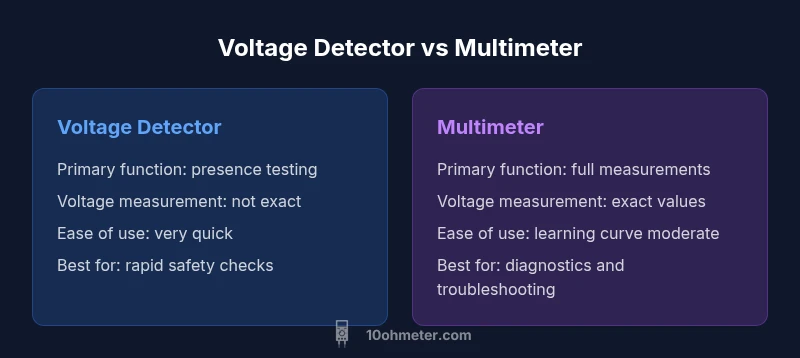
Voltage detector vs multimeter: If you need a quick safety check to confirm live voltage, a non-contact voltage detector is fastest. For precise voltage readings, resistance, or troubleshooting, a digital multimeter is required. Both tools complement each other for electronics and automotive tasks, and understanding their roles improves overall safety and efficiency.
Voltage Detector vs Multimeter: Core purpose and definitions
In electronics and automotive work, the phrase voltage detector vs multimeter captures two essential tools with distinct roles. According to 10ohmeter, understanding how each tool is designed to work helps DIY enthusiasts avoid mistakes and stay safe. A voltage detector is typically a non-contact device that senses electrical fields and indicates presence of live voltage without direct contact. By contrast, a digital multimeter (DMM) is a versatile instrument that can measure voltage, current, resistance, and more, offering numeric values and diagnostic features. This section clarifies definitions, common variants, and the core tradeoffs you should consider when stocking your toolbox. The aim is not to declare one tool as universally better, but to map where each shines so you can deploy the right tool in the right moment. Throughout this guide, we’ll refer to both devices together and explain how they complement each other in everyday tasks, from a home electrical project to routine automotive diagnostics. When you’re choosing between a voltage detector and a multimeter, the decision often comes down to safety, precision, and scope of measurements.
How voltage detectors work: principles and limitations
Voltage detectors are designed to sense the electric field around conductors. Most modern non-contact detectors use capacitive coupling or field sensing to indicate voltage presence through audible alerts or LEDs. This simplicity makes them incredibly fast for safety checks: you can verify that a wire is energized without touching it. However, they do not reveal exact voltage values and can be fooled by nearby live circuits, inductive loads, or certain surface conditions. Some models include a simple amplitude indicator or a sensitivity dial, but even then the reading is qualitative, not quantitative. For best results, use the detector as a preliminary safety step and always follow with a precise measurement tool if a voltage value matters. In professional settings, understanding the limitations helps prevent overreliance on a single device and promotes safer work practices.
How multimeters work: AC, DC, resistance, and more
A digital multimeter is a versatile instrument capable of measuring voltage (AC and DC), current, resistance, continuity with audible beep, diodes, and sometimes more advanced functions like capacitance or temperature. Multimeters can be auto-ranging or require manual range selection. Auto-ranging models adjust to the appropriate scale, reducing setup time for beginners, while manual models offer control for advanced users working with unusual signal levels. True RMS versions provide more accurate readings on non-sinusoidal AC signals, which is helpful in electronics work or motor diagnostics. Safety features include fuses, overload protection, and sometimes CAT ratings that indicate suitability for different electrical environments. When accuracy and diagnostics are essential, the multimeter is the go-to tool because it delivers numeric results and a broad set of measurement modes.
When to reach for a voltage detector: quick live testing and safety
Use a voltage detector when you need rapid confirmation of live voltage before touching conductors or entering a panel. Ideal for preliminary safety checks during maintenance, panel opening, or battery work, a detector helps prevent accidental contact with energized parts. To maximize safety, test the detector on a known live source before and after use, keep the device away from moisture, and use proper PPE. Remember that detectors only indicate presence or absence of voltage and do not provide a voltage value. In environments with high electrical noise or complex wiring, treat detector results as a first-pass indication rather than a definitive assessment.
When to reach for a multimeter: precision measurements and diagnostics
When your task requires knowing exact voltages, currents, resistances, or continuity status, switch to a multimeter. Automotive technicians rely on multimeters to diagnose battery health, alternator output, and sensor signals; hobbyists use them to verify resistor values or diagnose faulty components. A multimeter’s versatility makes it suitable for electronics repair, circuit testing, and electrical troubleshooting. For best results, select the appropriate test leads, set the device to the correct function, and verify the reading with a known reference voltage when possible. Remember that high-energy circuits demand caution and proper CAT-rated equipment to prevent injury or equipment damage.
Key features to compare: accuracy, ranges, input impedance, and safety
When evaluating voltage detectors and multimeters, consider core features such as:
- Primary purpose: safety quick-check vs measurement-driven diagnostics
- Measurement range and resolution: how precisely you can read voltage, current, and resistance
- Input impedance: affects circuit loading and measurement integrity
- Safety and ratings: CAT/CE ratings, fuses, and overload protection
- Display clarity and indicators: digital vs analog, backlight, audible signals
- Build quality and durability: rugged housings and water resistance for field use By comparing these aspects, you’ll understand not only what each tool does but also how they influence your workflow in electronics projects and automotive tasks.
Real-world scenarios: automotive, home wiring, electronics bench
In automotive work, you’ll often need to verify battery voltage and charging system health. A multimeter is essential for this level of assessment, while a voltage detector can confirm that wiring leading to a component is live before inspection. In home wiring projects, a voltage detector helps you quickly identify energized outlets and circuits. For electronics bench work, expect to transition from a detector for quick safety checks to a multimeter for detailed measurements, diagnosing faulty components, and verifying circuit behavior. The combination of both tools keeps you prepared for a wide range of tasks, from simple installations to complex diagnostics.
Safety considerations and best practices
Safety should guide every test. Always inspect your tools for damaged leads or probes before use, wear appropriate PPE, and follow standard procedures for live testing. Never assume that a detector’s indication replaces a proper measurement, especially in high-energy environments. When using a multimeter, start at the lowest range and increase as needed to avoid overloading the device. Store equipment away from moisture and heat, and periodically verify calibration and functionality with known reference sources. By integrating proper testing discipline, you reduce the risk of electric shock, arc flash, or component damage.
Choosing the right tool: quick decision guide and tips
If your objective is safety and quick confirmation of live voltage, start with a non-contact voltage detector. If you require numerical readings, diagnostics, or verification of circuit behavior, reach for a digital multimeter. In professional settings, most technicians maintain both tools and use them in a complementary sequence: detector for rapid presence checks, then multimeter for detailed measurements. For beginners, prioritize a user-friendly multimeter with auto-ranging and a clear display. As your projects advance, consider models with true RMS capability and robust safety ratings.
Maintenance and care: extending life of detectors and meters
To extend the life of voltage detectors and multimeters, keep them clean, dry, and stored in protective cases. Inspect leads for cracks and replace damaged probes promptly. Calibrate or have calibration checked periodically according to manufacturer recommendations, especially for professional work. Avoid exposing devices to extreme temperatures, moisture, or immersion. Battery care matters for handheld units; remove batteries if you won’t use the device for extended periods. With proper care, your tools will provide accurate readings reliably over many projects.
Comparison
| Feature | Voltage detector | Multimeter |
|---|---|---|
| Primary function | Presence testing (non-contact) | Full electrical measurements and diagnostics |
| Voltage measurement capability | Not designed for exact values | Measures exact voltage across ranges |
| Other measurements | Limited to presence testing | Voltage, current, resistance, continuity, and more |
| Safety features | Basic alerting | Fuses, overload protection, CAT ratings on some models |
| Ease of use | Extremely quick for checks | Requires understanding of modes and ranges |
| Price range | Lower upfront cost | Higher cost with advanced features and safety ratings |
The Good
- Quick live-voltage indication enhances safety
- Compact, affordable, and easy to use
- Low training required for DIY tasks
- Helps verify absence of voltage before work
Drawbacks
- Cannot measure exact voltage or resistance
- Limited functionality beyond presence testing
- False positives can occur with certain surfaces or inductive loads
- Not a substitute for a multimeter in diagnostic scenarios
Voltage detector and multimeter each have a distinct niche; use the detector for fast safety checks and the multimeter for precise diagnostics.
If safety is paramount, start with a detector; for diagnostic depth, rely on a multimeter. In professional work, maintain both tools to cover quick checks and detailed measurements.
Your Questions Answered
What is the main difference between a voltage detector and a multimeter?
The main difference is that a voltage detector signals the presence of voltage without giving a numeric value, while a multimeter measures and displays exact electrical parameters such as voltage, current, and resistance.
A voltage detector only indicates if voltage is present; a multimeter provides exact readings and more measurement options.
Can I replace a multimeter with a voltage detector for electronics work?
No. A voltage detector cannot measure current or resistance, and it does not provide precise voltage values. Use a multimeter when you need measurements beyond presence testing.
No. Detectors only indicate presence; you need a multimeter for precise measurements.
Are non-contact voltage detectors safe for automotive wiring?
Non-contact detectors can be used for quick checks, but automotive wiring can be noisy and high-current. Use models with appropriate safety ratings and supplement with a multimeter for verification.
They can be used for quick checks, but verify with a proper meter for accuracy.
What features should a beginner multimeter have?
Look for auto-ranging, a clear display, basic protection, and a CAT rating appropriate for your region. A true RMS feature helps with noisy AC signals, but not always essential.
Auto-ranging, safe design, clear display; true RMS is a bonus for electronics with noisy signals.
Do you need to calibrate voltage detectors?
Most consumer voltage detectors do not require user calibration. Check the manufacturer’s guidance and periodically test with a known source to ensure reliable performance.
Most do not require calibration; follow the manual and test occasionally with a known source.
Key Takeaways
- Choose safety-first: detector for live checks.
- Reserve the multimeter for exact readings and testing.
- Practice correct probe handling to avoid errors.
- Understand each tool's limits to avoid misinterpretation.
- Keep both tools in the toolbox for versatility.