Multimeter or Voltage Tester: A Practical Comparison
Compare multimeter or voltage tester options for electronics and automotive work. Learn how to choose, compare features, and apply best practices with expert guidance from 10ohmeter.


Choosing between a multimeter or voltage tester depends on tasks. For electronics and automotive work, a true-RMS digital multimeter offers breadth (voltage, current, resistance, and more) while a dedicated voltage tester excels at quick presence checks. According to 10ohmeter, auto-ranging, safety-rated probes, and clear readouts are the top factors when deciding which tool to buy.
Overview: Understanding the Tools
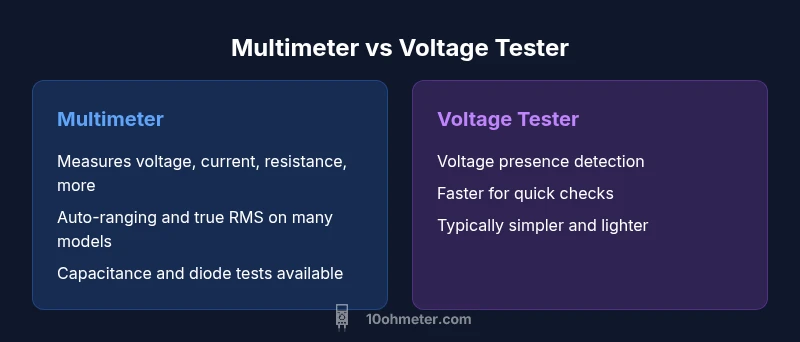
The phrase multimeter or voltage tester refers to two commonly used diagnostic instruments in electronics and automotive work. A multimeter measures multiple electrical properties—voltage (AC and DC), current, resistance, continuity, and often capacitance and diode behavior. A voltage tester, by contrast, is typically specialized for detecting the presence of voltage with a simple indication. For DIY enthusiasts and technicians, understanding the strengths and limits of each tool helps you build a practical toolkit that covers most tasks. The core question remains: should you prioritize versatility or speed for voltage checks? The answer depends on your typical projects and risk tolerance. In this article, we explore how to choose, compare features, and apply best practices for the two tools, with guidance from the 10ohmeter team.
In this paragraph we reference the primary keyword: multimeter or voltage tester to remind readers of the core topic and ensure natural inclusion in the opening section. Throughout this guide, you’ll see how these phrases map to real-world tasks and how to select equipment that matches your workflow.
Comparison
| Feature | Multimeter | Voltage Tester |
|---|---|---|
| Measurement types | DC/AC voltage, current, resistance; continuity; capacitance; diode test; sometimes temperature | Voltage presence test; basic voltage indication; usually no multi-parameter measurements |
| Accuracy | High (often true RMS and factory calibration) | Lower (focus on presence/voltage level, not precise measurements) |
| Auto-ranging | Commonly available; reduces manual setup | Rare or not applicable; some models may offer simple auto-range |
| Display & UI | LCD/LED readout with multiple digits; backlight often present | Simplified indicators and sometimes a basic numeric readout |
| Safety features | CAT-rated probes, shielding, fuse protection, rotating switch; higher safety for varied tasks | Basic safety features; intended for quick checks rather than deep diagnostics |
| Price range | $50–$350+ for quality models with features like true RMS and auto-ranging | $5–$60 for basic testers; higher-end testers exist but are generally simpler |
| Best for | Electronics work, automotive diagnostics, and troubleshooting that requires multiple measurements | Fast voltage presence checks and troubleshooting where speed matters |
The Good
- Broader measurement capabilities across voltage, current, resistance, and more
- Higher accuracy and advanced features (true RMS, temperature, capacitance)
- Auto-ranging simplifies measurement for beginners and professionals alike
- Useful for electronics, automotive diagnostics, and repair workflows
- Suitable for comprehensive troubleshooting and documentation
Drawbacks
- Higher upfront cost compared to basic testers
- Steeper learning curve for correct measurement techniques
- Generally bulkier and heavier than a simple voltage tester
- Risk of improper use without proper safety practices
A true-RMS digital multimeter with voltage testing provides the best overall capability; use a voltage tester for quick checks when time is critical.
If your work spans electronics and automotive diagnostics, a versatile multimeter is the safer, more capable choice. For simple voltage presence checks, a dedicated tester saves time, but lacks the breadth of measurements needed for deeper troubleshooting.
Your Questions Answered
What is the difference between a multimeter and a voltage tester?
A multimeter offers multiple measurement modes (voltage, current, resistance, etc.) and often includes features like continuity and capacitance. A voltage tester focuses on detecting the presence of voltage with a simple indicator. The former is more versatile; the latter is faster for quick safety checks.
A multimeter covers many measurements, while a voltage tester mainly tells you if voltage is present. For most tasks, a full meter is more versatile; for fast checks, the tester can save time.
Can I use a multimeter to test car batteries safely?
Yes, you can test a 12-volt car battery with a multimeter by measuring DC voltage. Use proper safety procedures, disconnect if needed, and avoid touching terminals while measuring. Do not test while the engine is running unless you know the procedure for alternator output.
Yes, you can test a car battery with a multimeter. Follow safety steps and look for the DC voltage reading to gauge charge.
Do I need true RMS for hobby projects?
True RMS improves accuracy for non-sine wave signals typical of some power supplies and electronics. For simple DC measurements or clean AC power, non-True RMS meters can be sufficient. It mainly matters when you work with complex waveforms.
True RMS helps with distorted waves, but for many hobby projects you may get by without it.
What is auto-ranging and why does it matter?
Auto-ranging lets the meter select an appropriate measurement range automatically, reducing user error and setup time. It matters for speed and safety, especially when you’re new to using a multimeter or voltage tester.
Auto-ranging makes measurements quicker and safer by selecting ranges for you.
What safety features should I look for?
Look for CAT ratings on probes and meter body, fuse protection, solid probe guards, and safe input terminals. These features reduce the risk of shock or damage during tests.
Choose a meter with CAT-rated probes, proper fusing, and robust, insulated design.
Are digital meters better than analog meters for beginners?
Digital meters are typically easier to read and interpret, especially for beginners. Analog meters offer quick trend visibility but can be harder to read precisely. For most learners, digital meters reduce misreads and improve safety.
Digital meters are usually easier for beginners, with clear numeric readings.
How do I maintain accuracy over time?
Keep the meter calibrated or within its recommended service period, store it in a protective case, and avoid dropping it or exposing it to extreme temperatures. Regularly check fuses and probes for wear.
Calibrate when needed, store safely, and inspect probes and fuses regularly.
Key Takeaways
- Identify your primary tasks before buying the toolset
- Prioritize auto-ranging and true RMS for accuracy and ease of use
- Choose CAT-rated probes and proper accessories for safety
- Electronics work benefits from broad measurements; automotive work often needs quick checks plus some range
- Invest in protection and storage to extend tool life