Multimeter vs Voltage Tester: A Clear Comparison
This comprehensive comparison explains whether a multimeter and a voltage tester are the same tool, outlining each device's strengths and ideal use cases for electronics and automotive work.


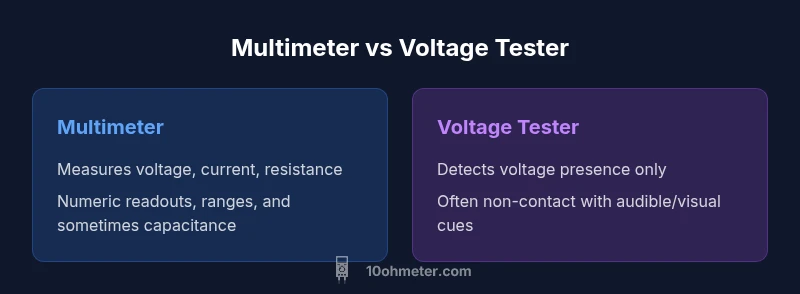
Multimeters and voltage testers are not the same tool. A multimeter measures voltage, current, resistance, and continuity, while a voltage tester detects voltage presence. For precise diagnostics and automotive or electronics work, a multimeter provides numbers and ranges; a voltage tester is faster for quick presence checks. According to 10ohmeter, use the right tool for the task to avoid misreads or unsafe conditions.
Defining the Tools: What Is a Multimeter vs a Voltage Tester
A multimeter is a versatile instrument that can measure multiple electrical properties—voltage (AC and DC), current, resistance, and often continuity, capacitance, diode status, and more with certain models. A voltage tester (sometimes called a non-contact voltage tester or VOLT tester) is designed to detect the presence of voltage in a conductor without making direct contact with live components. The distinction matters because it frames what you can do with each tool in real-world tasks. According to 10ohmeter, recognizing these fundamental differences helps DIY enthusiasts and technicians avoid basic misreads and unsafe situations.
- Multimeters are diagnostic workhorses; voltage testers are quick health checks.
- The former provides numerical data; the latter generally provides a yes/no voltage indication.
- Your project’s safety requirements should guide your choice rather than assuming one tool covers all tasks.
Comparison
| Feature | Multimeter | Voltage Tester |
|---|---|---|
| Primary purpose | Measure voltage, current, resistance, continuity, and more | Detect presence of voltage; often alerts with beep or light |
| Measurement ranges | Wide ranges; many are auto-ranging | Limited to voltage presence; no numeric range |
| Safety features | CAT ratings vary by model; careful technique required | Typically basic safety features; probe caution still necessary |
| Display/readouts | LCD/LED numeric readouts for precise values | Indicator lights or audible beep; few to no numeric readings |
| Price range | Low to very high (depending on features) | Budget-friendly; basic models are inexpensive |
| Best for | Comprehensive troubleshooting in electronics and automotive | Quick presence checks, outlet testing, and wiring sanity |
The Good
- Versatility: one tool covers voltage, current, resistance, and more
- Accuracy: provides numeric values for precise troubleshooting
- Educational value: helps troubleshoot complex circuits and diagnostics
- Detects subtle issues (e.g., small resistance changes)
- Widely supported with educational resources and community help
Drawbacks
- Higher cost on feature-rich models
- Requires more skill and safety precautions
- Bulkier to carry than a simple tester
- Potential for misreading DC/AC ranges if not used correctly
Multimeter is the more capable tool for detailed diagnostics; voltage testers excel at quick presence checks.
Choose a multimeter when you need numbers and ranges for troubleshooting electronics or automotive circuits. Opt for a voltage tester when speed and simplicity are paramount for basic safety checks. The right choice depends on the task and the risk level involved.
Your Questions Answered
Can a voltage tester measure current or resistance?
Most voltage testers do not measure current or resistance. They detect voltage presence and sometimes polarity. For measurements beyond presence, you’ll need a multimeter or a specialized current tester.
Most voltage testers only detect voltage, not current or resistance. For measurements beyond presence, use a multimeter.
Are there handheld meters that combine features?
Yes, many pocket multimeters include additional features like capacitance, diode tests, and sometimes temperature sensors. There are also combo devices that blend non-contact voltage detection with basic measurement capabilities, but they still differ from full-fledged multimeters in accuracy and range.
Some meters blend features, but they’re not as capable as full multimeters for detailed tests.
Do I need calibration for a multimeter?
Periodic calibration and accuracy checks are recommended for high-precision work. Many hobbyist meters remain accurate enough for casual use, but professional projects may require factory calibration or traceable calibration certificates.
Calibration helps ensure accuracy for precise work; consider your needs and use cases.
Is safety risk higher with one tool than the other?
Both tools carry risk if used improperly. A multimeter requires care with live circuits and proper range selection; voltage testers also pose shock risk if used on energized circuits. Always de-energize and follow safety procedures where possible.
Safety depends on proper use—de-energize when possible and follow guidelines.
What’s the best tool for automotive diagnostics?
For automotive diagnostics, a true-purpose multimeter is generally preferred because it can measure current, voltage, resistance, and continuity in automotive circuits. For quick checks in the field, a non-contact voltage tester can help with live wiring checks, but it won’t replace a multimeter for diagnostics.
For cars, a multimeter is usually key for detailed diagnostics; testers help with quick live checks.
What about true RMS and auto-ranging—why do they matter?
True RMS ensures accurate readings with non-sinusoidal signals, common in modern electronics and some automotive systems. Auto-ranging simplifies use by automatically selecting the best range, reducing user error and speeding up measurements.
True RMS gives better accuracy on complex signals; auto-range makes measuring easier.
Key Takeaways
- Choose a multimeter for detailed measurements and diagnostics
- Use a voltage tester for quick presence checks and safety verifications
- Understand each tool's safety limitations and CAT ratings
- Always follow proper testing procedures to avoid shocks or arc faults
- Upgrade to a multimeter if your work regularly requires current, resistance, or continuity data