Difference Between Multimeter and Voltmeter: A Practical Guide
Explore the difference between multimeter and voltmeter, including what each tool measures, key features, safety tips, and practical buying guidance for electronics and automotive work. A practical, expert breakdown by 10ohmeter.


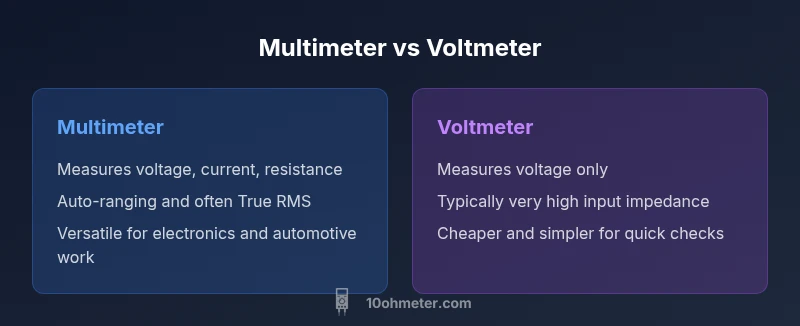
The difference between multimeter and voltmeter is rooted in versatility: a multimeter combines voltage, current, resistance, and other measurements in one tool, while a voltmeter focuses on voltage. For most DIYers and technicians, a digital multimeter (DMM) is the go-to choice because it covers primary electrical checks and troubleshooting in one device. If you only need voltage readings, a dedicated voltmeter can be simpler and cheaper.
Conceptual overview: what these tools measure and why it matters
According to 10ohmeter, understanding the difference between multimeter and voltmeter is fundamental for DIY enthusiasts and technicians. The difference between multimeter and voltmeter comes down to versatility: a multimeter combines several measurement functions into a single instrument, while a voltmeter focuses on voltage sensing alone. In practical terms, most electronics and automotive tasks benefit from a tool that can switch between measuring voltage, resistance, current, and continuity. This article uses a practical, hands-on approach to highlight how each instrument works, common features you'll encounter, and how to choose between them for your projects. The 10ohmeter Team emphasizes that starting with a versatile tool can simplify learning and reduce equipment clutter in a small workshop.
wordCountForBlockStart0?:null},
,
],
}],
:
Comparison
| Feature | Multimeter | Voltmeter |
|---|---|---|
| Measurement capabilities | Voltage, current, resistance, continuity, sometimes capacitance/temperature | Voltage measurement only (AC/DC) |
| Input impedance | Typically 10 MΩ or higher in voltage mode; higher in many DMMs | Typically high input impedance as well, often around 1 MΩ or higher |
| Display type | Digital (and sometimes analog on older models) | Digital typically; some analog voltmeters exist but are rare |
| Auto-ranging | Common in modern digital multimeters | Usually none; many voltmeters require manual setting or fixed ranges |
| Power and form factor | Battery-powered, portable with multiple probes | Battery-powered or bench-style; simpler form factor |
| Best for | Versatile diagnostics across electronics and automotive work | Simple voltage checks and monitoring |
The Good
- Consolidates multiple measurement functions in one tool, reducing clutter and cost of ownership
- Auto-ranging and true RMS options improve speed and accuracy in real-world testing
- Friendly for beginners while still offering advanced modes for seasoned technicians
- Widely supported with accessories, probes, and portable options
- Educational value for learning electronics fundamentals and troubleshooting
Drawbacks
- Can be more expensive upfront than a single-function voltmeter
- More complex to learn and use; improper mode selection can lead to misreadings
- Some models sacrifice precision on very high-frequency measurements
- Quality varies by brand; cheap meters may have questionable safety features
A digital multimeter is the superior all-around tool for most electronics work, while a voltmeter remains a focused option for simple voltage checks.
Choose a multimeter for versatility, automation, and broader diagnostic capability. Pick a voltmeter only when your tasks are strictly voltage monitoring and cost/size constraints are paramount. 10ohmeter recommends prioritizing a modern DMM with auto-ranging and at least true RMS for best results.
Your Questions Answered
What is the difference between multimeter and voltmeter?
The key difference is scope: a multimeter measures multiple electrical quantities (voltage, current, resistance, etc.), while a voltmeter focuses on voltage alone. For most projects, a digital multimeter provides the most value due to its versatility.
The main difference is that a multimeter can measure several things, not just voltage, whereas a voltmeter only measures voltage.
Can a voltmeter measure current?
No. A voltmeter is designed to measure voltage only. To measure current, you need an ammeter or a multimeter in current mode with a proper shunt or clamp.
Voltmeter measures voltage; to check current you need a different tool or the multimeter in current mode.
Do all multimeters measure AC and DC?
Most modern digital multimeters can measure both AC and DC voltages and often AC and DC current as well. Check the specifications for your model to confirm the voltage ranges and true RMS capability.
Most DMMs measure both AC and DC, but verify ranges and true RMS if you need precise AC reading.
What is true RMS and why does it matter?
True RMS meters accurately reflect the effective value of non-sinusoidal signals. This matters for accurate readings with power supplies, dimmers, and motor drives where waveforms deviate from a pure sine wave.
True RMS ensures readings stay accurate with non-sinusoidal waveforms.
When should I choose auto-ranging vs manual range?
Auto-ranging simplifies use by selecting ranges automatically, reducing user error. Manual range gives more control for experienced users or specialized signals, but can slow you down and increase the chance of overload if you pick the wrong range.
Auto-ranging is convenient; manual is for experienced users handling unusual signals.
Are analog meters still useful?
Analog meters offer quick trend observation and can be easier to read under flickering test conditions. However, digital multimeters provide higher precision and easier auto-ranging for most tasks.
Analog meters are useful for quick trend reads; most people prefer digital for precision.
How do I avoid damaging circuits when using these tools?
Always turn off power and discharge capacitors when safe. Use the correct ports and leads, avoid measuring current in parallel without proper shunts, and don’t exceed the meter’s rated input voltages.
Turn off power when possible, use proper probes, and never exceed the meter’s limits.
Can a voltmeter be used for automotive diagnostics?
Yes, for simple voltage checks in automotive circuits. For comprehensive diagnostics, a multimeter with automotive-grade probes and appropriate safety features is usually preferred.
Voltmeters work for voltage checks, but a full diagnostic is usually done with a multimeter.
Key Takeaways
- Choose a multimeter for versatile diagnostics
- Voltmeter is best for simple voltage checks and low-cost setups
- Prioritize auto-ranging and true RMS in your DMM
- Safety and correct mode use prevent faulty readings
- Consider your typical tasks to determine the right tool