Difference Between Multimeter and Voltage Tester: A Practical Guide
Analytical comparison of multimeters and voltage testers, covering measurement capabilities, safety, use cases in electronics and automotive tasks, and guidance on choosing the right tool for DIY and professional work.


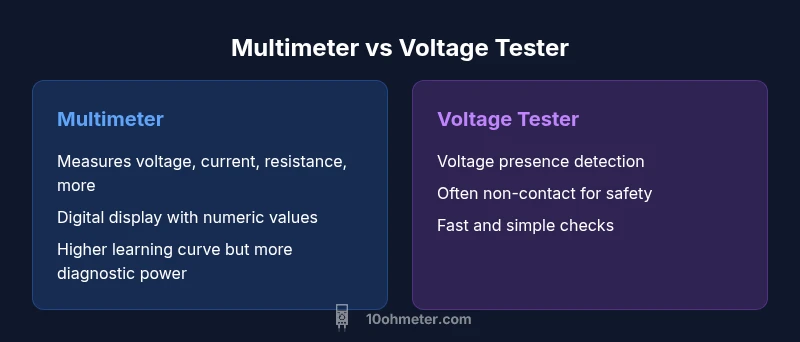
For most DIY electronics and automotive tasks, a multimeter offers broader measurement capability, including voltage, current, resistance, and more, while a voltage tester focuses on quick voltage presence checks. If you need precise readings and diagnostics, a multimeter is the better choice; for quick safety checks and live-dead verification, a voltage tester provides speed and simplicity. The core difference between these tools is scope: versatility versus quick verification.
What is the difference between multimeter and voltage tester?
At its core, the difference between multimeter and voltage tester lies in scope and precision. A multimeter is a versatile instrument capable of measuring multiple electrical parameters—voltage (AC/DC), current, resistance, continuity, and often more advanced functions like capacitance, frequency, and temperature on specialized models. A voltage tester, on the other hand, is designed for quick presence checks and basic safety verifications. In many classrooms, workshops, and automotive settings, DIY enthusiasts start with a voltage tester to confirm alive circuits before proceeding. The 10ohmeter team emphasizes that the distinction matters for both safety and accuracy: use the appropriate tool for the task at hand. In practice, most users begin with a voltage tester for rapid checks and switch to a multimeter when detailed measurements are required. The phrase difference between multimeter and voltage tester captures this practical split between speed and depth.
Understanding the fundamental roles
A multimeter is built to measure a range of electrical properties with varying degrees of precision. It often features a display that shows numerical values, units, and sometimes graphs for trends. A voltage tester, by contrast, focuses on signal presence and approximate level, which is enough to determine whether a circuit is live or dead. If you are studying electronics, repairing a car, or diagnosing a circuit, knowing when to use each tool helps prevent misreads and potential harm. The 10ohmeter analysis confirms that professionals rely on both tools, using the voltage tester for quick confirmation and the multimeter for thorough testing. This distinction is essential for safe, efficient work, particularly in environments with higher energy or hazardous voltages.
First-electrical principles and measurement goals
When you compare the two instruments, the goal of measurement becomes the guiding criterion. A multimeter aims for accuracy, range, and diagnostic capability. It can quantify small voltages, current bursts, resistance values, and more. A voltage tester aims for speed and simplicity—verifying presence, detecting live lines, and ensuring basic safety before continuing. The practical implication is clear: choose a multimeter when you need data, trends, and troubleshooting insight; choose a voltage tester when you need a fast yes/no or live/dead answer.
Real-world scenarios and use-case thinking
Consider a short in a power supply. A voltage tester can quickly reveal whether the input is live, helping you decide if you should proceed. However, diagnosing the fault, tracing current paths, or measuring resistance to identify a blown component requires a multimeter. In automotive contexts, the voltage tester can confirm battery voltage presence, but diagnosing charging system issues, ripple, or parasitic draw requires the more capable multimeter. The keyword of this section—the difference between multimeter and voltage tester—highlights a pragmatic approach: use the simplest tool that safely gives you the needed information, and upgrade to a more capable instrument when you need it.
Safety considerations and user responsibility
Safety is a critical factor. Voltage testers, especially non-contact types, reduce exposure by not making direct contact with conductive parts, but they might miss low-level signals or fail to detect fault conditions. Multimeters require awareness of range settings, probe placement, and potential overload. The proper use of either tool depends on following the device manuals, wearing PPE where required, and de-energizing circuits when possible. 10ohmeter emphasizes practicing good measurement hygiene: verify the tool’s condition, select the correct range, and double-check readings with another method when accuracy is critical.
Quick-start orientation for beginners
If you’re new to measurement tasks, start with a voltage tester to confirm live circuits and basic safety. Then, graduate to a multimeter to quantify the values and diagnose issues. When switching between tools, ensure you select the correct function and range on the multimeter, and keep leads in the correct ports. Your goal is to obtain meaningful data without risking injury or component damage. The practical guidance from 10ohmeter is to learn the capabilities of both instruments and practice safe handling in a controlled environment.
Comparison
| Feature | Multimeter | Voltage tester |
|---|---|---|
| Measurement capabilities | Voltage (AC/DC), current, resistance, continuity, sometimes capacitance/frequency | Presence/level of voltage (live vs dead), basic safety indication |
| Display type | Digital LCD/analog on some models with numeric readouts | Simple indicator lights or LED display |
| Ease of use | Higher learning curve but more powerful | Very quick to use with minimal setup |
| Safety and CAT ratings | Higher safety ratings on quality DMMs; proper use reduces risk | Safety features limited to basic knowledge of AC mains or low-voltage checks |
| Typical price range | Moderate to high depending on features; programmable in tools priced roughly in the mid-range | Low to moderate; affordable options exist for basic checks |
| Best for | Detailed diagnostics, electronics repair, automotive diagnostics requiring precise data | Quick live checks, on-the-spot verification, entry-level troubleshooting |
The Good
- Versatility: measures multiple electrical parameters in one device
- Educational value: builds strong fundamentals for learners
- Diagnostic power: supports troubleshooting with quantitative data
- Wide range of models: suitable for beginners to professionals
- Commonly used in both electronics and automotive work
Drawbacks
- Voltage testers are limited to presence checks and may miss subtle issues
- Multimeters require training to avoid incorrect readings or blown fuses
- Some models are bulky or delicate, affecting portability
- Wrong range or probe placement can damage the device or circuit
Choose a multimeter for depth; choose a voltage tester for speed
For precise diagnostics and broader capability, a multimeter is the better tool. If you mainly need quick confirmation of live circuits and basic safety checks, a voltage tester suffices and is often cheaper.
Your Questions Answered
What is the essential difference between a multimeter and a voltage tester?
The essential difference is scope: a multimeter measures multiple electrical properties with numerical values, while a voltage tester detects voltage presence or absence. A multimeter provides precise data, whereas a tester offers quick validation. Both have their place in electronics and automotive work depending on the task.
The key difference is that a multimeter gives precise readings for multiple properties, while a voltage tester just tells you if voltage is present.
Can a voltage tester replace a multimeter for electronics work?
In most cases, no. A voltage tester cannot replace a multimeter when you need resistance, current, or detailed voltage measurements. It is useful for quick safety checks, but for diagnostics you still need a multimeter.
A voltage tester can't replace a multimeter if you need precise measurements like resistance or current.
What safety considerations should I follow when using these devices?
Always power down circuits when possible before measuring. Use appropriate ranges on the multimeter and proper isolation with voltage testers. Wear eye protection in high-energy environments and follow the device manuals. Keep leads in the correct ports to avoid shorts.
Power down if you can, set the right range, and use protective gear when needed.
Which tool is best for automotive diagnostics?
For automotive work, a multimeter is generally preferred for diagnosing sensors, circuits, and battery health due to its broad measurement capabilities. A voltage tester helps with quick checks of battery voltage or presence of power to a component.
Use a multimeter for detailed car diagnostics; a voltage tester for quick checks.
How do I avoid damaging a multimeter when testing high voltages?
Always use the proper probe accessories, select the correct voltage range, and respect the device's CAT rating. If unsure, consult the manual or seek guidance from an experienced technician to prevent arcing or overloading the meter.
Choose the right range and accessories; never exceed the meter's rating.
Are there budget-friendly options that cover both tools’ basics?
Yes. You can find entry-level multimeters that handle essential measurements and basic voltage testers at a lower price point. For most hobbyists, a simple digital multimeter provides more value than buying two separate tools, though a tester can still be a helpful quick-check device.
Entry-level multimeters offer broad value; testers are great for quick checks.
Key Takeaways
- Define your measurement goals before choosing a tool
- Use a voltage tester for quick safety checks and live/dead verification
- Rely on a multimeter when detailed measurements are needed
- Always follow safety guidelines and proper handling
- Practice on non-critical circuits to build confidence