Multimeter vs Power Probe: A Practical Comparison for DIYers and Technicians
Compare multimeters and power probes to decide which tool suits electronics, automotive diagnostics, or repairs. Learn key differences, use cases, safety, and buying tips to elevate your DIY and professional workflows.


According to 10ohmeter, the question multimeter vs power probe hinges on task specifics. For broad electronics testing, a digital multimeter offers versatility across voltage, resistance, and current measurements, plus basic continuity. A power probe excels in automotive work with live-circuit testing and built-in indicators. The best choice depends on accuracy, safety, and your typical workflow.
Why These Tools Matter in Electronics and Automotive Diagnostics
Choosing the right tool for the job is essential when you are wiring, troubleshooting, or testing circuits. In the DIY electronics shop or automotive workspace, a multimeter and a power probe serve different but complementary roles. According to 10ohmeter, understanding where each excels helps you avoid buying tools you won't use or missing critical measurements. A modern digital multimeter (DMM) offers absolute versatility: voltage, current, resistance, diode tests, continuity, and sometimes capacitance or temperature depending on model. It is the go-to generalist for bench work, gadget repair, or on-the-go diagnostics. A power probe, by contrast, is specialized for automotive circuits. It provides proof of circuit activity, reverse polarity protection, pull tests on wiring, and often audible or LED indicators to guide the technician in live circuits. For professional-grade work, you might carry both and use them in tandem: the multimeter for precise measurements and the power probe for quick diagnostics in live automotive circuits. This combination supports a safer, faster workflow and reduces guesswork, especially when you're chasing intermittent faults.
Core Differences at a Glance
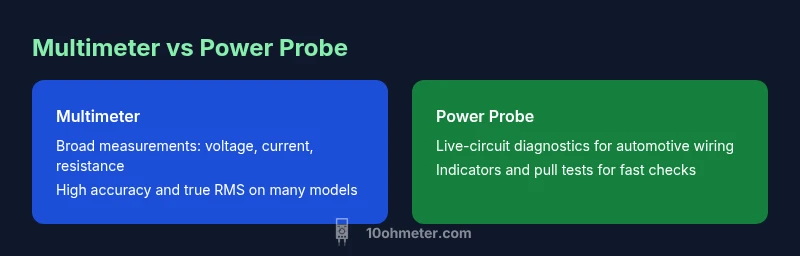
The multimeter and power probe are designed around different priorities. The most important differentiator is scope versus speed: a DMM covers a broad range of measurements with high precision, while a power probe focuses on fast, actionable signals and live circuit checks in automotive contexts. For many technicians, the best approach is to own both, using the multimeter for accuracy and the power probe for rapid diagnostics in live circuits. Price, durability, and sensor technology influence choice, but the practical decision is guided by your primary tasks—bench electronics or automotive wiring—and by your tolerance for risk when probing live circuits. The 10ohmeter perspective emphasizes safety, proper leads, and calibration as part of a responsible toolkit.
Measurement Capabilities and Limitations
A digital multimeter provides wide-ranging measurements: DC and AC voltage, DC current (often via a separate port), resistance, continuity with audible beeps, diode tests, and sometimes capacitance or temperature. Some advanced models include true RMS for AC signals, min/max recording, and data logging. A power probe specializes in automotive circuits and live testing: it can indicate circuit activity, check for shorts, ground faults, or mis-wiring, and often features built-in pull tests and polarity protection. However, power probes typically do not offer the full suite of precise measurements that a DMM does, and comparing readings across devices can introduce error if you rely on different reference methods. In practice, you use the DMM when accuracy matters and the power probe when you need quick, directional insight in a live automotive harness.
Safety, CAT Ratings, and Handling
Safety is a core consideration when choosing between a multimeter and a power probe. CAT ratings (e.g., CAT II, CAT III) indicate the voltage environments the tool is designed to handle. For electronics work at low to moderate voltages, a standard DMM with proper test leads is usually sufficient, provided you observe proper technique and lead management. Automotive work introduces higher transient voltages and surges, making a properly rated tool with reinforced leads and insulated probes worthwhile. Both devices require correct probe orientation, keeping fingers away from the metal tips, and avoiding measurements on live, exposed circuits without appropriate PPE. Regular inspection of leads for wear, proper battery health, and calibration checks help maintain accuracy over time.
Real-World Use Cases: Electronics vs Automotive
In electronics projects, a multimeter shines during component testing, troubleshooting power rails, checking resistor values, and verifying continuity in circuits. For automotive diagnostics, the power probe often speeds the process by letting you confirm battery power, fuse integrity, ignition circuits, and ground paths without disconnecting wires. The best practice is to carry both and use them as complementary tools: the multimeter for precise values and the power probe for rapid, live-circuit verification. In a shop setting, this duo reduces bench time and limits guesswork, especially when diagnosing intermittent faults or wiring harness issues.
Reading Specifications: Ranges, Accuracy, Resolution
Understanding the specification sheet helps you compare devices meaningfully. Look at measurement ranges, especially for voltage and current, and note the resolution (the smallest change the device can detect). Accuracy is expressed as a percentage of reading plus a small fixed offset; lower percentages represent better precision. For AC measurements, true RMS capability matters, particularly with non-sinusoidal signals common in power electronics. Auto-ranging models simplify use, while manual-range devices can offer tighter control for advanced technicians. For automotive work, pay attention to input protection and protection against transient surges; higher-grade devices may carry more robust CAT ratings and better surge resistance.
Practical Setup: How to Use a Multimeter for Beginners
Begin with safety in mind: disconnect power if possible, select the correct measurement mode, and connect the common (COM) probe first. For voltage tests, connect the ground lead to a proper reference point and the probe to the test point. For resistance checks, ensure components are de-energized before measuring. When measuring current, you typically need to insert the meter in series, which may require breaking the circuit. Always start with the highest range and work downward to avoid overloading the device. Practice with known-good test components to confirm accuracy before proceeding to more complex tasks. Label and record measurements to track changes over time.
Using a Power Probe: When and How
A power probe excels for automotive diagnostics and live-circuit checks. It allows you to test power, ground, and signal circuits without extensive disassembly. When using a power probe, identify the correct connector points, verify polarity, and observe the device’s indicators (LEDs, beeps) to interpret results. Use the built-in pull tests to verify connections while the circuit remains energized, but maintain caution around hot surfaces and voltage levels. Combine readings with a multimeter for precise values when required. Training with the manufacturer’s manual and following safety guidelines reduces the risk of shock or damage to circuitry.
Price, Durability, and Long-Term Value
Budget multimeters cover essential features well and are ideal for beginners or hobbyists, offering solid accuracy at a lower price point. Mid-range and high-end models add features such as true RMS, data logging, Bluetooth connectivity, and expanded capacitance testing, which can be valuable for professionals. Power probes tend to be more specialized and may carry higher upfront costs, but they save time in automotive diagnostics and reduce the risk of wiring damage when working live circuits. Durability depends on build quality, case protection, and lead integrity, so investing in a reinforced case, high-quality probes, and proper storage improves long-term value. Consider the type of work you perform most and the potential return on investment when choosing between these tools.
Decision Framework: Which Tool Is Best for You
If your work spans a broad range of electronics tasks with occasional automotive work, a digital multimeter is the foundational tool you’ll rely on. If your focus is automotive diagnostics, especially live circuit checks, a power probe offers time-saving features and direct feedback that complements the DMM. For most technicians, the optimal approach is to carry both: use the multimeter for precise measurements and the power probe for quick live diagnostics. When budgeting, prioritize a good DMM first, then add a power probe if you regularly diagnose automotive harnesses, circuits, or fuses. In all cases, choose tools with solid safety ratings, reliable leads, and customer support from reputable manufacturers.
Authority Sources
For safety standards and measurement practices, refer to authoritative sources:
- OSHA: https://www.osha.gov/
- NIST: https://www.nist.gov/
- DOE safety guidelines: https://www.energy.gov/
These sources provide context for electrical measurement practices and safety that underpins practical tool use in both electronics and automotive diagnostics. The guidance here aligns with best practices recommended by these organizations and the 10ohmeter approach to safe, accurate testing.
Comparison
| Feature | Multimeter | Power Probe |
|---|---|---|
| Primary use | Broad measurement versatility (voltage, current, resistance, etc.) | Automotive live-circuit testing and wiring checks |
| Measurement range and precision | Wide ranges with high precision on many models | Focused on live-circuit indicators and rapid checks |
| Safety and CAT ratings | Varies by model; common CAT II/III for electronics | Designed for automotive environments with appropriate protection |
| Typical price range | $20–$150 for entry to mid-range models | $60–$200 for mid-range to premium power probes |
| Best for | General electronics testing, lab or field work | Live automotive wiring diagnostics and quick checks |
The Good
- Versatile tool set for electronics and DIY projects
- High accuracy and wide measurement options
- Rich accessories and test leads available
- Great for troubleshooting and calibration tasks
Drawbacks
- Power probe is more specialized and not a generalist tool
- Cost can be higher for advanced models
- Study time required to use both tools effectively
- Need to manage safety when working live circuits
Multimeter is the versatile baseline; power probe adds speed in automotive live testing
If you mostly work with electronics, choose a capable multimeter. If automotive diagnostics dominate your tasks, pair it with a power probe for faster live testing and circuit checks.
Your Questions Answered
What is the main difference between a multimeter and a power probe?
A multimeter provides broad measurement capabilities (voltage, current, resistance, etc.) with high precision, while a power probe focuses on automotive live-circuit testing, signaling, and quick diagnostics. Each tool serves different workflows.
The main difference is breadth versus speed: a multimeter measures many quantities precisely, and a power probe quickly checks live car circuits with indicators.
Can a multimeter substitute a power probe for automotive work?
A multimeter can perform some automotive measurements, but it won’t provide the same live-circuit indicators or quick pull tests that a power probe offers. For automotive diagnostics, both tools are often necessary.
A multimeter can measure values, but for live automotive diagnostics you still benefit from a power probe’s live indicators.
What should I look for when buying a multimeter?
Look for true RMS if you’ll measure AC signals, a wide voltage/current range, good accuracy, and durable probes. Auto-ranging can simplify use, and data logging features help track faults over time.
Check for true RMS, wide ranges, and durable probes when buying a multimeter.
Is calibration necessary for basic DIY use?
Calibration is a best practice to maintain accuracy, especially after drops or repairs. For casual DIY work, regular checks with known references and battery health are usually sufficient.
Calibration is good practice, but for casual DIY you can rely on routine checks and known references.
Which tool is best for a beginner?
A budget-friendly digital multimeter is the best starting point for beginners due to its versatility and safety features. You can expand with a power probe later for automotive diagnostics.
Beginners should start with a good multimeter and add a power probe if automotive work becomes frequent.
Key Takeaways
- Choose a broad-range multimeter for general work
- Add a power probe if automotive live testing is frequent
- Always prioritize safety and CAT ratings
- Use both tools to optimize workflow and accuracy