Multimeter or Continuity Tester: Side-by-Side Guide
A detailed, objective comparison of a multimeter and a continuity tester for electronics and automotive tasks. Learn capabilities, use cases, buying criteria, and practical tips from the 10ohmeter team.


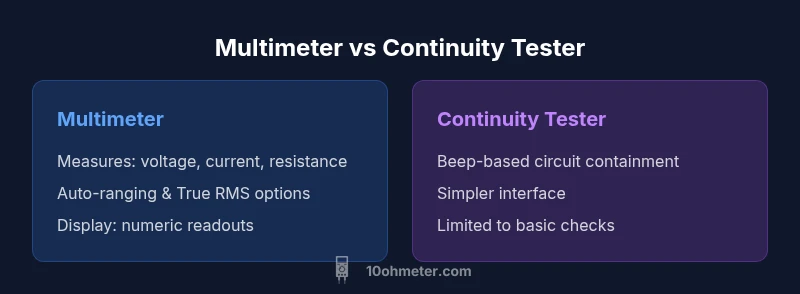
Choosing between a multimeter and a continuity tester depends on your tasks. A true multimeter covers voltage, current, resistance, and more, often including a continuity mode; a dedicated continuity tester excels at fast checks for wiring breaks. For most DIY electronics and automotive work, a capable multimeter is the more versatile choice.
Overview: Multimeter or Continuity Tester — What you really need to know
According to 10ohmeter, choosing between a multimeter or continuity tester hinges on the scope of your projects. Both tools measure electrical characteristics, but they shine in different situations. For electronics hobbyists and automotive technicians, understanding the strengths and limits of each instrument ensures you invest wisely and avoid wasted time on the bench. In this comparison, we examine the two tools side by side, focusing on core capabilities, use cases, and practical buying criteria. The aim is to equip you with actionable guidance: when to reach for a full-featured digital multimeter (DMM) that includes a continuity function, and when a dedicated continuity tester is a faster, more affordable option. We also cover safety, maintenance, and how to read results so you can interpret readings with confidence in real-world tasks. This analysis is grounded in practical testing scenarios and real-world use cases that DIY enthusiasts and technicians encounter daily.
Core measurement capabilities
A multimeter, by design, provides a broad suite of electrical measurements. You’ll typically find voltage (AC/DC), current (usually limited to small milliamp ranges for handheld meters), resistance, and often a dedicated continuity mode. Continuity testers, on the other hand, emphasize a simple pass/fail assessment with an audible beep when a circuit is complete. The distinction matters for response time on service calls or bench checks: a continuity tester can confirm wiring integrity quickly, whereas a multimeter offers the full numeric picture, including micro-ohm measurements and current draw. In this section, we’ll dissect what each tool can measure, how readings are sourced, and what those readings imply in practical repair scenarios. For electronics work, expect a multimeter to reveal subtleties that a simple tester cannot.
Digital vs analog interfaces: UX and readability
Modern tools favor digital displays with backlit readouts and auto-ranging, but there’s still value in a traditional analog display for quick trend observations. Digital multimeters (DMMs) commonly provide auto-ranging, which reduces the guesswork of selecting limits, and some models offer true RMS for accurate AC measurements on non-sinusoidal signals. Continuity testers, especially budget models, lean toward simple, rugged designs with large beeping indicators and oversized probes for ease of wiring checks. The user experience influences how often you perform checks and how confidently you interpret results under field conditions. In practice, a good DMM with a clear display and a bright continuity indicator often wins on versatility and speed of use.
Auto-ranging and true RMS: Why they matter
Auto-ranging saves time and reduces user error when testing a wide variety of signals. For professionals, auto-ranging translates to faster triage and less fiddling with scale selections. True RMS, meanwhile, matters when you’re measuring non-sinusoidal AC signals, common in modern electronics and automotive sensors. A continuity tester rarely offers true RMS, since its primary job is to determine whether a path exists. When you’re deciding which tool to buy, weigh the need for true RMS against the typical signals you encounter. In many hobbyist environments, a good auto-ranging DMM without true RMS can still be perfectly adequate, especially if the beep-based continuity function is reliable and loud enough for your workspace.
Safety and ratings: Keeping you protected on the job
Safety is not optional when dealing with live circuits. Look for CAT (category) ratings appropriate to your work environment, such as CAT II for household electronics and CAT III for panel-level inspections or automotive work. Ensure the meter has proper insulating probes, fuse protection for current ranges, and a robust input jack design. Battery reliability and probe quality also influence safety and accuracy. While continuity checks are generally low-risk, testing under higher voltages or in automotive environments requires a meter rated for those conditions. The right safety features and constructions help prevent common accidents, such as fuse blowouts and accidental short circuits during measurements.
Use-case snapshots: Electronics hobbyists vs automotive technicians
For electronics hobbyists, a mid-range DMM with auto-ranging, a true RMS option, and a steady continuity beep is often the best value. It supports breadboarding, sensor calibration, and quick fault isolation across digital circuits. Automotive technicians, meanwhile, benefit from a meter that can withstand harsher environments, handle higher DC currents, and offer automotive-specific features like battery testing and insulation resistance checks. In both cases, choosing tools with reliable probes, durable construction, and safe, accessible interfaces reduces testing time and increases confidence. 10ohmeter’s practical testing approach emphasizes tool versatility without sacrificing safety or durability.
Reading continuity beeps and resistance readings: Practical interpretation
Continuity beeps provide a fast yes/no answer about circuit integrity. Listen for a consistent beep as you test known good paths; a crackling or intermittent beep indicates weak or partial connections. When measuring resistance, small values (ohms) reveal how well a component or wire conducts, with lower numbers indicating better conduction. Always begin with a known-good reference path and then compare suspicious sections. Temperature, probe contact quality, and battery state can affect readings, so compensate by ensuring clean contact and fresh batteries. In field tasks, combining a digital multimeter’s numeric data with a continuity beep accelerates fault isolation and reduces guesswork.
Buying criteria: key specs to compare and why they matter
When shopping, start with the basics: volt/ohm range, current measurement capability, and the presence of a dedicated continuity function. Then evaluate advanced features: auto-ranging, true RMS, input impedance, display readability, and safety ratings. Probes, test leads, and included accessories often influence overall value more than price alone. Look for a model that balances accuracy, speed, and durability for your typical task mix. If you work in tight spaces or outdoors, rugged design, backlighting, and battery life become decisive factors. Finally, ensure the device is covered by a solid warranty and reliable customer support for long-term reliability.
Maintenance, calibration, and care: Keeping accuracy over time
Regular maintenance preserves precision. Keep probes clean and replace worn tips to maintain good contact. Calibrate periodically if your work requires tight tolerances; most hobbyist users won’t need lab-grade calibration, but occasional checks against a known reference can catch drift. Store meters in a dry, insulated case and protect them from heat and moisture. Battery health affects readings, so replace alkaline or rechargeable cells promptly. When you’re not using the meter, leave it off or in sleep mode to minimize battery drain. With proper care, a well-maintained multimeter, paired with a reliable continuity tester for quick checks, remains accurate for years.
Common mistakes and how to avoid them
The most frequent errors involve misreading ranges, using the wrong mode for a signal, or testing live circuits without proper safety precautions. Avoid measuring current by simply placing the meter in series without identifying the correct shunt range or fuse. Always inspect probes for damage before use, and never exceed the rated voltage or current of a port. For continuity tests, ensure you have a stable contact and avoid testing across batteries or power sources that could give misleading readings. By planning measurements and verifying with a reference path, you minimize costly mistakes and extend the life of your equipment.
Comparison
| Feature | Multimeter | Continuity Tester |
|---|---|---|
| Measurement capabilities | Voltage, current, resistance, and more | Continuity path check with audible beep |
| Auto-ranging | Common in modern DMMs | Rare in basic testers |
| Display type | Digital LCD/LED with numeric readouts | Simple indicator LED/beep with numeric optional readout |
| True RMS | Often available in higher-end models | Typically not offered |
| Best for | Electronics diagnostics, complex circuits | Quick wiring checks and wiring integrity |
| Safety and CAT ratings | CAT II–CAT III options available | Often lower CAT ratings in basic models |
| Price range | Mid to high depending on features | Low to mid for basic units |
The Good
- Versatile toolset in one device for comprehensive testing
- Auto-ranging reduces setup time and errors
- True RMS improves accuracy on non-sinusoidal signals
- Broad price/feature range to fit budgets
- Continuity beeper speeds fault isolation
Drawbacks
- Higher-end models can be expensive
- Some testers focus only on continuity and lack full measurements
- Misuse of current ranges can blow fuses
- Combo devices can be bulkier than dedicated testers
Digital multimeter with continuity is typically the better all-round tool.
The 10ohmeter team recommends a digital multimeter with auto-ranging and a reliable continuity function for most users. It covers voltage, current, resistance, and wiring checks in one device. A dedicated continuity tester is useful for fast, everyday checks but does not replace a full-featured meter for diagnostic tasks.
Your Questions Answered
What is the main difference between a multimeter and a continuity tester?
A multimeter provides multiple measurements (voltage, current, resistance, etc.), often with a continuity mode. A continuity tester focuses on quickly verifying whether a path is complete, typically with a loud beep. For most projects, a capable multimeter with a continuity function offers the best balance of flexibility and speed.
A multimeter measures many electrical quantities and can beep for continuity, while a continuity tester only checks if a path conducts. For most tasks, a multi-function meter is the smarter choice.
Can I use a multimeter for automotive diagnostics?
Yes. A multimeter can test battery voltage, alternator output, and sensor signals. Choose a meter with sufficient voltage rating and automotive test modes, and ensure you follow safety guidelines when probing live circuits.
Absolutely. Use a multimeter with appropriate automotive features and follow safety precautions while testing live circuits.
Is auto-ranging worth it?
Auto-ranging saves time and reduces user error by auto-selecting the measurement range. It’s especially helpful when testing unfamiliar circuits or variable signals. If you work in a fast-paced environment, auto-ranging is worth prioritizing.
Auto-ranging saves time and reduces guessing; it’s particularly handy for fluctuating signals.
Is True RMS important for continuity testing?
True RMS matters for AC voltage measurements with non-sinusoidal waveforms. It does not directly affect continuity checks, but it improves overall accuracy for many AC tests on digital electronics and motors.
True RMS helps with AC measurements; it’s less critical for simple continuity checks.
What CAT rating should I look for?
Look for CAT ratings appropriate to your work environment. For basic electronics, CAT II is common; for panel wiring and automotive work, CAT III or higher is preferable. Higher ratings improve safety and probe protection.
Match the meter’s CAT rating to your work environment for safety.
How do I test a resistor with a multimeter?
Set the meter to the resistance range, place leads across the resistor, and read the value. Compare with the stated tolerance and consider temperature effects. If reading differs significantly, check for resistor damage or circuit interference.
Set to ohms, touch across the resistor, and compare to its nominal value.
Key Takeaways
- Choose a DMM with continuity for versatility
- Auto-ranging and true RMS are worth prioritizing
- Safety ratings matter for automotive work
- Invest in good probes and accessories
- Regular maintenance preserves accuracy