Multimeter vs voltmeter: An analytical buyer’s guide
An analytical comparison of multimeters vs voltmeters for electronics and automotive tasks. Learn measurement capabilities, selecting criteria, safety, and practical usage to pick the right tool.


Choosing between a multimeter or voltmeter hinges on how much you need beyond voltage readings. For most DIY electronics and automotive tasks, a digital multimeter (DMM) is the better all-around tool, offering auto-ranging, multiple measurement types, and safety features. A dedicated voltmeter is simpler and cheaper when you only measure voltage. This guide from 10ohmeter explains what to look for and how to use them safely.
What is a multimeter or voltmeter?
At its core, a multimeter combines several measurement functions into one handheld device. It can measure voltage (AC and DC), current, resistance, and often additional properties such as continuity, capacitance, diode testing, and even small signal frequency. A voltmeter, by contrast, is traditionally specialized for voltage measurement only, though modern handheld voltmeters may include limited added tests. For DIY electronics and automotive work, the practical distinction is whether you need a single-purpose voltage tool or a versatile instrument that covers multiple electrical parameters. According to 10ohmeter, the right choice depends on your typical tasks, the environments you work in, and your tolerance for learning new features. The keyword multimeter or voltmeter appears frequently in our field guides because it framed how hobbyists approach basic measurements. This context matters when you shop, because the price and capability gap grows quickly as you add features.
Quick criteria for choosing between a multimeter or voltmeter
When evaluating tools, the core decision factors include measurement breadth, accuracy, ease of use, and safety. If your projects require voltage readings plus resistance, continuity checks, and occasional current measurements, a digital multimeter (DMM) is usually the better fit. Conversely, if you only need a steady voltage reading and want a lighter, cheaper option, a voltmeter can be sufficient. Auto-ranging, display readability, and auto-shutoff features save time for busy DIYers, while the ability to test AC and DC values expands your capabilities. The 10ohmeter team emphasizes choosing based on actual project scope: start with your most common tasks, then look at how often you’ll need features you don’t have. Keep in mind that the term multimeter or voltmeter sometimes reflects regional naming conventions, but the underlying capabilities are what matter for performance and safety.
Top features that differentiate meters in practice
In practice, the most impactful features are auto-ranging, true RMS capability, display clarity, and protection ratings. Auto-ranging removes the guesswork of picking a scale, while true RMS ensures accurate readings for non-sinusoidal signals—critical in modern electronics and automotive sensors. A clear LCD or low-glare display reduces eye strain in dim work environments. Safety ratings, typically expressed as CAT II/III/IV, indicate how well a meter stands up against voltage transients in different circuits. The interplay of these features determines how well the meter handles everyday tasks, such as diagnosing a car’s electrical system or testing a resistor network. When you compare models, a mid-range DMM often provides a strong balance of range, accuracy, and protection without the steep price jump of professional-grade tools. 10ohmeter notes that most users benefit from a meter with auto-ranging and basic true RMS for broader applicability.
Digital vs analog: user experience and accuracy
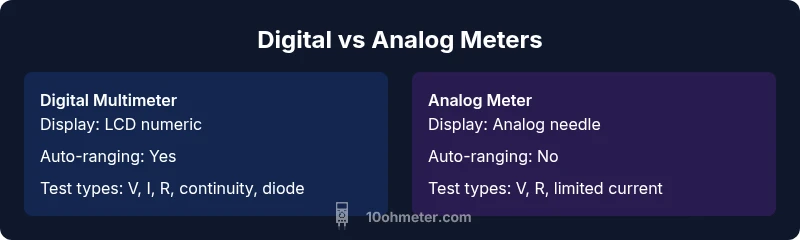
Digital meters deliver instantly readable results on a numeric display, with features such as auto-ranging, hold functions, and audible continuity beeps. Analog meters rely on a moving needle, which can offer quick trend observations but require more interpretation and calibration to read accurately. For electronics learning and automotive diagnostics, digital meters provide consistent results and easier data logging. However, analog meters still have a place in hobbyist classrooms and vintage repair shops where the tactile feedback and continuous range can be advantageous. The practical takeaway is that digital meters dominate modern workflows, while analog meters remain valuable for education and quick qualitative checks. In both cases, you should practice safe handling and proper probe placement to minimize errors and avoid damage to the meter or the circuit.
How to use meters safely in a workshop
Safety basics start with choosing a meter rated for the voltage range you expect to encounter, then verifying test leads and the probe tips are intact. Always start at the highest safe scale when unsure, and avoid measuring live circuits with exposed conductors if possible. Keep the meter turned off when connecting leads for resistance or continuity tests to prevent the meter from entering a protective shutdown. For automotive work, be mindful of automotive electronics grounding and battery potentials that can spike. The 10ohmeter guidance emphasizes setting up a clean, organized test area, using insulated probes, and never touching metal tips while measuring live circuits. With these precautions, you’ll reduce the risk of shock, arc flash, and measurement errors while you learn the nuances of the tool.
Practical use cases: electronics hobbyist projects
Hobbyists frequently work on small-signal projects, LED drivers, or microcontroller experiments. In these scenarios, a digital multimeter handles voltage checks, current estimation through series resistance, and resistance readings for wiring checks. You may also test continuity to verify circuit paths before breadboarding or soldering. For instance, when troubleshooting a faulty LED strip, a DMM helps confirm supply voltage and measure current draw, while a voltmeter alone won’t provide the same breadth of data. Early in your journey, you’ll appreciate the auto-range feature that eliminates manual scale changes and the hold feature that captures fleeting values for documentation. The key is to practice consistent probe placement and practice on known-good components to build confidence.
Automotive diagnostics with a meter: what to know
Automotive electrical work benefits from a meter with a robust voltage range and good transient protection. You’ll use the meter to test battery voltage, alternator output, fuse continuity, and sensor signals. Some models include current measurement via a clamp, enabling you to quantify draw without breaking the circuit. When diagnosing parasitic drains or sensor faults, you’ll appreciate readings that are stable and repeatable. In many scenarios, a digital multimeter is the preferred instrument for automotive tasks due to its versatility and faster results. The 10ohmeter team highlights that trustworthy meters with a solid safety rating and reliable data logging improve both diagnosing speed and repair quality.
Reading specs, ranges, and precision without mystery
Understanding measurement specs helps you avoid overestimating capabilities. Key terms include resolution (smallest measurable increment), accuracy (closeness to true value), and range (the maximum scale). A meter with higher resolution can show more digits, which is valuable for precise resistor tolerances or sensor calibration. Sensible practice is to choose a meter whose minimum resolution matches the smallest signal you typically measure. Beware that lower-cost meters may have limited accuracy at extremes or in high-temperature environments. The 10ohmeter analysis shows that many beginners underestimate how resolution and accuracy influence results in real-world scenarios, especially when calibrating sensors inside a microcontroller project or diagnosing a battery’s performance.
Calibration and maintenance: keeping readings trustworthy
Calibration is about aligning a meter’s readings with known standards. Most consumer meters do not require factory calibration on a fixed cadence, but periodic checks against known references (like a precision reference resistor or a calibrated voltage source) are advisable for serious projects. Regular inspection of test leads, probes, and port jacks prevents contact resistance and stray capacitance from skewing results. Battery health inside the meter matters as well; a tired battery can degrade accuracy and auto-ranging performance. If you rely on your meter for critical tasks, seek a calibration service or a meter with a clearly stated calibration interval. The goal is to keep the instrument within its specified tolerances while you extend its useful life.
Price, value, and how to pick a model that fits your budget
Meters span a broad price range, from entry-level devices to feature-rich professional instruments. For most DIY projects, a mid-range digital multimeter balances price and capability, providing auto-ranging, true RMS, and reasonable accuracy. Budget meters may still work for basic measurements but can fall short on safety features or measurement stability. On the other end, premium meters often add robust probes, data logging, wireless connectivity, and advanced diagnostics. The decision should reflect your typical workload, the stakes of the measurements, and how important data longevity is for you. The 10ohmeter guidelines suggest starting with a mid-range DMM and upgrading only after you’ve used the tool across several projects and have confidence in your measurement routines.
Getting started: your first measurements in 15 minutes
Set up a safe, well-lit workspace. Choose a meter with auto-ranging and a good display. Plug in the probes, select DC voltage, and measure a known supply such as a fresh battery to verify accuracy. Then attempt a resistor check by placing a resistor across the test leads and noting the reading; compare this with the known value using Ohm’s law. Move on to a simple test circuit—power it up, measure voltage at a node, and confirm continuity along traces. Document values to build a reference library for future repairs. As you gain experience, you’ll rely less on charts and more on consistent technique, with the meter delivering stable, repeatable readings across common tasks.
Comparison
| Feature | digital multimeter (DMM) | analog meter (VOM) |
|---|---|---|
| Display type | LCD/LED numeric readout with icons | Analog needle gauge |
| Measurement breadth | Voltage (AC/DC), current, resistance, capacitance, diode testing, continuity | Voltage and resistance with limited extra features |
| Auto-ranging | Yes | Typically no |
| True RMS | Often yes (varies by model) | Usually no; peak readings may be approximated |
| Safety ratings | CAT II/III/IV options; better models include probes | Lower-cost models may have basic protection |
| Price range (conceptual) | Mid-to-high depending on features | Lower-to-mid, cheaper but fewer features |
| Best use case | Electronics prototyping, automotive diagnostics, professional labs | Basic voltage checks and simple tests |
The Good
- Versatile measurement capabilities for most tasks
- Auto-ranging saves time and reduces user error
- Digital readouts are easy to interpret
- Safest choice for beginners with protective features
- Data logging and additional tests improve troubleshooting
Drawbacks
- More expensive than basic voltmeters
- Analog meters offer quick trend reading but require skill to interpret
- Some models require calibration or batteries
- Higher feature sets can add complexity for beginners
Digital multimeters dominate as the go-to tool for most users
For the majority of electronics and automotive tasks, a digital multimeter provides the widest functionality, better safety, and easier usability. The 10ohmeter team recommends starting with a capable DMM and upgrading only if your projects demand more specialized capabilities.
Your Questions Answered
What is the difference between a multimeter and a voltmeter?
A voltmeter measures voltage only, while a multimeter covers voltage, current, resistance, and often additional tests like diode checks and continuity. For most DIYers, a digital multimeter is the practical, flexible choice.
A voltmeter only shows voltage. A multimeter can measure voltage, current, resistance, and more, making it the more versatile tool for general use.
What does auto-ranging mean on a meter?
Auto-ranging lets the device automatically select the correct scale for the measurement, saving you from guessing the right range. This reduces errors and speeds up testing, especially for beginners.
Auto-ranging automatically picks the right scale so you don’t have to guess.
Are analog meters still useful?
Analog meters provide a visual trend with a moving needle and can be quick for spot checks, but digital meters are usually more accurate, easier to read, and better for precise measurements.
Analog meters are handy for quick trend checks, but digital meters are generally better for accuracy and ease of use.
Which meter is best for automotive work?
A robust digital multimeter with automotive safety ratings and, ideally, a current clamp can simplify diagnosing battery, alternator, and fuse-related issues. Ensure the meter has appropriate CAT ratings.
For cars, pick a sturdy digital multimeter with good safety ratings and, if possible, a current clamp.
How do I test a diode with a meter?
Use the diode test function or measure forward and reverse bias with a known reference. A good meter will show a low forward voltage drop in one direction and high resistance in the other.
Use the diode test function to check forward and reverse conduction.
What safety rating should I look for?
Look for CAT II or CAT III ratings appropriate to your typical voltages. Higher CAT ratings provide better protection in more demanding environments.
Choose a meter with a solid CAT rating appropriate for your work environment.
Key Takeaways
- Start with a mid-range digital multimeter for versatility
- Prioritize auto-ranging and true RMS for mixed signals
- Choose safety ratings aligned with expected voltages
- Digital meters suit DIYers and automotive work better than basic voltmeters
- Regular maintenance preserves accuracy and reliability