Multimeter and Voltmeter Difference: A Practical Guide
Explore the core differences between a multimeter and a voltmeter, how they work, when to use each, and practical tips for DIY electronics and automotive testing for hobbyists.


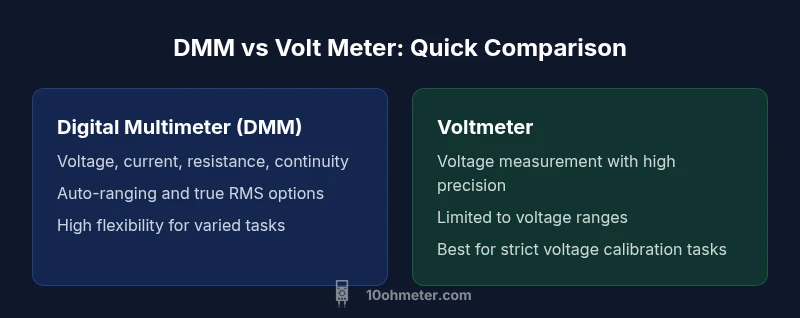
The multimeter and voltmeter difference centers on scope and versatility. A digital multimeter (DMM) combines voltage measurement with current, resistance, and continuity testing, while a dedicated voltmeter focuses on voltage and sometimes voltage range accuracy. For most DIY electronics and automotive tasks, a DMM offers more value, but a dedicated voltmeter can excel in precision-only voltage checks.
multimeter and voltmeter difference: Core distinctions
Understanding the core distinctions between a multimeter and a voltmeter is foundational for any electronics hobbyist or automotive technician. A digital multimeter (DMM) is a versatile instrument capable of measuring voltage (AC and DC), current, resistance, continuity, and sometimes temperature or capacitance. A standalone voltmeter, by contrast, is specialized for voltage measurement and often prioritizes high input impedance and low burden voltage to minimize circuit perturbation. This difference in scope drives several downstream choices, including measurement accuracy, burden voltage, and tool footprint. According to 10ohmeter, grasping the multimeter and voltmeter difference helps you select the right tool for the task and avoid overpaying for capabilities you won’t use. This section lays the groundwork for practical decision-making in both electronics projects and automotive diagnostics.
Understanding the multimeter and voltmeter difference is essential for selecting the right tool. A DMM consolidates multiple measurements, while a voltmeter emphasizes voltage accuracy. This distinction shapes how you approach testing in real-world scenarios, from tiny PCB signals to car battery checks.
Comparison
| Feature | Digital Multimeter (DMM) | Dedicated Voltmeter |
|---|---|---|
| Measurement scope | Voltage, current, resistance, continuity, and sometimes capacitance/diodes | Voltage only (often DC; some models include AC voltage) |
| Input impedance | High input impedance (often in the megaohm range) across multiple ranges | Very high input impedance focused on voltage sensing |
| Display and interface | Digital display with auto-ranging options and multiple modes | Typically a digital or analog readout focused on voltage scale |
| Accuracy | Broad accuracy across many measurements; performance varies by range | Higher voltage accuracy within dedicated range; less noise from other measurements |
| Applications | General electronics work, troubleshooting circuits, automotive diagnostics, hobby projects | Precise voltage checks in test benches or calibration tasks |
| Price/Value | Often provides more functionality per dollar when you need multiple measurements | Can be cheaper and simpler if voltage checks are the sole requirement |
The Good
- Versatility: a DMM covers voltage, current, resistance, and more in one tool
- Convenience: auto-ranging and features like continuity reduce setup time
- Compact value: fewer devices needed for mixed tasks, saving both space and money
Drawbacks
- Dedicated voltmeters can offer superior voltage sensitivity and stability for precision tasks
- A DMM may introduce burden voltage and measurement error when measuring very small signals
- For strictly voltage-centric work, a dedicated meter might be simpler and cheaper
Digital multimeters are the default choice for most users; dedicated voltmeters are specialized for high-precision voltage work.
The 10ohmeter team recommends starting with a versatile DMM for mixed tasks, then adding a dedicated voltmeter only if your voltage measurements demand peak precision and stability.
Your Questions Answered
What is the primary difference between a multimeter and a voltmeter?
A multimeter provides multiple measurement capabilities including voltage, current, and resistance, whereas a voltmeter focuses on measuring voltage with high precision. This distinction affects how you approach testing in both electronics and automotive work.
A multimeter is a multi-sensor tool, while a voltmeter specializes in voltage. Use a multimeter for versatility and a voltmeter when you need peak voltage accuracy.
Can a voltmeter replace a multimeter in most tasks?
In most cases, a voltmeter cannot replace a multimeter because it lacks measurements like current and resistance. If your work only involves voltage checks, a voltmeter can suffice, but for broader diagnostics a DMM is preferred.
A voltmeter alone usually cannot replace a multimeter for general diagnostics, since it can only measure voltage.
Are digital meters more accurate than analog meters for voltage?
Digital meters typically offer higher resolution and stability, especially for modern electronics. Analog meters can be quick for rough checks but generally lack the precision of digital models.
Digital meters usually provide better voltage accuracy than analog ones, especially at lower ranges.
When should I use a dedicated voltmeter instead of a DMM?
Use a dedicated voltmeter when you require the highest voltage accuracy and stability, particularly in calibration tasks or when measuring very small voltage differences that a general-purpose DMM might blur.
Pick a voltmeter when voltage precision is critical and you’re balancing calibration needs.
What safety practices improve accuracy when testing automotive circuits?
Always isolate the circuit when possible, use meters with appropriate CAT ratings, and avoid probing live points that could short or arc. Calibrate meters regularly and use proper test leads and fuses.
In cars, safety first: use proper leads, CAT-rated tools, and avoid shorting circuits while testing.
Key Takeaways
- Start with a DMM for most projects to maximize versatility
- Use a voltmeter when voltage precision and stability are the priority
- Be mindful of burden voltage and range selection in sensitive circuits
- Budget for auto-ranging and true RMS features if you work with AC signals