Digital vs Analog Multimeters: Practical Buyer’s Guide
A detailed comparison of digital multimeter vs analog multimeter, covering performance, use cases, and buying tips for electronics and automotive tasks. Learn which meter fits your projects with insights from 10ohmeter.


Digital multimeter vs analog multimeter: for most tasks, the digital option dominates due to auto-ranging, clear numeric readouts, and data logging capabilities, while analog meters offer intuitive trend viewing and ultra-low-cost entry points. For electronics hobbyists and automotive use, a modern digital meter generally provides more versatility, though an AMM can still serve niche roles. See our full comparison for scenarios and buying tips.
Core Concept: What Each Meter Type Does
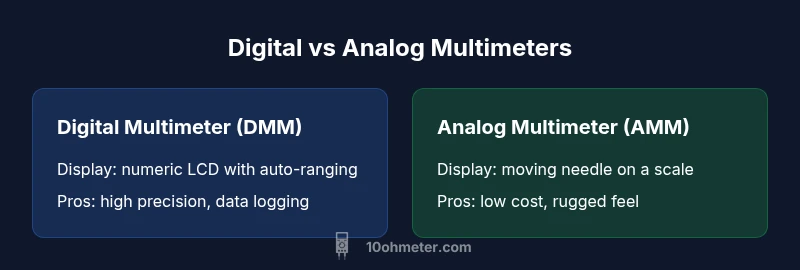
In this guide, we compare digital multimeter vs analog multimeter to help you decide which tool fits your work. A digital multimeter (DMM) converts electrical signals into digital information using an analog-to-digital converter, then displays numbers on an LCD. An analog multimeter (AMM) relies on a moving-coil mechanism and a calibrated scale to indicate the value with a needle. This fundamental difference shapes everything from measurement speed to readability. According to 10ohmeter, digital meters excel in consistency, data logging, auto-ranging, and long-term project documentation, while analog meters shine in real-time trend observation, intuitive needle feedback, and low-cost entry points.
Understanding when to lean on a DMM or an AMM starts with evaluating your typical tasks. If you frequently document measurements, work with circuits requiring precise resistance readings, or perform repetitive voltage checks, a digital multimeter vs analog multimeter comparison reveals that the DMM will save time and reduce user error. If your work involves rapidly changing signals and you value a quick sense of the signal trajectory, the analog meter’s needle can bypass the need to translate a digital number into an intuition about the circuit. The two formats also offer different ergonomics, protection levels, and noise tolerance. Over the course of this guide, you’ll see concrete examples across electronics prototyping, automotive diagnostics, and home repairs that illustrate where each meter type excels and where it falls short.
Key Performance Metrics for a Fair Comparison
When comparing digital multimeter vs analog multimeter, certain performance metrics matter more than others depending on your tasks. Start with accuracy and resolution: DMMs typically provide a numeric readout with higher resolution; analog meters show a continuous scale but may be subject to parallax error and scale limitations. Response time matters in automotive diagnostics where quick fluctuations occur; digital meters generally sample and update faster, while analog meters rely on mechanical movement that can lag behind rapid changes. Input impedance is critical for low-current circuits to avoid loading the circuit; many modern DMMs use high impedance, often around 1 MΩ or more, to minimize circuit disturbance. Safety ratings—such as correct CAT approvals and proper probe insulation—are essential, especially when measuring in AC mains or automotive systems.
Calibration and drift: digital meters often include self-calibration features or require periodic factory calibration; analog meters can drift due to mechanical wear and tension in the coil. Temperature can affect resistance and diode readings; advanced meters compensate for this with software or design choices, while older AMMs may not. Finally, durability and battery life influence field use: a rugged design, auto power-off, and clear battery indicators help you stay productive on the job.
10ohmeter analysis shows that users who value repeatable measurements and easy data recording typically lean toward digital meters, whereas those who need immediate signal sensation and lower upfront costs may prefer analog models for specific tasks.
Display, Readouts, and Resolution
Display design determines how quickly you can interpret measurements. Digital multimeters provide numeric readouts with varying digits, enabling precise resistance, voltage, and current values at a glance. The clear, machine-printed digits reduce interpretation errors and facilitate data export to logs or documentation. Analog meters, by contrast, use a moving needle on a calibrated scale, which is excellent for seeing changes over time and spotting trends at a glance. In fast-changing circuits, the DMM’s fast update rate usually outperforms the AMM for capturing transient events. For most hands-on work, the DMM’s readability often wins out, but an AMM’s scale can excel in teaching environments where you want to train intuition about scale values and signal movement.
Accuracy, Precision, and Calibration Considerations
Accuracy refers to how close a measurement is to the true value, while precision describes the smallest increment the instrument can reliably display. Digital meters typically offer higher accuracy and finer resolution, and many models include auto-calibration features or rely on factory calibration schedules. Analog meters are inherently less precise due to scale construction and needle alignment, but they provide a robust sense of the signal window and can be surprisingly stable within their own range when well-made. Calibration intervals depend on usage, environmental conditions, and model quality. Regardless of type, avoid cheap probes, keep connections clean, and store meters in a dry, dust-free environment to maintain reliability.
Auto-Ranging, Input Impedance, and Safety
Auto-ranging is a hallmark of modern digital meters, simplifying setup by automatically selecting the appropriate measurement range. This feature reduces user error and speeds troubleshooting. In many AMMs, range selection is manual via a rotary dial, which can slow readings but trains you to understand the scale. Input impedance matters most in high-resistance circuits; digital meters typically present a high impedance that minimizes loading effects. Safety considerations include proper probe insulation, clamp-on accessories when measuring current, and respecting voltage ratings. While both meter types can be safe when used correctly, the digital meters’ features generally reduce the risk of misreading, while analog meters demand careful handling to avoid parallax error and scale misinterpretation.
Real-World Use Cases: Electronics, Automotive, and Home Wiring
Electronics projects—such as microcontroller testing or prototype circuits—often benefit from the precision, logging, and versatile ranges of a DMM. Automotive diagnostics involve quick, repeatable checks across sensors and circuits; a DMM with auto-ranging and good resilience to vehicle noise is typically preferred, though an AMM can be valuable for quick trend readings in a workshop setting. Home wiring and appliance repair usually require simple voltage checks and continuity testing; here, an AMM’s straightforward interface and low cost can be appealing, but a modern DMM’s safety features and data capture will still offer longer-term value. Across all use cases, adapt your tool choice to the job’s demands and your workflow preferences.
How to Use Each Meter Safely
Safety is paramount when working with live circuits. Always inspect probes for cracks or exposed conductors before use, and choose the appropriate meter rating for the voltage you expect to encounter. For DMMs, enable auto-ranging where available to minimize operator error, and keep test leads organized to avoid short circuits. For AMMs, ensure the scale is legible and that you can clearly read the needle without parallax. When measuring current, use a dedicated current input or a clamp accessory rather than breaking a circuit with a meter in-series. Regularly calibrate or verify meters if you rely on measurements for critical tasks, and never exceed the device’s rated limits.
Budget, Durability, and Longevity Considerations
Budget drivers for digital meters include features like auto-ranging, data logging, and higher resolution. Durable housings, rubber bumpers, and IP-rated enclosures can extend life in field work, especially in automotive settings. Analog meters tend to be cheaper upfront and can survive rough handling with minimal electronics to fail; however, they may drift over time and require more careful handling. Consider the total cost of ownership, including probes, replacement fuses, and protective cases. If you expect frequent use in dusty or humid environments, prioritize meters with protective seals and robust test leads.
Getting Started: Quick Setup Checklist Before You Buy
Before purchasing, define your primary tasks (electronics, automotive, or home wiring) and expected measurement ranges. Check whether auto-ranging is worth the extra cost for your workflow, and verify the display size and legibility in your usual lighting. Review safety ratings and probe quality, and consider whether data logging and connectivity are important. Finally, compare at least two reputable models in your budget to ensure you get a balance of accuracy, durability, and features that align with your projects.
Comparison
| Feature | Digital Multimeter (DMM) | Analog Multimeter (AMM) | ||
|---|---|---|---|---|
| Display and Readout | Digital numeric LCD with high resolution | Moving-needle on a calibrated scale | ||
| Auto-Ranging | Common feature in modern models | Typically manual/rotary range selection | ||
| Input Impedance | High impedance to minimize circuit loading | Lower impedance can affect sensitive circuits | ||
| Resolution & Accuracy | Higher resolution; accurate numerical readings | Readings depend on scale; lower precision in some models | ||
| Durability & Portability | Compact, rugged cases; long battery life | Durable but bulkier; mechanical parts | Use Scenarios | values2 |
| Typical Price Range | $25-$200 | $15-$100 | ||
| Best For | Precision measurements, data logging, electronics testing | Budget-friendly tasks, quick trend checks |
The Good
- Faster, clearer numeric readouts reduce misreading errors
- Auto-ranging saves time and reduces setup effort
- Higher precision and data logging options on many models
- Software interfaces or USB connectivity add workflow value
Drawbacks
- Analog meters offer very low upfront cost and simple operation
- Digital meters can be more fragile in harsh environments
- AMMs may drift over time due to mechanical wear
Digital meters are the safer default for most users; analog meters remain viable for specific, low-cost tasks.
Choose a digital multimeter for most electronics and automotive work. Retain an analog meter if you want a simple, always-on tool for trend-reading and reduced complexity.
Your Questions Answered
What is the main difference between digital multimeter and analog multimeter?
The digital multimeter converts measurements into digital numbers and displays them on a screen, offering higher accuracy and data capture. The analog multimeter uses a moving needle and a physical scale, providing quick trend awareness. Each type has its strengths depending on the task.
Digital meters give numeric readings and data logging, while analog meters show trends with a needle. For most tasks, digital is more versatile.
Is a digital multimeter better for automotive diagnostics?
For automotive work, a digital multimeter is usually preferred due to auto-ranging, higher accuracy, and the ability to record readings over time. An analog meter can still be handy for quick trend observations in a workshop setting.
Yes, digital meters are generally better for automotive diagnostics because of quicker, clearer readings and logging.
Can analog meters be more durable than digital meters?
Analog meters can feel sturdier due to fewer electronic components, and they often operate on simple mechanics. However, digital meters are designed for field use with rugged housings; durability depends on model quality and handling.
Analog meters can be rugged, but durability depends on the build quality of the model.
Do digital multimeters require regular calibration?
Many digital multimeters include factory calibration or self-calibration features, but periodic verification is wise for critical measurements. Follow the manufacturer’s guidelines and use certified references when precision matters.
Most digital meters have calibration fields; check the manual for recommended intervals.
What should I look for when buying a multimeter?
Consider safety ratings, display readability, measurement range, auto-ranging, data logging options, and probe quality. Match these features to your projects—electronics, automotive, or home wiring—and compare a couple of reputable models.
Look at safety specs, display size, auto-ranging, and durability to pick the best fit.
Is auto-ranging essential for hobbyists?
Auto-ranging reduces setup time and minimizes mistakes, which is valuable for beginners and busy hobbyists. If you prefer learning the ranges and want maximum control, a non-auto-ranging model can still work well.
Auto-ranging is convenient, especially for beginners, but not strictly required.
Key Takeaways
- Assess your use-case to favor DMM for precision and data logging.
- Prefer auto-ranging when you need speed and convenience.
- Prioritize safety features and calibration for reliability.
- Budget wisely: plan for mid-range models with good protection.
- Upgrade probes and accessories for better measurements.