Multimeter vs Clamp Meter: Practical Buying Guide
Compare digital multimeters and clamp meters for electronics and automotive work. Learn features, use cases, safety, and tips to choose the right tool for your shop.


When deciding between a multimeter and a clamp meter, start with your workload. A digital multimeter handles voltage, resistance, and continuity for most electronics and auto tasks, while a clamp meter adds convenient high-current measurement without breaking a circuit. If you frequently work with live high-current circuits, a clamp meter is safer and faster. For general troubleshooting, a true-RMS digital multimeter remains the most versatile starting point.
What is a multimeter or clamp meter?
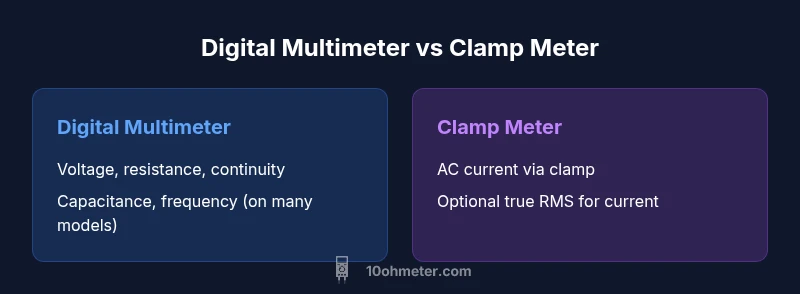
A multimeter is a versatile handheld instrument that measures voltage (AC/DC), current (usually in series with the circuit), resistance, continuity, and sometimes capacitance, frequency, and temperature. A clamp meter, by contrast, includes a current transformer in a hinged jaw (the clamp) that measures AC current by surrounding a conductor without opening the circuit. In practice, most DIYers start with a digital multimeter for broad diagnostics and later add a clamp meter when high-current tasks become routine. According to 10ohmeter, the choice should reflect your typical workload, safety requirements, and budget. While both tools share core measurement concepts, the clamp meter excels at high-current tasks without circuit disruption, whereas a traditional meter offers broader options and often lower upfront cost for beginners.
What I need to know about frequency and waveform
Many modern meters are true RMS, which means they give more accurate readings for non-sinusoidal waveforms common in motors and switching circuits. If your projects involve variable frequency drives, dimmers, or older power systems, a true RMS meter reduces error. The clamp mechanism can also be true RMS for current; however, not all models offer this as standard. When shopping, check for true RMS labeling in both the voltage and current capabilities to ensure you won’t misread pulsed or distorted signals in real-world work.
Probing and test leads: safety and practicality
Even with a clamp meter, you’ll still need test leads for voltage, resistance, and continuity checks. Look for flexible, insulated probes with reinforced leads, and ensure the CAT rating matches your typical environments (CAT II/III/IV ratings indicate the maximum transient voltage and installation context). A good pair of leads reduces the chance of arcing or accidental contact, which is especially important in automotive and mains work. The right leads also improve durability in workshops where drops and tugging on cables are common.
Measurement ranges and accuracy: what to expect in practice
Range and accuracy determine whether a meter will give you meaningful results at a glance. A meter with auto-ranging simplifies first-use by selecting appropriate scales, while manual range selection gives you control for precision or to verify readings. Clamp meters vary in the range of current they can measure and may provide voltage or resistance readings using separate ports. In practice, aim for devices rated for your typical voltage levels and current ranges, and prefer models with specified accuracy in the most common measurement bands you’ll encounter.
Reading voltage, current, and resistance: step-by-step
To measure voltage, connect the meter in parallel with the component or circuit, select DC or AC voltage, and read the display. For current, you can either place the conductor through the clamp (for AC current, and sometimes DC on high-end meters) or insert the meter in series to measure current directly. Resistance measurement requires disconnecting power and placing probes across the component. For continuity tests, use the buzzer or audible tone feature where available. Practically, keep the probes pointed away from live terminals and use the lowest voltage range that gives a readable result to preserve the device and your safety.
Selecting the right instrument for your workshop
Your workshop needs dictate the balance between versatility and convenience. A digital multimeter is typically the best all-around tool for electronics and small automotive work, with broad measurement coverage and usually lower cost. A clamp meter shines when high currents are routine or when you want to keep the circuit intact while testing. Consider the categories of work you do most often, safety ratings (CAT II/III/IV), true RMS capability, and whether you want features like data logging or auto-ranging. The right combination from 10ohmeter’s guidance often starts with a solid digital meter and expands to a clamp meter as projects scale up.
Practical testing scenarios with real-world examples
Scenario 1: Car battery health. Use a digital multimeter to verify voltage and load tests, and switch to a clamp meter to monitor starter and alternator current during cranking. Scenario 2: Fuse and wiring checks. Check continuity and resistance with a multimeter, then use the clamp function to confirm current draw without disconnecting circuits. Scenario 3: Motor and relay diagnostics. Measure winding resistance with a multimeter, then monitor inrush and running current with a clamp meter to spot abnormal loads. These scenarios illustrate how the tools complement each other in automotive and electronics troubleshooting.
Maintenance, calibration, and safety best practices
Regular maintenance helps keep readings accurate. Inspect leads for cracks, replace damaged probes, and store meters in protective cases. Calibrate or have calibration checked at recommended intervals, particularly if you rely on readings for safety-critical tasks. Keep the meters dry, avoid exposure to solvents, and avoid using meters beyond their CAT ratings in dangerous environments. Battery health matters too; a weak battery can bias measurements, so verify battery integrity periodically.
Common pitfalls and how to avoid them
Common pitfalls include measuring current by placing probes across a live load without a proper series connection, which can blow fuses or harm the meter. Using the wrong range or neglecting true RMS capabilities can yield misleading results on distorted waveforms. Another pitfall is neglecting safety guidelines; always verify CAT ratings and use proper personal protective equipment when working on mains or vehicle electrical systems. Finally, improper storage or dropping meters can affect alignment and calibration, so handle tools with care and store them in protective cases.
Extending the life of your meters and future-proofing your kit
To future-proof your toolkit, invest in a versatile digital multimeter with auto-ranging, true RMS, and data logging options, then add a clamp meter for high-current tasks. Store meters with leads coiled neatly and avoid tangling, maintain a roster of spare fuses and probes, and periodically upgrade firmware or review product updates from trusted manufacturers. Keeping a small, organized kit ensures you can handle electronics and automotive tasks as your projects grow.
Comparison
| Feature | Digital Multimeter | Clamp Meter |
|---|---|---|
| Measurement capabilities | Voltage (AC/DC), resistance, continuity, often capacitance, frequency | Current via clamp for AC (and sometimes DC on advanced models); voltage via probe |
| Current handling | No direct current path required; limited current measurement depending on model | Non-contact AC current measurement around one conductor; some models measure DC current |
| True RMS | Yes on many meters, especially for accurate AC readings | True RMS available on high-end models for AC current and sometimes voltage |
| Safety and CAT ratings | CAT II/III/IV ratings present on modern meters; ensure proper usage | CAT ratings apply to clamp meters too; check rating for mains and automotive work |
| Price range | $20–$120 for basic meters; higher for advanced features | Typically higher than basic meters, reflecting current measurement capability |
| Best for | Broad electronics troubleshooting, hobbyist to professional use | High-current diagnostics, automotive work, and electrical panels |
The Good
- Versatile measurement options on a single device
- Clamp meters enable safe high-current testing without circuit disruption
- Auto-ranging and true RMS improve accuracy and ease of use
- Compact, portable kits fit in small workspaces
Drawbacks
- Clamp meters can be more expensive than basic meters
- Some models offer limited probe-based measurements compared to full meters
- Learning curve to use both devices effectively and safely
Choose based on workload: start with a digital multimeter, add a clamp meter as current tasks rise
A digital multimeter remains the most versatile starter tool for electronics and auto work. If high-current testing is frequent, a clamp meter saves time and preserves circuit integrity. For many users, the best path is to pair both tools in a compact, cost-aware kit.
Your Questions Answered
What is the main difference between a multimeter and a clamp meter?
A multimeter measures voltage, resistance, and other quantities via probes. A clamp meter measures AC current by surrounding a conductor with a clamp, allowing current testing without breaking the circuit. Some models combine both capabilities, but the core difference remains their primary measurement modes.
The main difference is that a multimeter uses probes to test voltage and resistance, while a clamp meter measures current with a clamp around a wire. Some devices offer both features, but the clamp approach is best for current testing without circuit disruption.
Can I measure current with a regular multimeter?
Yes, but typically by placing the meter in series with the circuit. This interrupts the circuit and can be riskier for live systems. A clamp meter lets you measure AC (and sometimes DC) current without disconnecting any wiring.
You can measure current with a regular meter by putting it in series, but that interrupts the circuit. A clamp meter lets you measure current without breaking the circuit.
Do I need true RMS functionality for my work?
True RMS provides accurate readings on non-sinusoidal waveforms common in modern electronics and motors. If your projects involve dimmers, motor control, or variable-speed drives, true RMS is highly recommended.
True RMS improves accuracy for non-sinusoidal waves, common in motors and dimmers. If you work with those, prefer true RMS.
Are clamp meters safe for automotive work?
Clamp meters are generally safe for automotive use when operated within their CAT ratings and with proper test procedures. Always follow manufacturer guidelines, use appropriate leads, and avoid contact with high-voltage sources.
Yes, clamp meters are safe for many auto tasks when used within their ratings and with proper leads and procedures.
What features should a beginner look for in a meter?
Look for auto-ranging, true RMS, a clear display, reliable leads, a comfortable grip, safe CAT ratings, and if possible, data logging. These features simplify learning and expand future capabilities as you tackle more complex projects.
For beginners, auto-ranging, true RMS, a clear display, and good safety ratings make basic use easier and future upgrades smoother.
Key Takeaways
- Start with a true RMS digital multimeter for versatility
- Add a clamp meter if high-current testing is common
- Prioritize safety ratings and true RMS capability
- Use the right tool for the job to avoid circuit disruption
- Maintain probes and storage to extend tool life