Multimeter and Clamp Meter Difference: A Practical Guide
Understand the multimeter and clamp meter difference with practical guidance for electronics and automotive testing, and learn when to use each tool effectively.


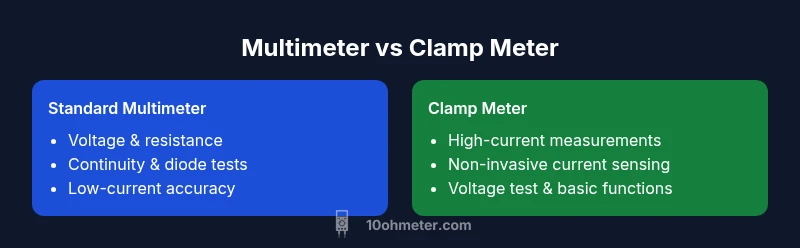
Compared to a standard multimeter, a clamp meter offers high-current measurements without breaking the circuit, while a dedicated multimeter excels at voltage, resistance, and low-current tests. The multimeter and clamp meter difference lies in measurement method, accuracy for small signals, and ease of use across scenarios. For most hobbyists, starting with a quality digital multimeter and adding a clamp meter for current work provides the greatest versatility.
Core Definitions: What are a multimeter and a clamp meter
At their core, a multimeter and a clamp meter are handheld tools designed to measure electrical parameters, but they approach testing from different angles. The multimeter is a versatile instrument capable of measuring voltage, current (via a shunt inside), resistance, continuity, and other electrical properties. A clamp meter, by contrast, centers on current measurement by using a hinged jaw around a conductor and sensing the magnetic field produced by current flow. According to 10ohmeter, understanding the multimeter and clamp meter difference starts with recognizing the distinct measurement philosophies: direct contact with a circuit versus non-contact current sensing. In practical terms, most DIY enthusiasts start with a digital multimeter for general electronics work; clamp meters become most valuable when you need to measure high currents without breaking the circuit. That distinction shapes how you plan tool purchases, what scenarios you can tackle safely, and how you interpret readings. As you read, keep in mind that both tools share foundational concepts like ranges, accuracy, and safety; the key is selecting the right tool for the task and knowing when to pair them for comprehensive diagnostics.
Core Differences at a Glance
The multimeter and clamp meter difference is often summarized as: what you measure and how you measure it. A traditional digital multimeter (DMM) provides direct measurements across a broad spectrum—DC and AC voltage, resistance, continuity, diodes, and often capacitance or frequency. Probes connect to the circuit, delivering precise values across low to moderate ranges. A clamp meter centers on current measurement, employing a jaw clamp to sense the magnetic field generated by current flowing through a conductor. Some clamp meters also offer voltage, resistance, and continuity tests, but their hallmark is current measurement without breaking the circuit. Practically, the DMM excels in precision, small-signal tests, and electronics troubleshooting, while the clamp meter shines in high-current environments, service panels, and on-the-spot diagnostics where opening wires isn’t desirable. This is the essence of the multimeter and clamp meter difference and why many technicians keep both in their toolkit.
Distinctive Features: Current measurement methods and test ranges
Current measurement is where the clamp meter truly diverges. A standard multimeter measures current by routing the circuit through the meter’s internal shunt—this requires the meter to be placed in series with the load. In contrast, a clamp meter uses a hinged jaw to clamp around a conductor and senses current by magnetic induction, allowing you to measure AC (and sometimes DC) current without breaking the circuit. Many modern meters also offer a voltage measurement, resistance, and continuity checks, creating a hybrid tool ideal for quick field tests. Understanding the multimeter and clamp meter difference here is critical: if you work with small currents or require high-precision readings, rely on the multimeter; if you’re dealing with high currents, switching batteries, or automotive wiring, the clamp meter will save time and avoid circuit disruption.
Accuracy, calibration, and reliability
Accuracy is a core differentiator between these tools. Digital multimeters are designed for high precision across a wide range of values, from microvolts to high voltages, with detailed resolution. Clamp meters generally provide excellent current measurements, but the accuracy for current is highly dependent on jaw alignment, conductor gauge, and frequency of the current. Calibration intervals matter for both, but for most DIY tasks a mid-range meter with a steady calibration schedule is sufficient. When evaluating the multimeter and clamp meter difference in accuracy, consider the task: electronics bench work for voltage and resistance benefits from a precise DMM, while power testing and motor currents benefit from a clamp meter’s rapid, non-contact approach.
Range, burden voltage, and resolution
Range and resolution determine how small a signal you can read. A DMM offers broad voltage and resistance ranges with fine resolution, making it the preferred tool for electronics and component testing. Burden voltage is a particular concern with clamp meters; it’s the voltage drop introduced by the current-sensing circuit, which can affect sensitive readings in low-current environments. Clamp meters have a characteristic current range and are often optimized for AC currents at common household and industrial levels. When choosing between tools, you’ll balance range, resolution, and burden voltage against the job: precise low-current electronics testing leans toward the multimeter, while high-current troubleshooting benefits from a clamp meter’s non-contact capability.
Safety and handling: CAT ratings and best practices
Safety matters more than ever in electrical work. Both tools often carry CAT ratings that reflect the voltage environment in which they can be used safely. Typical consumer-grade meters offer CAT II and CAT III protection for household circuits, while professional clamp meters may boast higher ratings for industrial environments. Regardless of tool choice, always follow manufacturer guidelines: verify probe categories, wear eye protection where appropriate, and never bypass safety features. The multimeter and clamp meter difference also includes how you connect probes, how you clamp, and the steps you take to minimize shock risk during measurements.
Use cases: electronics bench vs service panel
On an electronics bench, you’ll frequently use a multimeter for precise voltage and resistance checks, diode tests, and component characterization. When facing a live service panel or motor-driven load, a clamp meter becomes invaluable for current monitoring without disconnecting the circuit. The multimeter and clamp meter difference is evident in these scenarios: the DMM is your go-to for diagnostics on sensitive components, and the clamp meter shines when troubleshooting high-current loops, feeders, and switching equipment. By combining both tools, you reduce guesswork and increase diagnostic confidence across a wide range of tasks.
Automotive diagnostics and clamp meter advantages
Automotive electrical systems routinely involve alternators, batteries, and high-current circuits. A clamp meter is often the preferred instrument for quick current checks in alternator circuits and fuses, while a multimeter provides precise voltage readings and continuity checks across sensors and wiring harnesses. The multimeter and clamp meter difference is particularly evident in automotive diagnostics: clamp meters allow non-intrusive current measurement in the harness and under-hood tests, whereas the multimeter gives you the precise signal values to diagnose sensor faults or ground problems. For DIYers and technicians, maintaining both tools provides a robust toolkit for vehicle electrical troubleshooting.
Price, value, and budget planning
Economic considerations drive tool selection. A quality digital multimeter typically offers broad functionality at a reasonable price, with variations in accuracy and features. Clamp meters tend to sit in a separate price band, reflecting their specialized capability and ruggedness. 10ohmeter analysis shows that most hobbyists benefit from a mid-range digital multimeter paired with a mid-range clamp meter, providing broad coverage of electronics and automotive needs without overspending. When planning a kit, consider not only the upfront cost but also the value of reduced downtime and safer testing in live circuits.
How to build a practical kit: steps to maximize utility
To maximize the multimeter and clamp meter difference in your toolkit, start with a mid-range digital multimeter that offers essential functions (voltage, resistance, continuity, diode testing) and at least basic capacitance and frequency where possible. Add a clamp meter with AC current measurement and a reasonable voltage range for automotive or panel work. Look for models with auto-ranging, relative mode for zeroing baseline readings, and solid safety ratings. Practice best practices: test your meters on known references, maintain probes, and store equipment in protective cases. In practice, smart selection based on real tasks will produce a kit optimized for both electronics and automotive environments.
Maintenance and longevity tips
Regular maintenance extends instrument life and preserves accuracy. Keep probes clean and fully seated in their jacks, store meters away from moisture and heat, and periodically inspect the clamp jaw for wear. If a meter has undergone a rough drop or exposure to moisture, have it calibrated and tested professionally before relying on readings for critical work. Batteries should be replaced with the manufacturer-specified type to maintain performance, and probes should be rated for the expected voltage range. A well-maintained multimeter and clamp meter will remain accurate and safe for years, protecting you and your projects.
Comparison
| Feature | Standard Multimeter | Clamp Meter |
|---|---|---|
| Measurement capabilities | Voltage, resistance, continuity, diode testing, sometimes capacitance and frequency | Voltage, current (via clamp), resistance, continuity; some models include capacitance/diode tests |
| Current measurement method | Direct measurement through internal shunt (in series with the circuit) | Non-contact current measurement using jaw clamp around conductor |
| Best use case | Precise low-to-mid range measurements, electronics troubleshooting, component testing | High-current measurements, on-the-go testing, service panels, automotive work |
| Safety rating (CAT) | CAT II/III typical in consumer models | Higher CAT ratings possible in professional models |
| Price range / value | Budget to mid-range with broad features | Mid-range to high-end with robust current testing |
| Form factor and usability | Handheld with probe leads | Handheld with jaw clamp; some include additional probes |
| Learning curve | Steeper if learning multiple functions | Quicker to start for current tasks; some models simpler |
The Good
- Versatile measurement for electronics testing (voltage, resistance, continuity)
- Precise readings with broad range on the multimeter
- Clamp meters excel at high-current measurements without circuit disruption
- Safer for live testing in some scenarios when measuring current
- Both tools complement each other for comprehensive diagnostics
Drawbacks
- Clamp meters may sacrifice some precision for very small currents
- Basic clamp meters offer fewer measurement functions than a full DMM
- Some models have limited capacitance or frequency ranges
- Non-clamp meters can be cheaper but less capable for current-heavy tasks
The multimeter and clamp meter complement each other, with the clamp meter excelling at high-current measurements and the multimeter handling voltage, resistance, and small-signal tests.
For most DIYers and technicians, a digital multimeter plus a clamp meter covers a broad range of tasks. Use the multimeter for precision and low-current tests, and the clamp meter for high-current and non-invasive measurements. Together, they reduce guesswork and improve safety in electronics and automotive work.
Your Questions Answered
What is the main difference between a multimeter and a clamp meter?
The main difference is in how they measure current: a multimeter measures current directly through a shunt in series with the circuit, while a clamp meter measures current non-invasively by closing the jaw around a conductor. For voltage and resistance, both can perform similar tasks, but the clamp meter’s strength lies in high-current testing without circuit disruption.
The multimeter measures current through a shunt, while the clamp meter measures current with a jaw clamp, allowing non-invasive high-current testing.
Can a clamp meter measure DC current?
Many clamp meters measure AC current by default and some models add DC current capability. If you need precise DC current, verify the meter’s specifications before purchase. Readings can vary if the current is pulsed or non-sinusoidal.
Some clamp meters measure DC current, but check the specs for DC capability before buying.
Is a clamp meter as accurate as a multimeter for voltage?
For voltage, high-quality multimeters generally provide greater accuracy and resolution than clamp meters. A clamp meter can measure voltage, but the precision and calibration requirements often favor a dedicated DMM for voltage-sensitive tasks.
A good multimeter typically offers better voltage accuracy than a clamp meter.
Do I need both tools?
Not always, but for most electronics and automotive enthusiasts, having both is beneficial. A DMM covers precision measurements, while a clamp meter handles high-current testing without circuit disruption.
Most people benefit from having both—a DMM for precision and a clamp meter for current testing.
What is burden voltage and why does it matter on clamp meters?
Burden voltage is the voltage drop introduced by the current-sensing element in a clamp meter. It can affect readings, especially at low currents. Choosing a model with a low burden voltage helps maintain accuracy in delicate circuits.
Burden voltage is the drop caused by the meter’s sensing element and can affect readings at low currents.
Are clamp meters cheaper than multimeters?
Prices vary by model and features, but mid-range digital multimeters are typically affordable, and clamp meters add cost for current capability. Overall, a balanced kit (DMM + clamp meter) often provides the best value for the money.
Prices depend on features, but a combined kit is common and cost-effective for most users.
Key Takeaways
- Use both tools to cover a wide range of tasks
- Choose a mid-range DMM for precision electronics
- Add a clamp meter for high-current work without disconnecting circuits
- Prioritize safety ratings and calibration when selecting gear
- Maintain meters regularly to preserve accuracy