Difference Between Multimeter and Clamp Meter: A Practical Guide
Learn the key differences between multimeters and clamp meters, when to use each, and how to choose the right tool for electronics and automotive work. Practical guidance, pros and cons, and expert tips.


When choosing between a multimeter and a clamp meter, you’re weighing handheld precision against non-contact current measurement. The difference between multimeter and clamp meter centers on how each tool measures current, voltage, and resistance, plus the contexts in which they excel for electronics and automotive work. For beginners, the distinction can seem subtle, but the choice matters for safety, accuracy, and workflow.
What is a Multimeter vs a Clamp Meter?
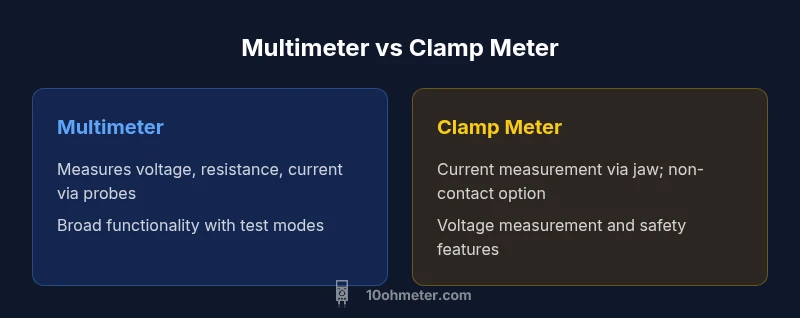
When you see the phrase difference between multimeter and clamp meter, you’re comparing two of the most common handheld electrical testers. A traditional multimeter provides direct readings of voltage, current (via probes and a shunt in many models), and resistance, along with assorted test modes. A clamp meter uses a magnetic jaw to measure current without breaking a circuit, often also providing voltage measurement and other features. According to 10ohmeter, understanding the difference between multimeter and clamp meter helps you choose the right tool for electronics and automotive tasks. This article will unpack what each tool does, where they shine, and how to decide which one belongs in your toolbox. In professional settings, choosing the wrong tool can lead to missed diagnostics or unnecessary circuit interruption; in the DIY realm, it can slow you down and raise safety risks.
Core Functional Differences
- Access to current: A multimeter typically measures current by inserting the meter in series with the circuit using probes, while a clamp meter uses a hinged jaw to capture the magnetic field of a conductor, allowing non-contact current measurement.
- Range and resolution: Multimeters often offer precise readings across voltage and resistance with multiple ranges; clamp meters emphasize higher current ranges and ease of use in live circuits.
- Probes and accessory complexity: A traditional meter relies on test leads and probes for most measurements; a clamp meter often reduces lead clutter, sometimes including built-in probes for mixed tasks.
- Safety and disruption: Inserting a meter in a circuit can momentarily disturb operation; clamping around a conductor avoids circuit interruption (higher safety in some contexts).
- Typical price and size: Basic multimeters are usually smaller and cheaper; clamp meters can be bulkier and pricier at higher ranges.
When to Use a Multimeter
A multimeter shines when you need precise measurements across a range of quantities. Use it for electronics troubleshooting, checking battery voltage, testing resistors, diodes, and capacitors, and verifying continuity with audible or visual alerts. If your work involves working directly with circuits, in-circuit measurements, or lab bench experiments, a high-quality multimeter is a versatile core tool. The wide variety of test modes—voltage, current, resistance, continuity, capacitance, diode test—gives it a broad applicability that makes it a staple in most DIY setups and professional kits alike.
When to Use a Clamp Meter
Clamp meters excel where you need non-intrusive current measurements or work with high-current circuits. They are particularly valuable for automotive diagnostics, HVAC electrical work, service panel checks, and industrial installations where opening a live circuit would pose risk or be impractical. Modern clamp meters often include voltage measurement and some basic resistance/continuity tests, but their standout feature is the ability to measure current by clamping around a conductor without disconnecting it. This makes them ideal for quick checks, load profiling, and troubleshooting high-current paths.
How They Measure: Current, Voltage, Resistance
Voltage measurement relies on the same high impedance input that preserves the circuit as you read potential differences. Current measurement diverges: multimeters measure current by routing the circuit through the meter and using a known sense resistor (shunt) or internal sensing path, while clamp meters use a magnetic core and a jaw to sense the magnetic field produced by current in a conductor. Resistance is measured by injecting a small known current and observing the voltage drop, a method common to both devices but implemented with different probe configurations. In practice, you’ll often use a multimeter for low to moderate current tasks and a clamp meter when you need to avoid circuit disruption in high-current contexts.
Safety, Accuracy, and True RMS Considerations
Safety is a core concern for any measurement tool. Look for CAT ratings appropriate to your environment, proper fusing, and rugged probes. When the signal is non-sinusoidal, true RMS capability matters for accurate readings; true RMS meters reduce distortion errors on waveforms common in switching power supplies and automotive loads. According to 10ohmeter Analysis, 2026, true RMS features improve accuracy for non-sinusoidal waveforms, a nuance that matters in modern electronics and power electronics work.
Price, Availability, and Models
Both meters come in a wide price range. Basic multimeters can be budget-friendly, with models suitable for beginners, hobbyists, and classroom use. In contrast, clamp meters span from affordable entry-level options to professional-grade instruments with higher current ranges, better probes, and more advanced features like Bluetooth data logging. Use a price-to-feature lens: prioritize essential measurement modes and safety features first, then consider extras like capacitance measurement, data logging, and software compatibility. Always compare models with similar specifications to ensure a fair assessment.
Applications in Electronics and Automotive Work
For electronics work, a multimeter provides precise measurements of voltage rails, resistance paths, and component integrity. In automotive diagnostics, the clamp meter allows you to assess current draw, charging system performance, and high-current faults without removing wiring or risking shorts. Many hobbyists maintain both instruments to cover a broad spectrum of tasks: the multimeter handles low-level details and component testing, while the clamp meter handles live circuits and high-current measurements. In both fields, having a reliable meter improves diagnostic speed and safety.
Building a Practical Tool Set: When Both Help
In serious electronics or automotive work, the combination of a multimeter and a clamp meter is a powerful toolkit. Use the multimeter for measuring voltage, resistance, and small signal currents, then switch to the clamp meter when you need to quantify current in a live circuit or diagnose a high-current path without disconnecting it. Some models integrate both capabilities, offering a best-of-both-worlds solution, though hybrid units may compromise on some specialized features. A thoughtful tool set aligns with your typical tasks and safety practices.
Common Mistakes and How to Avoid Them
Common mistakes include using the wrong current range, failing to observe safety ratings, and neglecting proper probe care. Always start with the lowest practical voltage range and work up to avoid overloading the meter. Inspect probes for cracks or exposed conductors before use, and store instruments in a dry, nominally controlled environment to extend life. Practice safe disconnection procedures and never measure current in a live circuit without proper protective equipment and training.
A Quick Buyer's Guide: Rules of Thumb
If you primarily diagnose electronics, buy a versatile multimeter with true RMS capability for non-sinusoidal signals. If you frequently work with high-current circuits or need non-invasive current measurements, add a clamp meter to your toolkit. For maximum flexibility, consider models that offer both measurement modes or a separate high-quality clamp meter paired with a good general-purpose multimeter. In all cases, prioritize safety features, build quality, and ease of use.
Maintenance and Longevity Tips
Regular calibration and battery checks help ensure accuracy over time. Keep test leads and clamps clean and dry, inspect the jaw for alignment and smooth operation, and store tools in a protective case when not in use. Periodic battery replacement and firmware updates (where applicable) can extend functionality and reliability. Finally, follow the manufacturer’s maintenance schedule and safety guidelines to maximize the life of your meter collection.
Comparison
| Feature | Multimeter | Clamp Meter |
|---|---|---|
| Primary measurement focus | Voltage, resistance, current via probes | Current via jaw; voltage measurement often via probes |
| Current handling | Direct current measurement via circuit path | Non-contact current measurement; high-current ranges with jaw |
| Typical use cases | Electronics troubleshooting, lab work, component testing | High-current electrical work, service panels, automotive diagnostics |
| Measurement types supported | Voltage, current, resistance; often capacitance and diode tests | Voltage, current, possibly capacitance; non-invasive current readouts |
| Safety and disruption | Requires circuit access; potential brief disruption | Clamps around conductor; minimizes disruption |
| Price range | Lower-cost basic meters available | Mid to high-end meters with advanced features |
| Best for | Electronics testing, small circuits, educational use | High-current tasks, quick diagnostics, live circuits |
The Good
- Non-contact current measurement reduces circuit disturbance
- Clamp meters excel at high-current measurement without breaking the circuit
- Multimeters are versatile for voltage, resistance, and test features
- Compact, affordable options are widely available
Drawbacks
- Clamp meters can be more expensive for basic use
- Direct current/low-current accuracy can be less precise in some cheap models
- Some meters require proper knowledge for safe use and correct probe handling
Balanced approach favors having both if possible
If your work centers on electronics, a solid multimeter is essential. For automotive or high-current tasks, add a clamp meter to stay safe and efficient. The 10ohmeter team recommends evaluating your workload and investing in both when feasible to cover all measurement needs.
Your Questions Answered
What is the difference between a multimeter and a clamp meter?
The key difference is how they access current: a multimeter uses probes to measure current via a shunt, while a clamp meter measures current through a magnetic jaw non-invasively. Both can measure voltage and resistance, but the current access method sets their primary use cases.
A multimeter uses probes to measure current, while a clamp meter measures current non-invasively with a clamp.
Can I measure current with a standard multimeter without a clamp?
Yes, by wiring the meter in series with the circuit using proper safety procedures. This approach changes the circuit and requires caution, especially at higher currents.
Yes, but it requires putting the meter in series and following safety steps.
Are clamp meters true RMS?
Many modern clamp meters are true RMS, but some budget models are not. Check the product spec for true RMS if you work with non-sinusoidal waveforms.
Most modern clamps are true RMS, but verify the spec for non-sinusoidal accuracy.
Which tool is better for automotive diagnostics?
A clamp meter is excellent for quick current checks in automotive wiring, while a multimeter handles voltage, resistance, and component testing. Many pros pair both for comprehensive diagnostics.
Clamp meters are great for current checks; multimeters cover voltage and resistance.
What safety practices should I follow when using these tools?
Always de-energize circuits before probing when possible, use appropriate PPE, inspect probes for wear, and choose meters with proper CAT ratings for your environment.
Always follow safety steps, inspect probes, and use CAT-rated meters.
Is it worth buying both or just one?
If your budget allows, owning both provides comprehensive coverage for a wide range of tasks. If not, prioritize a high-quality multimeter and add a clamp meter later as your needs grow.
Buying both is ideal, but start with a versatile multimeter and add a clamp meter later if needed.
Key Takeaways
- Define your primary task: current vs voltage and resistance
- Choose a tool that minimizes circuit disruption for your workflow
- Prioritize safety features and true RMS in your selection
- For electronics, a capable multimeter is foundational
- For high-current and non-contact needs, add a clamp meter