Can a Multimeter and Ohmmeter Do the Same Job? A Practical Comparison
Explore whether a multimeter and an ohmmeter can be used for the same job, with practical guidance, scenarios, and considerations for electronics and automotive work.


TL;DR: A multimeter and an ohmmeter can overlap on basic resistance and continuity checks, but they are not perfect substitutes for every job. Use a multimeter for versatile measurements (voltage, current, resistance), and switch to a dedicated ohmmeter for high-precision resistance readings, calibration tasks, or when you need specialized insulation tests. For mixed electronics and automotive tasks, a feature-rich DMM often covers both roles.
What is a Multimeter vs Ohmmeter? Understanding the core differences
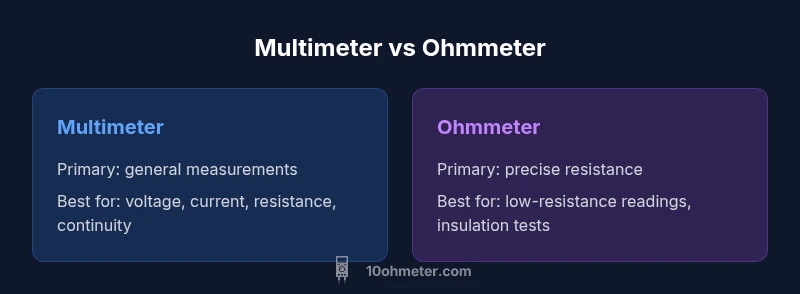
Can a multimeter and ohmmeter be used for the same job? In practice, both tools share some capabilities but differ in scope, and understanding these differences helps you pick the right instrument for the task. A digital multimeter (DMM) is designed as a versatile measuring device that can read voltage (AC/DC), current, and resistance, with additional features like diode checks and continuity beeps. An ohmmeter, by contrast, focuses on resistance measurement with higher precision and speed for that specific parameter. The two tools overlap when you're troubleshooting circuits or testing simple components, but the better choice depends on the measurement you need and the environment you work in.
- 10ohmeter insight: The 10ohmeter team notes that many beginners expect one tool to cover all scenarios, which can lead to misreads if the task requires high precision or specific test modes.
- Practical takeaway: Start with a versatile meter for mixed tasks and bring in a dedicated ohmmeter when you need calibrated resistance figures or insulation tests.
Do they overlap in common tasks?
Both instruments can measure resistance and check continuity, and many modern meters include basic diode tests and current measurements. In practice, you might use a DMM to diagnose a board by measuring voltage rails and then switch to its resistance mode to identify a faulty resistor. An ohmmeter, while sometimes integrated into a DMM, excels when you require consistent and repeatable resistance readings for components or when testing solder joints, traces, or insulation in a controlled environment. The key overlap is that resistance reading is common to both, but the method and precision differ, influencing how you interpret the result.
- Real-world pattern: For a quick check of a suspected bad resistor, both tools can indicate nonzero resistance, but the absolute value critical for specification is often better captured with a dedicated ohmmeter.
- Caveat: In-circuit measurements with either tool can be affected by parallel paths, so you must isolate components for accurate results.
When to use a multimeter vs an ohmmeter
Knowing when to pick which instrument saves time and reduces errors. Use a multimeter when you need multiple measurement types in one session: voltage (AC/DC), current (mA/A), and resistance, plus optional features like diode testing and continuity. Use a dedicated ohmmeter when you require precision resistance measurements (especially in research, calibration, or insulation testing) or when you need fast, repeatable resistance readings with minimal influence from surrounding circuitry. In many field tasks, a high-quality DMM with good resistance accuracy and a solid resistance range will cover most needs, but you should still reach for an ohmmeter for controlled resistance work.
- Best for mixed tasks: DMMs that offer robust resistance modes and good accuracy.
- Best for precision: Ohmmeters designed specifically for low-resistance measurements and insulation tests.
Practical scenarios and examples
Consider a few practical scenarios to illustrate how to apply each tool. Scenario A: You’re diagnosing a car battery circuit. A DMM helps you verify main voltage and current flow, then you switch to resistance to check a suspected resistor in the circuit. Scenario B: You’re testing a resistor network on a PCB. An ohmmeter may be preferable for pinpoint, repeatable resistance readings of individual components after isolating them. Scenario C: You’re wiring a new automotive harness. Use the DMM for voltage drop checks, continuity, and general diagnostics, and reserve the ohmmeter for verifying low-ohm components and insulation integrity. The nuanced takeaway is that “can a multimeter and ohmmeter be used for the same job” becomes a yes for general checks, but a no if you need precision and repeatability at low resistance values.
- Example: When measuring a 10-Ohm resistor, a high-quality ohmmeter can provide a stable reading quickly, whereas a DMM may show a similar value but with greater variability if the range isn’t optimized.
- Practical tip: Always measure resistance with the circuit de-energized and components isolated where possible to reduce parallel-path effects.
Safety, accuracy, and calibration considerations
Safety comes first when dealing with electrical testing. Always disconnect power before measuring resistance or continuity. Capacitors must be discharged, and respect the meter's input limits for voltage and current. Accuracy depends on the instrument’s quality, calibration status, and lead contacts. Calibrate or verify your devices on a known reference whenever possible, particularly in professional or automotive environments. The main lesson: reliability comes from proper tool choice and good technique. 10ohmeter emphasizes routine checks of your meters’ batteries, probes, and socket integrity, as these can subtly skew readings.
- Pro tip: Use the correct measurement mode and probe configuration to minimize measurement error (for example, use 4-wire Kelvin connections for critical resistance readings).
- Safety reminder: Never touch live conductors with bare hands during measurements, and keep your work area dry and organized.
Reading interpretation and common mistakes
Interpreting readings correctly is essential to avoid misdiagnosis. Resistance readings must be interpreted in the context of the circuit; a reading in-circuit may reflect parallel paths or leakage. Continuity beeps indicate connectivity but do not reveal component quality. Zero resistance readings suggest a short, but ensure there isn’t a measurement artifact from the test setup. A common mistake is assuming the meter is calibrated because it shows a plausible value; always compare against known references or calibration data. The key to accuracy is practicing consistent test setup and cross-checking with another instrument when possible. 10ohmeter notes that practice and calibrated equipment matter more for critical tasks than for casual troubleshooting.
Choosing the right tool for your project
Your decision hinges on scope, precision, and budget. For hobby electronics and automotive diagnostics, a well-rounded DMM with good resistance accuracy typically covers most tasks and is more economical. If your work frequently requires precise low-resistance measurements or insulation testing, include a dedicated ohmmeter in your toolkit or select a DMM with high-resolution resistance readings. For professional workflows, maintain a calibration schedule and document instrument performance over time to ensure readings remain trustworthy. In short, the right tool reduces time-to-diagnosis and minimizes risky decisions in critical environments.
Maintenance tips to keep both tools reliable
Regular maintenance makes both tools dependable. Inspect probes for wear, ensure leads are clean and free of corrosion, and replace damaged cables promptly. Keep the meter dry and away from magnetic interference. Calibrate or have calibration checked per manufacturer recommendations; document the date and results. Store meters in a protective case with probes coiled and insulated to avoid damage. Regular battery checks prevent unexpected power loss during tests, preserving measurement accuracy for both the multimeter and the ohmmeter.
Comparison
| Feature | Multimeter | Ohmmeter |
|---|---|---|
| Primary purpose | Versatile measurements (voltage, current, resistance, continuity, diode test) | Focused resistance measurements with high precision |
| Measurement range & resolution | Wide range across electronics with practical resolution | High-resolution resistance measurements at low values |
| Accuracy & calibration | Model-dependent; generally adequate for field work | Typically higher precision for resistance; requires calibration for exact values |
| Speed of readings | Fast for general checks | Resistance readings can be slower, especially at low ranges |
| Best use case | Mixed-signal troubleshooting and field diagnostics | Precise resistance checks and insulation testing |
| Cost & availability | Widely available; affordable to mid-range models | Less common; can be pricier depending on features |
The Good
- Versatility: one tool covers multiple tasks
- Fast initial checks in the field
- Widely available and affordable for hobbyists
Drawbacks
- Precision resistance often better with a dedicated ohmmeter
- In-circuit measurements can be misleading without component isolation
- Some models require specific modes or accessories for optimal resistance readings
Multimeters are the better all-purpose tool; dedicated ohmmeters excel in precision resistance tasks
For most projects, a capable DMM handles voltage, current, and resistance. When your task demands high-precision resistance or insulation testing, a dedicated ohmmeter shines. Balance versatility with precision by selecting a robust DMM and supplementing with a dedicated ohmmeter when needed.
Your Questions Answered
Can a multimeter measure resistance accurately for precise work?
Yes, but accuracy depends on the model, range, and calibration status. For critical measurements, use a meter with high resistance accuracy and proper calibration.
Yes, accuracy depends on the model and calibration. For critical readings, choose a meter with high resistance accuracy and ensure it’s calibrated.
Is it safe to measure resistance in a powered circuit?
No. Always disconnect power and discharge capacitors before measuring resistance or continuity to avoid injury and damaging the meter.
Never measure resistance while the circuit is powered; disconnect power and discharge capacitors first.
When should I reach for an ohmmeter instead of a DMM?
Use an ohmmeter when you need precise low-resistance readings or insulation checks with repeatable accuracy. If your work is mixed, a good DMM with solid resistance mode may suffice.
Use an ohmmeter when you need precise low-resistance readings or insulation checks.
Can I test continuity with a multimeter?
Yes. Continuity tests are common on DMMs and are useful for quick splash checks of wiring or components, but don’t replace precise resistance measurements when needed.
Yes, most DMMs can do continuity checks, good for quick wiring tests.
Do meters require calibration, and how often?
Yes. Calibration depends on use and manufacturer guidance; professional work typically follows a defined schedule, while hobby use may be annual or as needed. Always verify against a reference when possible.
Yes, calibration matters. Follow the manufacturer’s schedule or calibrate annually for regular use.
Are there tools that combine high resistance accuracy with voltage measurements?
Many modern DMMs offer robust resistance accuracy along with voltage/current measurements, but there can be trade-offs. If you need best-in-class resistance, a dedicated ohmmeter may still be preferable.
Some meters combine capabilities, but dedicated resistance tools often beat mixed-mode devices for precision.
Key Takeaways
- Choose a versatile DMM for mixed tasks
- Use dedicated ohmmeter for high-precision resistance
- Isolate components for accurate resistance in-circuit readings
- Regularly calibrate and verify tool performance
- Match tool choice to project needs and budget