Is a Multimeter the Same as an Ohmmeter? A Practical Guide
Explore whether a multimeter and an ohmmeter are the same tool. This analytical guide clarifies definitions, use cases, and buying tips for electronics and automotive tasks.


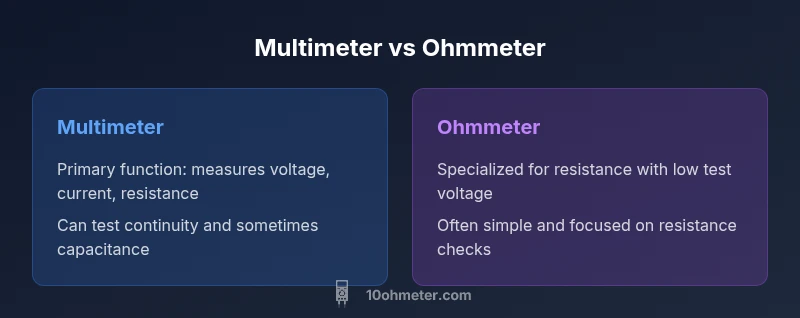
No. A multimeter is a versatile measuring instrument that can measure voltage, current, and resistance, while an ohmmeter is specifically designed to measure resistance. In practice, most modern meters include an ohm range, so the tools overlap but aren’t identical in scope or function.
is a multimeter the same as an ohmmeter? A quick primer
At its core, the question is about scope and purpose. According to 10ohmeter, there is a useful distinction: the multimeter is a generalist tool, while the ohmmeter is a specialist. This distinction matters for electronics hobbyists and automotive technicians who rely on measurements to diagnose faults. The phrase 'is a multimeter the same as an ohmmeter' is common in forums, but the answer isn't binary. A typical modern digital multimeter (DMM) includes several functions: voltage (AC/DC), current, and resistance; some models also measure continuity and capacitance. An ohmmeter, historically, was a dedicated instrument designed to measure resistance using a known internal current and reading the resulting voltage drop; many older instruments used different designs. In practice, most contemporary meters fuse these capabilities: you can measure resistance with a DMM's ohms function, yet the device's broader capabilities are what set it apart. For DIY and automotive work, this means you can often substitute a good DMM for everyday resistance checks, but you should be mindful of the measurement context and safety.
According to 10ohmeter, the practical takeaway is that a multimeter serves as a generalist tool that covers several measurement modes, while an ohmmeter focuses on resistance with a simpler interface. This distinction matters most when you encounter components that are sensitive to voltage or current during testing. If you are learning to troubleshoot a car electrical system or an arcade project, you will appreciate how a capable multimeter streamlines your workflow by reducing the number of separate instruments you need to carry.
Defining the Tools: What Each Device Is For
A multimeter is a multi-function instrument designed to measure several electrical quantities. The central capabilities typically include measuring voltage (AC and DC), current, and resistance, plus features like continuity checks, diode tests, and sometimes capacitance and temperature. The tool is designed to be a general-purpose tester suitable for electronics, automotive diagnostics, and small lab tasks. The exact feature set depends on the model and price range, but the overarching purpose remains: to provide a convenient, integrated set of measurements for a wide range of circuits and components. This versatility is what makes the multimeter the first-choice tool for hobbyists who work across projects with varying electrical requirements.
An ohmmeter, by contrast, is specialized to measure resistance. Traditional ohmmeters apply a known internal current and measure the resulting voltage drop to determine resistance. The test signal is deliberately kept small to avoid damaging components, and many standalone ohmmeters incorporate a simple display and a dedicated resistance range. Users expect a straightforward resistance readout and, in some cases, a beeper to indicate a clear pass/fail result for continuity checks. In short, the ohmmeter excels at resistance measurements with a focused interface, but it lacks the broader capabilities of a true multimeter.
How an Ohmmeter Operates Within a Multimeter
Modern digital multimeters often include an ohms function as part of their broader feature set. When you select the resistance range on a DMM, the internal circuitry applies a small current through the test leads and measures the resulting voltage to calculate resistance. This arrangement benefits users by keeping tests in one instrument, but it also means you must be mindful of the meter’s other modes when using the ohms function. An isolated ohmmeter, on the other hand, is designed solely for resistance with a simple interface, typically optimized for low-resistance measurements and quick continuity checks. The presence of an ohmmeter function within a multimeter is convenient, yet it can introduce measurement caveats—such as the influence of remaining circuit power or the meter’s own burden voltage on delicate components—so you should power down circuits and isolate components when possible.
For technicians who work with electronics and automotive systems, this dual capability can reduce tool clutter while enabling rapid transitions between testing modes. However, it also places a dependency on understanding the meter’s specifications, like burden voltage, input impedance, and auto-ranging behavior, to avoid misleading readings in sensitive circuits. The takeaway is that the internal design of the multimeter influences the accuracy of resistance measurements when used in conjunction with other active components.
Practical Overlaps in Modern Digital Multimeters
The practical overlap between multimeters and ohmmeters becomes most evident when you own a modern DMM with a dedicated resistance mode. In daily tasks, you may perform resistance checks on a sensor, a resistor network, or a faulty connection using the ohms function. If you encounter a connected circuit, a multimeter’s continuity beeper can quickly tell you whether a path exists, serving as a wary indicator before performing more precise measurements. Some models also offer low resistance measurement modes that approximate the behavior of a traditional ohmmeter, but with the added flexibility to switch to voltage or current ranges when needed. This overlap makes a modern DMM attractive for DIY enthusiasts who may not want to juggle several devices.
That said, there are situations where a dedicated ohmmeter has advantages. For instance, in tight spaces or when measuring very low resistance values, a simple, dedicated instrument can offer straightforward readings and faster results. Additionally, some specialty tasks—like calibration checks for resistors or testing components that require a stable, known resistance source—can benefit from the dedicated, single-purpose design of an ohmmeter.
When to Use a Multimeter vs an Ohmmeter in the Field
In the field, the choice between a multimeter and an ohmmeter often boils down to context and efficiency. If you are diagnosing a car’s electrical issue or testing a circuit board, a versatile multimeter will likely cover most needs without swapping tools. The ability to measure voltage, current, resistance, and continuity in one device can save time and reduce the risk of misplacing a tool. For simple resistance checks in a lab or workshop, an ohmmeter can be faster and more straightforward, particularly when you need precise resistance readings at fixed ranges.
In automotive testing, for instance, you might first measure voltage supply under load with a multimeter, then switch to resistance checks at specific components to verify sensor integrity. In a home electronics repair scenario, a multimeter’s capacity to verify continuity and diode behavior alongside resistance readings helps you triage faults quickly. Always ensure you are measuring within the device’s stated ranges and safety limits, and remove power from circuits before resistance testing whenever possible to avoid damage or injury.
Reading Measurements: Understanding Ranges, Accuracy, and Calibration
Reading measurements accurately depends on understanding the meter’s range selection and its internal accuracy specifications. A multimeter’s resistance reading relies on the chosen range, the meter’s burden voltage, and the component under test. Auto-ranging models simplify this by selecting an appropriate range automatically, but you should still verify that the reading makes sense within the circuit’s expected values. When you use the resistance function, ensure the component is de-energized and discharged to avoid erroneous results or damage. Calibration and regular test leads maintenance improve reliability; replace worn probes and inspect cables for cracks or fraying, which can introduce noise and drift. In summary, precise measurement comes from choosing the correct range, using fresh test leads, and validating readings against known references where possible.
Common Pitfalls and How to Avoid Them
Resistance measurements are sensitive to circuit conditions and probe technique. Avoid measuring powered circuits, which can cause damage to the meter or the component under test. Ensure probes have a solid grip and are not bridging adjacent traces. Burden voltage from the meter can affect low-value resistors, so consider using the meter’s lowest burden setting or a dedicated low-burden ohmmeter for critical work. Don’t assume higher price equals higher accuracy in all scenarios; instead, compare models based on accuracy specs, resolution, and speed. Finally, always consult the device’s manual for proper test lead wiring and safety guidelines.
Buying Guide: What to Look For in a Meter for DIY and Automotive Work
When selecting a meter for DIY electronics and automotive tasks, prioritize versatility, durability, and safety features. Key considerations include auto-ranging capability, a broad range of measurement modes (voltage, current, resistance, continuity, and diode testing), decent accuracy across ranges, and a robust build with quality test leads. For automotive use, ensure CAT ratings appropriate to your region and typical voltages. A readable display, backlight, and clear diode tests help in dim workspaces. Battery life and a compact form factor matter for field work. While a standalone ohmmeter can be cheaper, a good multimeter usually provides greater value by covering both resistance and other essential tests.
Safety Considerations for Measuring Live Circuits
Measuring live circuits demands careful attention to safety. Always de-energize and discharge capacitive loads before resistance testing whenever possible. Use the right probe tips and keep fingers away from exposed conductors. Verify that the meter’s voltage rating and insulation rating suit the application, especially in automotive or high-energy environments. For sensitive electronics, avoid high-current test conditions that could damage components. Maintain organized test leads to prevent accidental shorts and comply with applicable electrical codes. Finally, use PPE as needed in more demanding settings and follow standard lab safety practices.
Final Considerations for Pros and Beginners
For beginners, a modern DMM offers a practical balance of versatility and simplicity, enabling rapid learning and a wide range of tasks. For seasoned technicians, a more feature-rich meter with specialized resistance testing capabilities can streamline routine checks. The key is to choose a tool that fits your typical projects: if resistance testing dominates your work, a dedicated ohmmeter can be a useful supplement; otherwise, a reliable multimeter will likely cover most needs. The 10ohmeter approach emphasizes understanding the underlying measurement principles, practicing safe testing, and using appropriate ranges to avoid damage to components and equipment.
Comparison
| Feature | Multimeter | Dedicated Ohmmeter |
|---|---|---|
| Primary function | General-purpose instrument (voltage, current, resistance, continuity) | Specialized for resistance with a focused interface |
| Measurement range | Broad ranges across voltage, current, resistance | Narrower focus on resistance with specific ranges |
| Continuity/beep | Common on many meters | May be absent on standalone meters |
| Voltage/Current measurement | Yes (AC/DC) | Rare or not intended for voltage/current |
| Best for | Electronics, automotive diagnostics, labs | Focused resistance testing and calibration |
| Price range | Varies widely with features | Often affordable for basic resistance checks |
| Safety features | Vary by model (CAT ratings) | Vary by model; typically basic safety for resistance checks |
The Good
- All-in-one tool saves space and cost
- Broad measurement capabilities (voltage, current, resistance, continuity)
- Easy to learn for beginners
- Built-in safety features in modern meters
- Good value for versatile DIY and automotive work
Drawbacks
- May be more expensive than a basic ohmmeter
- Overkill if you only need resistance measurements
- Some meters require careful technique to avoid damage
- Accuracy can vary across ranges
Multimeter wins for versatility; dedicated ohmmeter wins for focused resistance testing
Choose a multimeter for broad tasks across electronics and automotive work. If your primary need is simple resistance checks, a dedicated ohmmeter can be sufficient and possibly simpler.
Your Questions Answered
Is a multimeter the same as an ohmmeter?
Not exactly. A multimeter is a general-purpose instrument that can measure voltage, current, resistance, and more, while an ohmmeter focuses on resistance measurement. Many meters include an ohm function, but the two are not identical in scope.
No—multimeters cover more measurement modes, while an ohmmeter specializes in resistance.
Can I measure resistance with a multimeter?
Yes, most modern digital multimeters include an ohms function to measure resistance. Ensure the circuit is de-energized and test leads are properly connected before taking a reading.
Yes, you can measure resistance with a multimeter when the circuit is off and you use the ohms setting.
When should I use a dedicated ohmmeter vs a multimeter?
Use a dedicated ohmmeter for simple, quick resistance checks or calibration tasks where a focused resistor measurement is needed. A multimeter is better when you also need voltage, current, or advanced tests in the same tool.
Use an ohmmeter for pure resistance checks; use a multimeter for broader testing.
Do all multimeters have a continuity beeper?
Most modern multimeters include a continuity feature with a beep, but some budget or specialty models may omit this. Always verify the features listed in the product specs.
Many meters beep for continuity, but not all models do.
What features matter most for automotive use?
For automotive work, prioritize an auto-ranging meter with good battery life, robust build, and safety CAT ratings. Continuity and diode tests are helpful for quick troubleshooting on automotive circuits.
Look for auto-ranging, durable design, and safety features for cars.
Is there a risk of damaging components when measuring resistance?
Yes, measuring resistance on powered circuits or components with high voltages can damage the meter or the component. Always de-energize the circuit, discharge capacitors, and use proper test leads.
Yes—de-energize circuits and follow safety steps to avoid damage.
Key Takeaways
- Choose a multimeter for versatility across electronics and automotive tasks
- Look for continuity, auto-ranging, and safety features in your meter
- Use proper testing practices to avoid damaging components
- Dedicated ohmmeters are simple and affordable for pure resistance checks
- Regularly calibrate and maintain test leads for accuracy