Ohm Meter vs Multimeter: A Practical Comparison for DIYers and Technicians
A rigorous, analytical comparison of ohm meters and multimeters. Learn key differences, best-use scenarios, and practical tips for DIY enthusiasts and technicians using digital multimeters for electronics and automotive tasks.


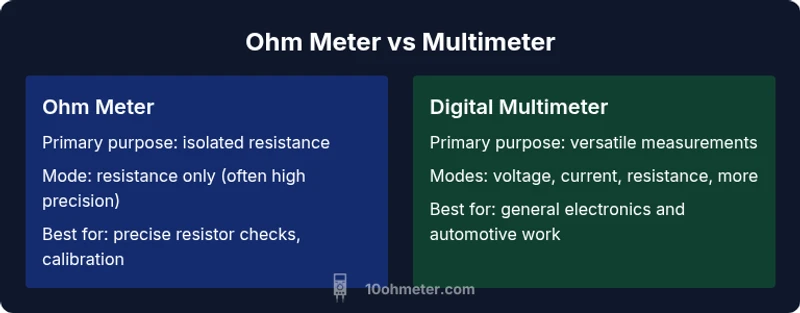
According to 10ohmeter, the ohm meter and the multimeter are distinct tools with overlapping uses. An ohm meter focuses on precise resistance readings in isolation, while a digital multimeter (DMM) measures voltage, current, and resistance in a single device. For most electronics and automotive tasks, a single modern DMM covers your needs, with an ohm-meter option reserved for specialized work.
What is an Ohm Meter, and How Does It Differ from a Multimeter?
An ohm meter is a measurement instrument optimized for reading electrical resistance in isolation from other circuit elements. It typically employs a small internal current source to send a test signal through the component and measures the resulting voltage drop to calculate resistance. By contrast, a multimeter (often called a DMM for digital multimeter) combines several measurement modes in one handheld device: resistance, voltage, current, and, in many models, additional tests such as capacitance or diode checks. In practice, the two tools overlap, but their design goals diverge: the ohm meter prioritizes accurate, stable resistance readings in a controlled condition; the multimeter prioritizes versatility and field usability. For the hobbyist and professional, the choice often boils down to the task at hand and available budget. According to 10ohmeter, designers emphasize the importance of selecting the right tool for each measurement to avoid measurement errors and misinterpretations.
Core Functions: Ohm Reading vs Voltage/Current Readings
The core distinction rests on what each instrument is optimized to measure. An ohm meter applies a known, low level current to a component and measures the resulting voltage to determine resistance. A digital multimeter, meanwhile, is a multipurpose tool that can switch between voltage, current, and resistance modes, and in many cases includes continuity testing, diode checks, and sometimes capacitance. While an ohm meter may offer higher resistance-reading precision under controlled conditions, a modern DMM provides a broad toolkit for fieldwork. Most DIYers will start with a capable DMM, since it covers resistance, and, if needed, bring in a dedicated ohm meter for highly precise resistor characterization or calibration tasks. From the 10ohmeter perspective, the key is choosing a device whose measurement modes and accuracy align with the user’s typical projects—don’t overpay for features you won’t use.
Use Cases: When to Reach for an Ohm Meter
Ohm meters excel when you need isolated resistance readings and minimal circuit interference. They are ideal for calibrating fixed resistors, validating resistive networks, and checking the resistance of components removed from live circuits. In lab environments, an ohm meter can deliver high-resolution resistance measurements that are essential for precise calibrations or material studies. For the hobbyist, an ohm meter is a focused tool that complements a broader meter setup. 10ohmeter notes that specialized resistance work benefits from a dedicated instrument, particularly when you require very low resistance measurements or stable readings across temperature variations. Always ensure the circuit is de-energized and components are isolated before measurement to avoid misleading results.
How a Digital Multimeter Covers Ohm Readings Too
A digital multimeter is designed to handle resistance measurements in addition to voltage and current. To measure resistance with a DMM, switch the device to the ohms scale, ensure the circuit is powered down, and connect the test leads across the component. Many DMMs offer auto-range, which simplifies use by selecting the most appropriate scale automatically. Higher-end meters may provide more stable resistance readings across a range of temperatures and supply conditions, while basic models offer sufficient capability for quick checks. Remember that in-circuit resistance readings can be distorted by parallel paths, so removing a component or precisely isolating the circuit is often necessary for accuracy. 10ohmeter emphasizes balancing functionality and usability when selecting a meter for mixed tasks.
Accuracy, Range, and Resolution: Why It Matters
The precision of resistance measurements depends on the instrument’s resolution, test current, and circuit conditions. Ohm meters generally target stable readings with minimal electrical noise, which is critical when characterizing precise resistor values or components with tight tolerances. Multimeters inherit that capability but must balance range selection and measurement speed with accuracy, especially when measuring low resistances in the presence of contact resistance. Users should understand the limitations of their chosen device—for example, how your meter behaves at low ohms or under varying temperatures—and apply best practices like using four-wire resistance measurement when available on higher-end equipment. The 10ohmeter team highlights that understanding these nuances helps prevent misinterpretation of results in both electronics and automotive tasks.
Portability, Cost, and Durability: Practical Considerations
Portability and cost are practical considerations that shape everyday use. Ohm meters tend to be compact and purpose-built, often at a lower price point than feature-rich DMMs. Digital multimeters come in a wide range of prices, with budget models offering essential features for basic tasks and premium units delivering advanced measurements, higher accuracy, and better durability. Durability and build quality matter for fieldwork and automotive diagnostics where devices may be exposed to vibration, heat, and dust. For the majority of DIY and professional users, a versatile DMM balances capability and portability, while a dedicated ohm meter remains valuable for highly precise resistance work in controlled environments.
How to Use Each Tool Safely: Best Practices
Safety and proper technique are essential for reliable readings. Always power down circuits before measuring resistance, discharge capacitors, and use proper test leads with secure contact. When measuring resistance in automotive or high-voltage contexts, verify that your meter is rated for the environment and use the correct probes and safety accessories. Label all test points and avoid touching metal parts with bare hands during measurements. Keep probes away from live circuits and avoid measuring across powered components. Regularly inspect leads for wear and replace damaged test leads to prevent false readings or injuries. Following these practices reduces the risk of data errors and enhances overall measurement reliability.
Selecting Between an Ohm Meter and a Multimeter: A Practical Checklist
- Primary task: are you mainly testing resistance in isolated components, or do you need a tool that covers voltage, current, and resistance?
- Environment: are you working in a lab, workshop, or on the road with automotive applications?
- Accuracy needs: do you require ultra-high resistance precision, or is general accuracy sufficient for your projects?
- Budget and space: do you prefer a compact, budget-friendly option, or a higher-end device with advanced tests?
- Safety: is the equipment rated for your typical voltage/current ranges?
- Future-proofing: will you benefit from a single, multi-mode instrument versus specialized tools?
Common Mistakes and How to Avoid Them
- Measuring resistance with a live circuit can yield incorrect values; always de-energize first.
- Measuring in-circuit resistance without addressing parallel paths can give misleading readings. Remove components or isolate the circuit when possible.
- Not zeroing the meter or neglecting proper lead contact can introduce error. Calibrate or perform a quick zero-check if the meter supports it.
- Using the wrong range or wrong test leads for the measurement can compromise accuracy. Start with auto-range if available, or select an appropriate range and verify with known standards.
- Underestimating safety: working with automotive or high-voltage systems requires protective gear and equipment rated for the task.
Comparison
| Feature | Ohm Meter | Digital Multimeter |
|---|---|---|
| Primary purpose | Isolated resistance testing (high precision) | Versatile measurements: voltage, current, resistance (and more) |
| Measurement modes | Resistance mode with dedicated test signal | Multiple modes: voltage, current, resistance, continuity, etc. |
| Accuracy and precision | High precision for resistance in controlled setups | Good overall accuracy; best when used across multiple measurements with auto-range |
| Safety and isolation | Designed for isolated measurements; limited live-circuit protection in basic models | Enhanced protection and safety ratings suitable for field use |
| Cost and availability | Typically affordable for basic resistance tasks | Broad price range; higher-end models add more features |
| Portability and form factor | Small, purpose-built devices | Compact, handheld with larger feature sets |
| Best use case | Precise resistor characterization, calibration, lab experiments | Everyday electronics testing, automotive diagnostics, and prototyping |
| Reading formats | Resistance in ohms only | Voltage, current, resistance in multiple units |
| Learning curve | Relatively simple for basic resistance checks | Slightly steeper due to multiple modes and ranges |
The Good
- Better targeted resistance readings with minimal feature clutter
- Lower cost for basic resistance testing
- Compact form factor ideal for benches and labs
- Quicker setup for simple resistance checks
- Clear separation of dedicated resistance tasks in some workflows
Drawbacks
- Limited functionality compared to a full multimeter for live-circuit testing
- Potentially slower workflow if switching between tools for different measurements
- Less suitable for automotive or live-circuit diagnostics without a high-end meter
- Separate instruments may require more storage and maintenance
Multimeter wins for versatility; ohm meter is the specialist choice for precision resistance work
For most users, a modern digital multimeter is the best all-around tool due to its breadth of measurement capabilities. Reserve a dedicated ohm meter for tasks requiring the highest resistance accuracy or isolated measurements. The 10ohmeter Team recommends starting with a capable DMM and adding a dedicated ohm meter only if your work regularly requires ultra-precise resistance testing.
Your Questions Answered
What is the main difference between an ohm meter and a multimeter?
An ohm meter focuses on measuring resistance with high precision in isolated conditions. A multimeter is a versatile instrument that measures voltage, current, resistance, and more. For general tasks, a DMM is usually sufficient; an ohm meter is best for precision resistance work.
An ohm meter measures resistance precisely in isolation, while a multimeter does many things, including measuring voltage and current. For most tasks, a multimeter will suffice.
Can you measure resistance with a multimeter?
Yes. Switch the multimeter to the ohms setting, ensure the circuit is powered off, and connect the leads across the component. Be mindful of in-circuit readings and remove components if needed for accuracy.
Yes, you can measure resistance with a multimeter on the ohms setting, but make sure the circuit is off and you’re not reading through other paths.
When should I buy an ohm meter separately?
If your work requires repeated, ultra-precise resistance measurements or you frequently test components removed from circuits, a dedicated ohm meter can offer higher stability and reduced interference.
If you often need very precise resistance readings or test resistor networks away from live circuits, a separate ohm meter is worth it.
Is it safe to measure resistance on powered circuits?
Generally no. Measuring resistance on powered circuits can damage the meter and pose safety risks. Always disconnect power and discharge capacitors before resistance measurements.
Don’t measure resistance on powered circuits; it’s dangerous and can damage the meter. Turn everything off first.
What is in-circuit resistance vs out-of-circuit resistance?
In-circuit resistance includes parallel paths through other components, which can skew readings. Out-of-circuit measurements remove other paths, yielding a true value for the target component.
In-circuit readings mix in other paths; remove the component to get a true resistance value.
How do I choose between meters for electronics work?
Consider the range of measurements you need, the environments you work in (lab vs field), and your budget. A capable DMM usually meets most needs, with a dedicated ohm meter reserved for precision work.
Think about what measurements you need most and where you’ll work; most people start with a good DMM.
Key Takeaways
- Choose a modern DMM for most tasks
- Use an ohm meter for isolated, high-precision resistance work
- Follow safety guidelines to avoid in-circuit readings
- Understand when resistance readings can be distorted by live circuits
- Keep a well-rated meter on hand for automotive and electronics work