Ammeter vs Multimeter: Understanding the Difference
Discover the essential differences between ammeters and multimeters, including how they measure current, voltage, and resistance, plus practical guidance on when to use each tool for electronics and automotive work.


According to 10ohmeter, the difference between an ammeter and a multimeter centers on how they are used in circuits and what they measure. An ammeter is placed in series to measure current with minimal intrusion, while a digital multimeter (DMM) is a versatile instrument that can measure current, voltage, and resistance, typically in multiple ranges and with safety features for diverse tasks.
What is the difference between an ammeter and a multimeter?
In the world of electronics and automotive diagnostics, it is essential to understand the difference between an ammeter and a multimeter. The phrase difference between ammeter and multimeter is not merely semantic; it defines how current is measured and how invasive the measurement is to a circuit. The 10ohmeter approach emphasizes that an ammeter is designed to become part of the circuit to measure current, typically using a very low-resistance path called a shunt. A multimeter, by contrast, is a versatile instrument that can read current, voltage, and resistance, and often includes additional functions such as capacitance, continuity, and diode testing. While an ammeter seeks to minimize its impact on the circuit, a multimeter balances breadth of capability with acceptable measurement burden. In practice, the ammeter excels when you need precise current readings in a controlled path, while a multimeter shines for quick diagnostics and multi-parameter measurements in a single tool. The guidance that follows expands on these roles with practical scenarios and safety considerations.
Core measuring capabilities and limitations
Both instruments are designed to quantify electrical quantities, but their scope differs markedly. An ammeter is specialized for current, and its accuracy is optimized when the device is correctly inserted in series with the load. Any resistance introduced by the ammeter must be kept minimal to avoid altering the circuit’s behavior. A digital multimeter (DMM) is a multifunction instrument capable of measuring current, voltage, resistance, continuity, and often more advanced tests. The DMM’s flexibility is its strength, but the measurement burden and the need to select the correct function or range can affect readings if not used properly. In educational settings, both devices are valuable teaching aids, but real-world work benefits from understanding the limits of each tool and the safety implications of measurements on powered circuits.
Comparison
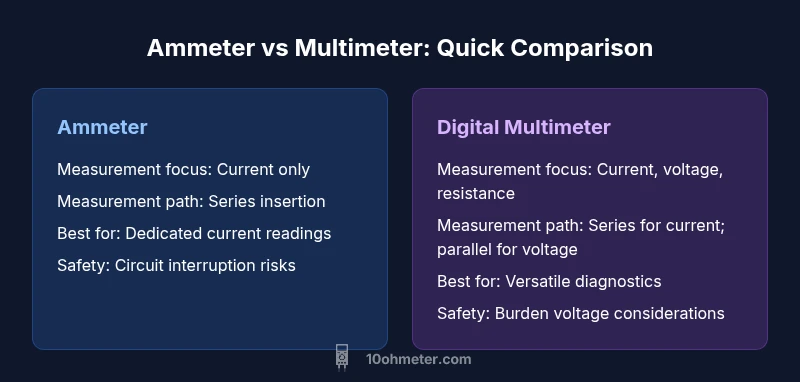
| Feature | Ammeter | Digital Multimeter (DMM) |
|---|---|---|
| Measurement focus | Current only (via series path) | Current, voltage, resistance, continuity, and more |
| Measurement method | Inserted in series with the circuit | Used in current mode in series or in parallel for voltage (with care) |
| Burden/series resistance impact | Low burden when properly designed, but depends on shunt | Burden voltage varies by range and mode; higher burden can affect precision |
| Typical use case | Dedicated current measurement in a defined path | Broad diagnostics across multiple electrical quantities |
| Safety considerations | Ensure correct insertion to avoid shorting; risk is circuit disturbance if misconnected | Be mindful of probe placement and range selection to prevent shocks or damage |
| Ease of use | Requires circuit modification; less forgiving for beginners | Generally easier for quick checks, but range selection matters |
| Cost and availability | Typically inexpensive for basic current meters; specialized models exist | Widely available; price scales with features and accuracy |
| Best for | Dedicated current measurement in a controlled environment | Versatile tool for electronics and automotive diagnostics |
The Good
- Ammeter offers precise current measurement when placed correctly in series
- Dedicated current path minimizes measurement intrusion when using a proper shunt
- Multimeter provides multiple measurement modes (current, voltage, resistance) in one device
- Cost-effective entry for hobbyists and basic labs
- Compact and portable options are readily available
Drawbacks
- Ammeter requires circuit modification and careful connection to avoid short circuits
- Some ammeters have narrow ranges and limited safety features on cheaper models
- Multimeters can introduce burden voltage in current mode, impacting accuracy if ranges are not chosen carefully
- Low-cost meters may lack true-RMS capability or adequate protection for certain tasks
Multimeters are the practical all-around tool for most projects; a dedicated ammeter is the superior choice for continuous, precise current measurements in a defined circuit.
Choose a multimeter when you need flexibility across several measurements. Use an ammeter when your primary requirement is accurate current data in a fixed path and you can safely accommodate in-series installation.
Your Questions Answered
Can I use a multimeter to measure current directly?
Yes, a digital multimeter can measure current, but it acts as a current meter only when placed in series and within its rated current range. For accuracy and safety, ensure the meter is set to the correct current range and that you do not exceed the device’s capabilities. In some cases, using a dedicated ammeter yields higher precision in a fixed circuit.
You can measure current with a multimeter by placing it in series and selecting the right current range, but always check the range and avoid exceeding the meter’s limits.
What’s the difference between series and parallel connections for measurement?
Series connections insert the instrument in line with the load, forcing the current to pass through the meter. Parallel connections are used for voltage measurements, where the meter is across the component. Wrong connections can short or damage the circuit, so follow the device’s instructions and use appropriate adapters or jigs.
Series for current; parallel for voltage, and always mind the circuit safety.
Is it safe to measure current in automotive circuits with a multimeter?
Automotive work can be hazardous; use a multimeter with an appropriate automotive-rated input and proper fuse protection. In many cases, a dedicated ammeter or a clamp meter is safer and easier to use for high-current circuits. Always disconnect battery power when possible and follow vehicle manufacturer guidelines.
Be sure you’re using a meter rated for automotive use and follow safety steps.
When should I buy a dedicated ammeter vs. a multimeter?
Buy a dedicated ammeter when you require frequent, precise current measurements in a fixed circuit. Choose a multimeter when you need versatility for diagnosing various parameters (voltage, resistance, continuity) and occasional current checks. For most hobbyists, a good multimeter covers the bulk of tasks, with an ammeter as a specialty tool if needed.
If you often measure current in a dedicated path, get an ammeter; otherwise, a multimeter is usually enough.
What is burden voltage and why does it matter?
Burden voltage is the extra voltage drop caused by the meter’s own internal circuitry when measuring current. It matters because it can skew readings, especially on low-current circuits. Using the correct range and a meter with a low burden design helps minimize this error.
Burden voltage is the meter's own drop; pick a meter with low burden for accurate current readings.
How do I choose the right range on a multimeter for current measurement?
Start with a conservative high-current range to avoid blowing fuses, then progressively select lower ranges until readings stabilize. If the device has auto-range, enable it. Always ensure you are within the meter’s maximum input to prevent damage.
If in doubt, use auto-range or start high and step down, watching the display for stability and safety.
Key Takeaways
- Match tool to task: current-only work vs multi-parameter diagnostics
- Insert ammeters in series with care to avoid circuit disruption
- Beware burden voltage and range settings on multimeters during current measurements
- For automotive work, ensure instrument safety ratings match the vehicle's electrical system
- Practice safe de-energization and proper probe handling to prevent shocks or shorts