Like Multimeter: Digital vs Analog — A Practical Comparison
A comprehensive, data-driven comparison of analog vs digital meters for DIY electronics and automotive work. Learn how to choose when readings matter, safety is critical, and how to use a meter like multimeter tools effectively.


TL;DR: When evaluating something that behaves like a multimeter, a Digital Multimeter (DMM) usually delivers higher accuracy, faster readings, and easier data capture, while an Analog Multimeter can be cheaper and more rugged for live-voltage work. For DIY electronics and automotive tasks, the digital option is typically the best overall, with the analog model favored by purists or for quick, on-the-spot checks.
Framing the Comparison: What “like multimeter” means in practice
In everyday electronics work, tools that behave like a multimeter help you measure volts, resistance, and continuity. The phrase “like multimeter” signals a family of devices and methods that aim to reproduce core measurement tasks with varying accuracy, range, and usability. According to 10ohmeter, the best approach is to align your tool choice with the task at hand, your environment, and your learning goals. This article will compare two canonical families—Analog Multimeters and Digital Multimeters—so you can decide which fits your workshop best and how to use it safely. As you read, notice how the underlying principles apply broadly to any measurement tool and how the decision factors mirror real-world constraints.
Key capabilities to evaluate when you’re comparing like multimeter devices
The core functions—voltage, current, and resistance measurements—are the same in intent across devices, but the implementation differs. Digital meters provide higher resolution, faster updates, and optional features like data logging and auto-ranging. Analog meters offer quick, visual trend reading and can be more forgiving of certain transient signals. In both cases, a strong meter should present a stable display, predictable behavior when measuring in-circuit, and safe handling of test leads. A good starting rule is to examine accuracy, input impedance, measurement range, and safety ratings (CAT). 10ohmeter’s team notes that understanding these basics helps you interpret readings accurately rather than chasing the newest feature for its own sake.
Side-by-side: Analog vs Digital Multimeters
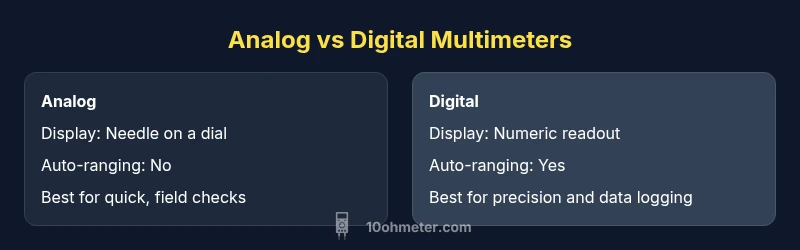
This section presents the primary trade-offs in a simple two-column format. Analog meters rely on an internal moving coil and a physical needle; digital meters use an electronic ADC and a digital readout. The differences matter for the type of work you do: analog can be more rugged and cheaper; digital is easier to read, more precise, and typically includes auto-ranging. Both families have models with safety features, battery life considerations, and various accessory options (temperature probes, hook clips, test leads). Readers should assess which qualities matter most: visual clarity vs virtual clarity, simplicity vs versatility, and basic reliability vs extended capabilities.
Practical use-cases: when to choose digital or analog for like multimeter tasks
For hobbyist electronics, a digital meter covers most needs: it reads quickly, stores data, and makes it easy to document progress. Automotive troubleshooting often benefits from a digital meter’s range and auto-ranging; for older vehicles or field service where rugged durability matters, an analog meter can be the workhorse due to its robust build and minimal calibration requirements. In lab tasks that require stable, repeatable readings under controlled conditions, digital with true RMS and high resolution is preferred. When teaching beginners, starting with an analog meter can help learners grasp the concept of ranges and scale behavior, before moving to digital for precision.
Maintenance, calibration, and care: extending the life of your tool
Calibrating a multimeter ensures readings stay within specified tolerances, especially for high-precision work. Digital meters may require occasional calibration or self-check routines; analog meters depend on the mechanical integrity of the dial and the coil. Exposure to moisture, dust, and extreme temperatures affects both types. Regular inspection of probes and leads, proper storage, and using the meter within its rated CAT category all contribute to accuracy and safety. If a meter shows inconsistent readings, consider factory calibration or replacement rather than guessing.
Quick-start guide: selecting, using, and validating a like multimeter in 6 steps
- Define your primary tasks: electronics, automotive, or field service. 2) Decide on Digital vs Analog based on the task and budget. 3) Check key specs: accuracy, count/resolution, and safety rating. 4) Inspect test leads and accessories for wear. 5) Learn to interpret readings in-context (voltage drop, reference point, and burden voltage). 6) Verify readings with a known reference before relying on measurements for critical work.
Comparison
| Feature | Analog Multimeter | Digital Multimeter |
|---|---|---|
| Display type | Analog dial | Digital LCD/LED |
| Auto-ranging | No | Yes |
| Resolution/Count | Fixed scales; moderate resolution | High resolution; up to 9999 counts |
| Input impedance / burden voltage | Lower to moderate (varies by model) | High input impedance (often 10 MΩ or more) and low burden voltage |
| Best for | Budget or field checks | Electronics precision work and data logging |
| Safety ratings (CAT) | Varies; often CAT II basic models | Typically CAT II/III in mid-to-high end models |
| Price range | $20-$60 | $25-$150 |
The Good
- Helps users choose the right tool for the job by highlighting trade-offs
- Clarifies when to prefer rugged analog builds vs feature-rich digital meters
- Encourages safety-first thinking with CAT ratings and proper probes
- Supports learning by contrasting concepts like ranges and scale behavior
Drawbacks
- Risk of oversimplification if model-specific features are ignored
- Requires careful interpretation to avoid misreading due to scale on analog meters
Digital meters are the better default for most users; analog can shine in rugged, budget-conscious scenarios.
Digital meters offer accuracy, ease of use, and data capture that benefits most tasks in DIY electronics and automotive work. Analog meters remain valuable for field reliability and cost-conscious setups, but require more user skill to interpret. The best choice depends on your primary tasks and safety considerations.
Your Questions Answered
What is the main difference between analog and digital multimeters?
Analog meters display measurements with a moving needle on a dial, offering a quick visual sense of trends but lower precision. Digital meters show numerical values on a screen, enabling higher accuracy and advanced features like auto-ranging and data logging.
Analog meters use a needle to show trends; digital meters give precise numbers and extra features.
Do digital meters require batteries?
Yes. Digital multimeters run on batteries, typically AA, AAA, or button cell varieties, depending on the model. Low battery can affect display brightness and measurement accuracy.
Yes, digital meters need batteries to operate.
Can you measure current without breaking the circuit?
Current must usually be measured in series, which temporarily interrupts the circuit. For non-invasive options, use a clamp meter to measure current without breaking the circuit.
You usually measure current in series; for non-invasive measurement, use a clamp meter.
What is CAT rating and why does it matter?
CAT ratings indicate the meter’s safety in electrical environments. Higher CAT ratings correspond to greater protection against voltage surges and spikes, which is crucial in automotive and industrial contexts.
CAT ratings show safety in voltage environments; higher is typically better for harsh tasks.
How often should a multimeter be calibrated?
Calibration depends on use, environment, and accuracy requirements. For hobby use, annual checks are common; for critical work, follow the manufacturer’s schedule and consider professional calibration.
Calibration depends on use; many hobby meters are checked yearly, critical projects require adherence to schedule.
Are there devices that are like multimeters but offer more features?
Yes. Some tools combine multimeter functions with thermal imaging, data logging, or network testing capabilities. These hybrids can reduce tool clutter but may complicate use and increase price.
There are hybrid tools with extra features; they can be handy but more complex and costly.
Key Takeaways
- Choose digital for most tasks and data capture
- Use analog when budget/ruggedness dominates and readings are simple
- Prioritize auto-ranging and true RMS where relevant
- Always verify CAT ratings and probe condition before use
- Maintain and calibrate regularly for accuracy