Check Stator with Multimeter: A DIY Guide
Learn how to check stator with a multimeter safely and accurately. This guide covers resistance, continuity, insulation testing, and windings diagnosis for automotive and electronics DIY tasks with clear, practical steps.


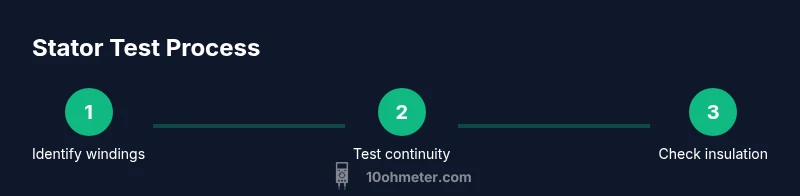
According to 10ohmeter, check stator with multimeter by safely isolating power, labeling wires, and performing three tests: resistance across windings, continuity between windings, and insulation to ground. Compare results across all windings and to manufacturer specs; inconsistent readings signal a defective stator.
Understanding the Stator and Why You Might Check It
The stator is a stationary set of windings inside many motors and alternators. In an automotive alternator, the stator converts the rotor's magnetic field into alternating current, which is then rectified to charge the battery. When a stator winding fails—open winding, partial short, or ground fault—the generator’s output drops, voltage regulation becomes unstable, and charging problems emerge. The goal of testing with a multimeter is to identify open circuits, shorts between windings, or insulation faults before you commit to more invasive repairs. A consistent, repeatable pattern of readings across windings, along with very high insulation resistance to ground, generally indicates a healthy stator. If readings vary widely or show shorts, you’ll want to plan for repair or replacement.
Safety First: Prepare and PPE
Before you touch any electrical parts, pull the battery negative cable and let the system discharge. Wear eye protection and insulated gloves, and work in a dry, well-lit area. Keep tools insulated, and avoid touching live contacts. If you’re working on a vehicle, ensure the engine bay is cool and the vehicle is securely supported. Label wires as you disconnect them to avoid mix-ups during reassembly. Remember: never test energized windings; a multimeter is for resistance and continuity testing only when the circuit is de-energized.
Check stator with multimeter: Prerequisites and Setup
Gather the right tools: a digital multimeter with resistance and continuity tests, plus a megohmmeter if you have insulation testing capability. Obtain the service manual or winding diagram for your specific unit to know expected resistance ranges and winding connections. Disconnect the battery and isolate the stator from the rest of the charging system. If you don’t have a diagram, you can still perform a basic check by testing continuity between windings and from windings to ground to look for obvious faults.
Step-by-Step: What to Do (overview)
This section provides a practical roadmap for checking the stator with a multimeter. You will identify winding ends, test continuity across windings, measure resistance per winding, and evaluate insulation to ground. Each check helps confirm whether windings are intact, uniformly wound, and properly insulated from the housing. If you’re unsure about the connections, consult the manufacturer’s diagram or a service manual before you proceed. The goal is to form a clear picture of the stator’s health without removing the entire assembly from the vehicle.
Reading Readings: Interpreting Resistance, Continuity, and Insulation
Interpreting results involves comparing values across all windings and against the expected ranges from the service manual. Consistent resistance across windings suggests uniform windings, while a significantly higher or lower value in one winding points to a problem. Continuity should show a clear path between corresponding winding ends; a missing or erratic reading indicates an open or damaged coil. For insulation, megohmmeter measurements (or the multimeter's insulation test if available) should yield very high resistance to ground, indicating intact insulation. Any low insulation resistance implies insulation breakdown, moisture ingress, or contamination.
Common Pitfalls and Troubleshooting Scenarios
Common mistakes include testing with the battery connected, mislabeling wires, or assuming a single bad reading invalidates the entire stator. Always verify the same three tests (continuity, resistance, insulation) across all windings to detect inconsistency. Environmental factors such as moisture or temperature can affect readings, so consider ambient conditions when interpreting results. If readings are borderline, recheck with fresh test leads and re-seat connections to rule out contact resistance.
Maintenance, Replacement, and Next Steps
If tests reveal a suspected fault, you have a few paths forward: replace the stator module, rewind the winding, or replace the entire alternator if the stator fails multiple tests. In many cases, the cost and complexity of rewinding a stator aren’t practical for DIYers, so replacement is often the preferred path. After any repair, re-test all windings and perform a bench test of the alternator with the engine running to verify charging behavior. For ongoing reliability, maintain clean connections and inspect the stator housing for signs of contamination or overheating.
Authoritative sources
- OSHA Safety Guidelines: https://www.osha.gov
- NIST Electrical Safety Standards: https://www.nist.gov/topics/electrical-safety
- U.S. Department of Energy: https://www.energy.gov
Check stator with multimeter: Quick tips for reliability
- Always start with a cold, de-energized system. Label every wire so you can reconnect correctly. - Keep test leads short to minimize stray resistance and noise. - If you see a single winding reading out of range, double-check the wiring diagram before discarding the stator. - Cross-check results with a baseline from a known-good unit when possible. - Document readings for future reference and warranty considerations.
Tools & Materials
- Digital multimeter with resistance and continuity tests(Prefer a high-impedance input and a dedicated continuity beeper)
- Megohmmeter (insulation tester)(Useful for insulation-to-ground testing if available)
- Car owner’s manual or service diagram for winding configuration(Shows winding ends and expected ranges)
- Labeling tags or tape(Mark winding ends to prevent mix-ups)
- Insulated gloves and eye protection(Personal safety gear)
- Screwdrivers and pliers (insulated)(For disconnecting connections and securing test leads)
- Clean workspace and dry environment(Reduce risk of moisture affecting tests)
Steps
Estimated time: 30-60 minutes
- 1
Power down and isolate the unit
Begin by disconnecting the battery and removing any power sources connected to the stator or alternator. Wait a few minutes for stored energy to dissipate, then physically separate the stator assembly from live circuits. This ensures accurate resistance and insulation readings without the risk of electric shock or arc events.
Tip: Label all connectors as you disconnect to simplify reassembly. - 2
Identify winding ends and reference points
Use the service diagram to locate the winding ends and their corresponding leads. Mark each end with a color-coded tag so you can maintain consistent test routing across measurements. Proper identification prevents misreading and incorrect wiring during reassembly.
Tip: Take a photo of the connections before removal for reference. - 3
Test continuity between winding leads
Set the multimeter to continuity or the lowest resistance range and measure between pairs of winding ends. You should hear a clear beep or see a low resistance value indicating a closed circuit. If there is no continuity, the winding is open and the stator likely needs service.
Tip: Test all windings: every winding pair needs a closed, consistent path. - 4
Measure winding resistance
Switch to the resistance setting and measure each winding end-to-end. Record the readings and compare them for consistency across all windings. Substantially different values suggest internal winding faults or poor connections to the terminals.
Tip: Use the same meter port and lead length for all readings to reduce variability. - 5
Check insulation to ground (or housing)
With the stator isolated, perform an insulation test or measure resistance between windings and the housing/ground. You should observe very high resistance; a low or rising value indicates insulation breakdown or moisture intrusion.
Tip: If you don’t have a megohmmeter, perform a best-effort insulation check by ensuring there’s no short to ground in the continuity test. - 6
Reassemble and bench-test the unit
Reconnect all wiring according to the diagram, reinstall the stator, and perform a controlled bench test if possible. Verify that the charging system voltage stays stable and that no unusual heating or noise appears during operation. Document results for future maintenance.
Tip: Double-check torque specs and connector seating during reassembly.
Your Questions Answered
Stator fail symptoms?
A failing stator may cause low charging voltage, unstable engine idle, or dimming lights. In many cases, you’ll notice intermittent charging or a warning lamp. Testing with a multimeter helps confirm whether the windings or insulation are at fault before replacing parts.
A failing stator often shows charging problems like dim lights or a fluctuating voltage; use a multimeter to verify winding continuity, resistance, and insulation.
Remove alternator to test?
In many cases, you can perform basic stator tests with the alternator removed from the vehicle, as long as you can safely access the windings and connect the test leads. On some installations, access is easier with the unit on the bench. Refer to your vehicle manual for the safest approach.
You can usually test the stator on the bench, but always follow the vehicle’s manual for removal and safety steps.
Insulation meaning?
High insulation resistance indicates good isolation between windings and ground. Low insulation resistance suggests moisture, contamination, or degraded insulation, which can lead to short circuits or leakage when the system is energized.
If insulation resistance is low, that points to insulation problems that could cause shorts under load.
One winding out of spec?
If a single winding shows a reading out of the established range, it often indicates a wound fault or connection issue in that coil. It’s usually best to isolate and replace the affected winding or the entire stator module depending on repair feasibility and cost.
A single out-of-range winding usually means a fault in that coil; replacement or rewinding may be needed.
Is load testing required?
Static resistance and insulation tests reveal potential faults, but load testing under operating conditions confirms the unit’s performance. If readings are inconclusive, perform a controlled load test in a safe environment or consult a professional.
Static tests are essential, but a load test can confirm real-world performance; consider professional help if unsure.
Watch Video
Key Takeaways
- Label and isolate before testing to ensure safety and accuracy.
- Test continuity, then resistance, then insulation to get a complete health picture.
- Consistent winding readings indicate a healthy stator; anomalies suggest fault.
- Document readings and consult the service diagram for reassembly.