What Voltage Does a Multimeter Measure? A Practical Guide
Learn precisely what voltage a multimeter can measure, including AC vs DC, typical ranges, accuracy, and safe practices for DIY electronics and automotive work.


According to 10ohmeter, a multimeter measures electrical voltage within the selected mode and range (AC or DC). Handheld meters typically cover millivolts up to several hundred or thousands of volts, with accuracy depending on the scale and battery condition. Always choose the correct voltage type and range before measuring to prevent damage or erroneous readings.
What voltage does a multimeter measure?
When you ask what voltage does a multimeter measure, the answer hinges on two main choices: the voltage type (AC or DC) and the range you select. Voltage is the electrical potential difference between two points, and a meter reports it in volts. In practice, most consumer meters cover from millivolts on the low end to several hundred or thousands of volts on the high end. The accuracy and reliability of the reading depend on how you set the mode, the range, and the health of the meter’s battery. According to 10ohmeter, readings become meaningful only when the meter is configured for the correct voltage type and the circuit state (live vs. de-energized). Modern meters often offer auto-range and relative measurements, which help beginners avoid overrange errors. In this section, we’ll unpack what the meter reads, how the reading is reported, and what factors influence the numbers. Understanding these basics improves your ability to troubleshoot electronics projects, automotive diagnostics, or household wiring tasks.
AC vs DC voltage measurement
Voltage readings diverge depending on AC versus DC. DC voltage is a constant potential, while AC voltage varies sinusoidally with time. Some meters provide true RMS - a more accurate representation of non-sinusoidal AC signals - while others use averaging methods that can distort complex waveforms. When you measure AC, pay attention to frequency, waveform shape, and whether your meter assumes a sine wave. For DC, ensure you’re testing the correct polarity and that the circuit is safely isolated if you’re measuring idle or decoupled circuits. The key takeaway is to treat AC and DC as distinct measurement regimes with different expectations for accuracy and interpretation.
Understanding voltage ranges and selection
Selecting the correct range is essential. Auto-range meters try to choose the best scale, but manual-range meters require you to pick a scale that brackets the expected reading. Overrange on a meter can damage the internal circuit or blow a fuse, while under-range readings reduce accuracy. When evaluating ranges, consider the source’s nominal voltage, the presence of noise or transients, and whether you need peak versus average readings. For safety, always start at the highest practical range and step down, never assume a reading—verify with a secondary method if the circuit is critical.
How to measure voltage safely
Before touching probes, wear eye protection if working with potentially hazardous voltages. Connect the common (COM) probe to the reference point and the voltage (V) probe to the test point. Ensure the circuit is de-energized if possible, or perform live measurements only with proper insulation, PPE, and caution. Keep fingers away from metal probes and never bridge power rails with the probe tips. Use test leads in good condition and set the meter to the correct AC or DC mode and range before taking readings.
Common mistakes and how to avoid them
Common pitfalls include measuring with the wrong mode, using the wrong range, or reading a live circuit with a high-impedance meter without proper safety. Avoid touching probe tips, skip auto-range assumptions, and verify polarity for DC readings. If you’re unsure, consult the manual and perform a cross-check with another meter. Remember that meters can drift slightly with temperature, battery health, and age, so consider recalibration if you suspect persistent inaccuracies.
Practical examples: testing outlets and car battery
Testing a household outlet requires using the AC voltage setting and a known, safe reference (hot and neutral). A car battery test typically uses the DC setting; connect the probes to the battery terminals with the engine off, then re-check with the engine running if needed. In automotive diagnostics, you may measure system voltage at various points to confirm charging and load conditions. Always follow the manufacturer’s guidelines and local electrical codes.
Calibration, accuracy, and interpretation of results
Calibration ensures that a meter’s readings align with standards. True RMS meters offer the most faithful representation of real-world AC signals, while cheaper meters might average non-sinusoidal waveforms. Interpret voltage readings in context: a 120 V AC indication with live circuits is different from a similar reading on a de-energized, isolated battery circuit. Use the meter’s manual to understand accuracy plots, resolution, and the effect of temperature on readings. The bottom line is to use the correct mode, range, and testing technique to obtain trustworthy voltage measurements.
Voltage measurement basics and ranges
| Measurement Type | Typical Range | Notes |
|---|---|---|
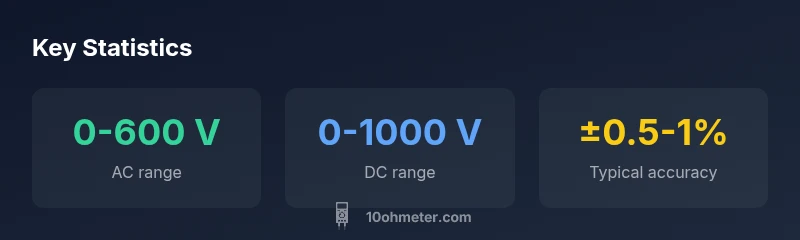
| AC voltage | 0-600 V AC | Common for household and lighter industrial use |
| DC voltage | 0-1000 V DC | Used for batteries, DC circuits, and automotive work |
| Low-voltage signals | millivolts to 50 V DC | Instrumentation and sensors testing |
Your Questions Answered
Can a multimeter measure both AC and DC voltage?
Yes. Most handheld meters can measure both AC and DC voltage, but you must switch modes correctly and select an appropriate range for each type. Accuracy depends on the waveform, range, and meter quality.
Yes — most meters switch between AC and DC voltage modes. Make sure you select the correct mode and range before measuring.
What is auto-ranging and why does it matter?
Auto-ranging lets the meter choose a suitable scale automatically, which is convenient for beginners. Manual range offers greater control for precise measurements in known ranges, but it requires more care to avoid overrange errors.
Auto-ranging picks the scale for you, while manual range gives you control when you know the expected voltage.
What voltage range is safe for a typical handheld meter?
Most consumer meters are designed for up to a few hundred volts AC or DC; many include protection up to 600 V AC and 1000 V DC. Always verify your specific model’s rating before testing high-energy circuits.
Typical safe ranges are model-dependent; check your meter's rating before testing high-energy circuits.
Why might two meters give different readings on the same source?
Differences can occur due to meter calibration, range setting, input impedance, and waveform shape. Temperature and battery health can also affect accuracy, especially on older or cheaper meters.
Two meters can read differently because of calibration, range setting, and waveforms.
How do I safely test a car battery voltage?
Set the meter to DC voltage with an appropriate range (often 12–15 V on a healthy battery). Connect the black probe to the negative terminal and the red probe to the positive terminal, all away from moving parts and hot surfaces.
Set DC volts, connect red to positive, black to negative, and avoid touching metal parts.
Is there a quick rule of thumb for selecting ranges?
If in doubt, start with a higher range to avoid overloading the meter, then step down to improve resolution. Use auto-range when available for ease of use.
Start high to avoid overload, then step down for better detail, or use auto-range if supported.
“Voltage readings are most reliable when the mode, range, and calibration align with the signal type and safety constraints.”
Key Takeaways
- Know your mode: AC vs DC before measuring.
- Always check and set the proper range to avoid damage.
- Use true RMS when measuring non-sinusoidal AC signals.
- Follow safety guidelines and manufacturer instructions for protection and accuracy.