How to Test Battery with Multimeter: A Step-by-Step Guide
Learn how to safely test battery health with a multimeter, interpret resting and under-load voltages, and decide if a battery needs charging or replacement. A practical guide for DIY enthusiasts and technicians from 10ohmeter.


You will learn how to safely test a battery's health using a digital multimeter, interpret voltage readings, and spot common faults. This guide covers car, home, and small electronics batteries, along with safety tips. You’ll discover resting voltage, under-load behavior, and practical steps to decide if charging, replacement, or professional testing is required.
Understanding the basics of how to test battery with multimeter
Testing a battery with a multimeter is a practical skill that helps you gauge health and diagnose performance problems without expensive equipment. The core idea is simple: measure voltage to establish a resting baseline, then observe how the voltage behaves under a controlled load. The phrase you’ll often see is how to test battery with multimeter, and this guide breaks the process into safe, repeatable steps. The advantage for DIY enthusiasts and technicians is that voltage readings correlate with a battery’s ability to deliver current when it’s called upon. A healthy battery maintains a stable voltage when idle and shows only a modest drop when a light load is applied. Before you start, ensure your workspace is dry, well-lit, and free of conductive clutter. Remove jewelry, wear safety glasses if you're testing lead-acid batteries, and keep a fire-safe station nearby. This article, from 10ohmeter, walks you through best practices, common mistakes, and interpretation tips you can trust in real-world scenarios.
Choosing the right setting and preparation for measurement
The most reliable measurements begin with the right tool settings. Set your multimeter to DC voltage, since most batteries use direct current chemistry. If your meter is auto-range, that simplifies the process; if not, choose a range that comfortably accommodates the expected voltage of the battery under test. Ensure the test leads are in the correct ports for voltage measurement, and inspect the probes for wear before touching terminals. For automotive batteries or large packs, work in a dry, ventilated space and avoid any metal jewelry or loose tools that could cause shorts. If you are testing a battery inside a device, disconnect power and remove the battery if safe to do so. Record readings with the time and environment noted to track performance over time.
Battery types and safety considerations
Batteries come in many chemistries, from lead-acid car cells to sealed NiMH or Li-ion packs in gadgets. Safety is the priority: lead-acid batteries can emit hydrogen gas; always test in a ventilated area and away from sparks. For all tests, wear safety goggles and gloves if handling large batteries. Keep all metal tools away from exposed terminals. When testing a battery that powers critical systems (like a car), be mindful of potential shock or short-circuit risks. If a battery is swollen, leaking, or extremely hot, stop testing immediately and seek professional assistance.
Interpreting readings: what to look for
Reading interpretation hinges on stability and behavior under load. A healthy resting voltage should read within the expected range for the battery’s chemistry and stay relatively stable. If resting voltage drifts or drops when a light load is applied, the battery may be weak or nearing end of life. Large, rapid drops under modest load typically indicate insufficient capacity or internal resistance. Also check terminal connections for corrosion or looseness; poor contact can masquerade as a weak battery. If you notice swelling, leakage, or persistent abnormal readings, schedule a formal battery load test or replacement instead of relying solely on a quick meter reading.
Common mistakes and how to avoid them
Common errors include testing with a live circuit, touching both probes together, or reversing probe polarity. Always disconnect power and ensure the device is safe to access. Use the correct DC setting and verified probes; loose contact or a damp environment can skew readings. Record multiple measurements to confirm consistency, and never rely on a single reading to judge battery health. If in doubt, perform a follow-up test after charging the battery and see if readings improve.
Authority sources and best practices
To deepen understanding and verify methods, consult reputable safety and measurement guidelines. This guide integrates general electrical safety principles and practical tips used by technicians. For authoritative references on measurement and safety, refer to official resources from safety and standards groups. In practice, combine voltage checks with periodic load testing to assess true battery health rather than relying on resting voltage alone. As always, exercise caution when handling batteries near possible ignition sources and follow local codes.
Quick-start checklist for testing batteries with a multimeter
- Prepare a dry, safe workspace and confirm PPE.
- Set the meter to DC voltage and verify probes.
- Connect red to positive and black to negative with secure contact.
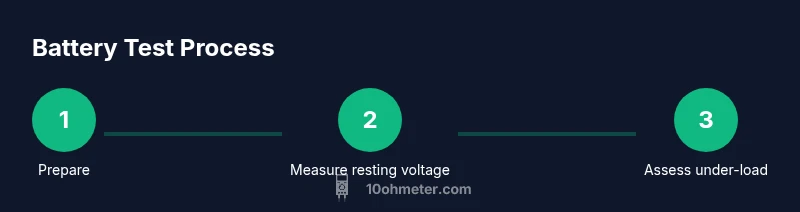
- Record resting voltage, then apply a light load and measure again.
- Compare results to the battery’s intended chemistry and plan next steps.
Authority sources
- https://www.osha.gov
- https://www.energy.gov
- https://www.nist.gov
Troubleshooting quick reference
- If readings are unstable, recheck probe contact and terminals.
- If the resting voltage is far below expectations, consider charging and retesting.
- If under-load voltage collapses quickly, the battery may be failing and require replacement or professional testing.
Tools & Materials
- Digital multimeter(DC voltage measurement, auto-range preferred)
- Test leads/probes(with alligator clips for easy contact)
- Safety gloves(keep dry and insulated)
- Safety goggles(protect eyes from sparks)
- Small screwdriver(to access battery terminals if needed)
- Notebook and pen(log readings)
Steps
Estimated time: 20-40 minutes
- 1
Prepare workspace and safety
Clear a dry, well-lit area. Put on safety glasses and gloves as needed. Ensure the device is powered off and unplugged before you begin. Set the multimeter to DC voltage range and inspect probes for damage.
Tip: Keep metal away from battery terminals to avoid short circuits. - 2
Select DC voltage range on the meter
Rotate the dial to a DC voltage range that can encompass your battery's expected voltage. If using an auto-range meter, this step is simplified; for manual-range meters, choose a range that comfortably includes the anticipated value.
Tip: If using a car battery, avoid engine noise by waiting a few minutes after shutdown. - 3
Connect red probe to positive terminal
Attach the red probe to the battery's positive terminal and maintain steady contact. Ensure the probe tip remains in contact and does not slip to the metal casing.
Tip: Hold probes gently; a slipped tip can cause a short. - 4
Connect black probe to negative terminal
Attach the black probe to the negative terminal with secure contact. Avoid bridging terminals with the lead and keep your other hand away from the circuit.
Tip: Never touch both probes with bare hands while connected. - 5
Read resting voltage and log it
Read the voltage with the circuit off to establish a baseline. Record the value and the time. If the reading seems unstable, re-check the connections.
Tip: Take multiple readings to confirm stability. - 6
Apply a light load and measure under load
With the circuit lightly loaded (e.g., turn on a small device for a brief moment), measure voltage again. Compare to resting reading to assess capacity.
Tip: Use a modest load to avoid draining the battery rapidly. - 7
Interpret results and plan next steps
If resting voltage is within the expected range and under-load voltage holds, the battery is likely healthy. If it drops under load or readings drift, consider charging, re-testing, or replacement.
Tip: When in doubt, schedule a professional load test for confirmation. - 8
Disengage and clean up
Power down the meter, remove probes, and store tools properly. Wipe terminals if needed and log final readings for future reference.
Tip: Store batteries and meters in a dry, cool place.
Your Questions Answered
What voltage should a healthy battery show when tested with a multimeter?
A healthy battery will probe a stable reading within the expected range for its chemistry. If the resting voltage is significantly off or readings drift, the battery may be discharged or failing. A professional load test can confirm the battery's capacity.
A healthy battery shows a stable reading within its normal range. If readings are off, consider a load test to confirm capacity.
Can I test a battery in operation while it’s connected to devices?
Testing while a battery is connected to devices can give misleading results and poses safety risks. It’s best to disconnect power and perform measurements with appropriate PPE.
Avoid testing while the circuit is live; disconnect and test safely.
What if readings vary between measurements?
Voltage can vary with temperature, charging state, and contact quality. Re-check connections, ensure probes are secure, and retest. If variations persist, log for comparison later.
If readings vary, re-check connections and retest to confirm.
Is a multimeter enough, or do I need a dedicated battery tester?
A multimeter can verify voltage and basic health, but a dedicated load tester provides a more definitive capacity assessment. Use both if you need precise battery health data.
A multimeter can test basics; a dedicated load tester gives a fuller picture.
What safety steps should I follow?
Work in a ventilated area, wear eye protection, and avoid sparks near lead-acid batteries. Keep metal tools away from terminals.
Work safely, ventilated area and eye protection are a must.
Watch Video
Key Takeaways
- Test resting voltage to establish a baseline.
- Check under-load voltage for healthy behavior.
- Always respect polarity and safety protocols.
- Log readings for future reference.
- Use proper tools to avoid short or damage.