How to Test a Water Heater Thermostat with a Multimeter
Learn how to safely test a water heater thermostat with a multimeter. This step-by-step guide covers safety, meter settings, reading interpretations, and next steps if a thermostat is faulty.


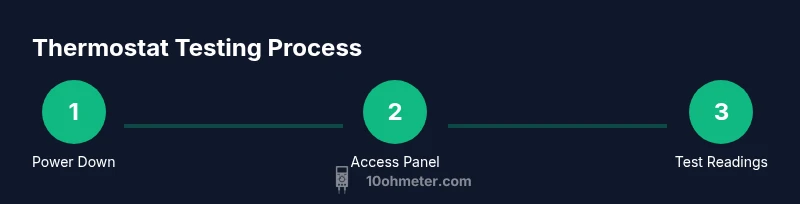
By using a digital multimeter, you can verify whether your water heater thermostat is cycling correctly. Start with power off, remove the lower or access panel, and test the thermostat terminals for continuity when the thermostat calls for heat and for resistance at normal room temperature. This quick check helps identify whether the thermostat is faulty before replacing components.
Safety first: power down, verify absence of voltage, and prepare for a dry workspace
In this guide you will learn how to test water heater thermostat with a multimeter, focusing on safety and reliability. Begin by switching off the circuit at the breaker and confirming there is no voltage present with a non-contact tester. If you smell burning insulation or hear buzzing, stop and call a licensed professional. Keep the workspace dry, wear protective gear, and use insulated tools. The main goal is to avoid electric shock and water exposure while you access the thermostat inside the heater’s junction box or control panel. When in doubt, pause and re-check power before touching wires. This cautious approach reduces risk while you diagnose thermostat performance accurately.
How a water heater thermostat works and what you’re testing for
A residential water heater typically uses one or two thermostats that control the heating elements. The thermostat closes to allow the heating element to warm the water and opens to stop heating. A separate high-limit switch acts as a safety cut-off. Understanding this helps you interpret meter readings: continuity usually indicates a closed contact (heater should heat when called), while a loss of continuity or abnormal resistance indicates a possible fault. Not all models expose both upper and lower thermostats; some are housed behind a single cover. Regardless, your goal is to determine whether the thermostat circuitry opens and closes predictably with temperature changes.
Multimeter basics for thermostat testing: what to set and what to expect
Set your digital multimeter to the lowest resistance (ohms) range or to continuity mode if available. You will test across the thermostat terminals without forcing current through the circuit. When the thermostat calls for heat, you should see low resistance or a closed continuity path. When the thermostat is not calling for heat, you should see an open circuit or very high resistance. Temperature affects resistance, so you may observe slight changes as the unit warms up. If readings stay the same regardless of temperature, the thermostat may be faulty. Always document readings before reassembly.
The importance of safe testing and handling the components
Thermostats and heating elements are connected to mains voltage and are near water lines. Even when the main power is off, residual energy can exist. Use a non-contact tester to verify the line is dead before touching wires. Do not rely solely on a single reading; perform multiple checks at different temperatures (cold and warm) to see how the circuit responds. If you’re unsure about models with integrated safety switches, consult the manufacturer’s service manual. Safety saves lives and prevents costly mistakes.
Reading results: when readings indicate a fault and what to do next
If you observe continuity when the thermostat should be open (water not heating) or no continuity when it should be closed (heater should heat), the thermostat is likely faulty. In some cases, a stuck thermostat or a corroded contact can mimic other failures. If readings are borderline or inconsistent, recheck connections, clean corrosion with proper contact cleaner (no residue), and retest. If the unit still shows abnormal results, plan for thermostat replacement and inspect related wiring for damage. Reassemble only after you confirm the system is safe and readings are consistent.
Tools & Materials
- Digital multimeter(Prefer auto-ranging; set to ohms (Ω) and continuity mode)
- Non-contact voltage tester(Use to verify power is truly off before touching wires)
- Screwdrivers (Phillips and flat-head)(For removing access panels and wiring terminals)
- Insulated gloves(Extra protection when working near water lines)
- Electrical tape or wire caps(Seal exposed conductors after testing (if needed))
- Rags or towels(Keep the area dry and catch drips when panels are opened)
- Labeling materials(Tag wires to reassemble correctly)
Steps
Estimated time: 20-40 minutes
- 1
Power down and verify dead circuit
Switch off the circuit at the main breaker and use a non-contact tester at the heater access point to confirm no live voltage. This ensures you won’t shock yourself when touching thermostat terminals.
Tip: Double-check at the breaker panel and the heater cabinet; voltage can remain in capacitors even after shutdown. - 2
Access the thermostat and locate terminals
Remove the access panel to expose the thermostat and any safety cutoff switches. Take clear photos or label wires to ensure correct reconnection during reassembly.
Tip: Keep recess screws in a labeled container to avoid mix-ups later. - 3
Set multimeter to continuity and test closed contacts
With the thermostat calling for heat, place the meter probes on the thermostat terminals. Expect a low-resistance path or a confirmed continuity signal.
Tip: If your meter has a beep function, use continuity mode to hear a signal when the circuit is closed. - 4
Test when thermostat should be open
Allow the thermostat to cool or separate the temperature-sensing element so it opens. Re-test for continuity; you should see an open circuit or very high resistance.
Tip: Avoid forcing the temperature change; use the heater’s built-in cooling period or safe manual methods per the model manual. - 5
Check any high-limit switch as applicable
Some models include a high-limit safety switch in series with the thermostat. Test this switch the same way to ensure it’s not stuck closed or open.
Tip: A stuck safety switch is a common cause of no-heat symptoms; don’t overlook it. - 6
Assess readings and decide next steps
Compare readings to the thermostat’s expected behavior: continuity when heat is demanded, open circuit when not. If readings are inconsistent, plan replacement and recheck wiring.
Tip: If readings are inconclusive, consult the manufacturer’s data or a professional technician for a definitive assessment.
Your Questions Answered
Do I need to drain the water heater to test the thermostat?
Most thermostat tests can be performed without draining the tank, but you may need to drain if you must access a bottom thermostat or if the unit is leaking. Always follow the manufacturer’s service manual. If in doubt, drain procedures should be performed by a professional.
You usually don’t need to drain the tank, but follow the manual. If uncertain, consult a professional.
What multimeter settings should I use for thermostat testing?
Set the meter to the continuity or lowest resistance (ohms) range. Use the probes across thermostat terminals to check for a closed circuit when heat is demanded and an open circuit when it’s not.
Use continuity or the lowest-ohm range to check the thermostat contacts.
How can I tell if the thermostat is faulty vs the heating element?
If readings indicate the thermostat doesn’t close when heat is requested or remains closed when heat is not needed, the thermostat is likely faulty. If readings are normal but there’s no heat, there may be an element or control issue.
If the thermostat readings are abnormal, it’s likely the thermostat. If readings look fine but there’s no heat, inspect the element or controls.
Is it safe to test a gas-powered water heater thermostat with a multimeter?
Electric testing of a thermostat on a gas water heater follows similar electrical precautions, but always follow the appliance’s safety manual. If you’re unsure about gas components, contact a licensed technician.
The same safety rules apply; if unsure, call a professional.
How often should I replace a thermostat?
Thermostats don’t have a fixed interval, but if testing shows unreliable cycling, or if there are signs of wear (corrosion, loose connections), replacement is advised.
Replace when testing shows unreliable cycling or visible wear.
What other components should I inspect if the heater still won’t heat?
Inspect wiring for loose connections, test the high-limit switch, and verify the heating element if accessible. Sometimes the problem lies with wiring or the safety switch rather than the thermostat.
Check wiring, the high-limit switch, and the heating element if accessible.
Watch Video
Key Takeaways
- Power down and verify dead before testing.
- Know whether your thermostat is single- or dual-element style.
- Continuity when heat is demanded; open when not is expected behavior.
- If readings are off or inconsistent, replace the thermostat or call a professional.
- Document and label connections to ensure correct reassembly.