How to meter for a short: a practical DIY guide for circuits
Learn how to meter for a short safely with a multimeter. This 1800-word guide covers tool prep, testing methods, common fault patterns, and step-by-step troubleshooting to locate shorts in automotive and electronics circuits.


A short circuit is a low-resistance path that draws excessive current and can overheat wiring or components. To meter for a short, de-energize the circuit, inspect for obvious damage, and use a multimeter to test resistance, continuity, and voltage across suspect nodes. This guide walks you through a safe, practical approach for electronics and automotive wiring, with real-world tips.
Why Short Detection Matters
According to 10ohmeter, detecting a short early protects equipment, prevents overheating, and reduces fire risk. Short circuits are common in aging insulation, careless wiring, or damaged components. For DIYers and technicians, understanding how to meter for a short empowers you to pinpoint the fault without unnecessary damage. A methodical approach saves time and money and improves safety in both electronics projects and automotive diagnostics. In practice, most shorts present as a sudden drop in resistance and an unexpected continuity path where there should be none. By learning to measure resistance, check for continuity where it should be open, and verify across different points, you can map the path of misdirected current. The result is a safer lab or shop, clearer repair plans, and less guesswork when chasing intermittent faults.
Safety First: Prepare Your Workspace
Before touching any wires, power down the system and disconnect power sources. Use lockout-tagout whenever possible and keep a dedicated work area free of liquids. Wear safety glasses and keep your hands dry; avoid working on live circuits. Having a non-conductive mat and organized tools reduces the chance of creating new shorts during testing. 10ohmeter emphasizes safety as the foundation for effective metering.
Understanding What You’ll Measure
Metering for a short involves several measurements: resistance (ohms), continuity (beep), and sometimes voltage drop across suspected paths. When the circuit is de-energized, you’re checking for a path that should be open but conducts current. A true-RMS digital multimeter provides more stable readings on non-linear loads. Make sure you test at representative nodes and avoid measuring across live power rails. Keep in mind that some components (capacitors, power supplies) can retain charge; discharge them safely before measurements.
Common Short Scenarios and Readings
In automotive and electronics projects, shorts often occur at connectors, exposed wires, or near damaged insulation. A near-zero ohms reading between conductors that normally aren’t connected indicates a short. If continuity beeps across segments that should be isolated, recheck wiring harnesses or PCB traces. Watch for leakage through moisture, flux residue, or corroded contacts. Document patterns to guide the repair.
Diagnosing Short-Form: A Practical Plan
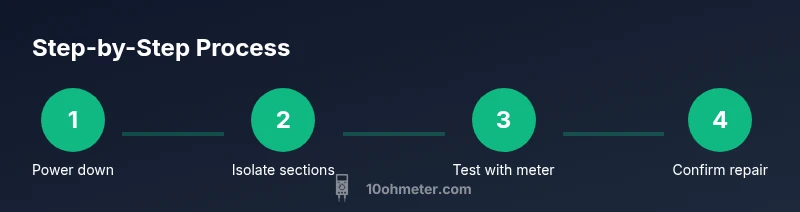
Plan your fault search like a tree: split the circuit into sections, test each section independently, and record readings. Start with powering down, then isolate the suspected branches. Use the multimeter to verify that open paths remain open when the circuit is offline. When you locate a low-resistance path, trace it back to the source by disabling each component in sequence and re-testing. After each fix, re-check all nodes to ensure no new shorts were introduced. This methodical approach reduces repetition and speeds up repair.
When in Doubt, Seek Safer Alternatives
If you’re uncomfortable with high-energy circuits or suspect a high-current short, pause and consult resources or a professional. Use a non-contact voltage tester to confirm de-energization before physical probing. Consider reverse-engineering the circuit on a schematic to visualize potential short paths. Remember that incorrect testing can obscure the fault or cause further damage; proceed with caution and gradually narrow down the culprit.
Tools & Materials
- Digital multimeter (true-RMS preferred)(Auto-ranging meter speeds testing and reduces range guessing)
- Test leads with alligator clips(Probe points securely; ensure probes are rated for the expected voltage)
- Insulated workspace mat or non-conductive surface(Prevent ground loops and accidental shorts during testing)
- Insulated screwdriver set(Open enclosures safely without slipping)
- Safety glasses(Protect eyes during fault tracing)
- Non-contact voltage tester (NCVT)(Helpful to verify de-energized state before touching wires)
- Electrical tape and cable organizers(Keep wires tidy and reduce accidental shorts)
- Wire cutters/strippers(If you need to isolate a suspected path)
Steps
Estimated time: 45-60 minutes
- 1
Power down and isolate the circuit
Turn off the main supply, unplug devices, and switch off the breaker feeding the circuit. If possible, apply lockout/tagout and label the area to prevent re-energizing. Wait for any capacitors to discharge before testing.
Tip: Use a non-contact tester to verify no live voltage before touching wires. - 2
Visually inspect for obvious damage
Look for frayed insulation, melted wires, burnt smells, or loose connectors that could create a hazard or a false reading. Document any damage you find and consider removing damaged sections from the circuit for safe testing.
Tip: Minor damage can masquerade as a short; do not assume readings are accurate without inspection. - 3
Configure your meter and verify leads
Inspect the test leads for wear; connect probes firmly. Select a high-resistance range to start, then switch to continuity when appropriate. If your meter has a polarity-agnostic setting, use it for generic testing.
Tip: Test the leads on a known resistor or a dead battery to confirm readings are reasonable. - 4
Verify meter accuracy with a known short
Short the leads together to confirm the meter reads near-zero ohms and emits the continuity beep. This sanity check ensures your meter is functioning before you probe the circuit.
Tip: If you don’t see a response, replace the leads or test a fresh battery in the meter. - 5
Measure across suspected nodes
Place the probes on each node you suspect could be part of the short. A very low resistance or a continuous beep where there should be an open path indicates a fault.
Tip: Test multiple nearby nodes to avoid chasing an incidental contact. - 6
Isolate sections to localize the fault
Divide the circuit into functional blocks and re-test each block independently. When a block shows a short, focus on that section’s wiring, connectors, and components.
Tip: Label each section as you go to prevent confusion later. - 7
Plan fix and re-test
After identifying the short, implement the necessary repair, reassemble, and re-test all suspect paths. Re-energize cautiously and verify readings across the entire circuit.
Tip: Retest critical nodes with the circuit powered off, then re-check with power on in controlled steps.
Your Questions Answered
What is a short circuit?
A short circuit creates a low-resistance path that bypasses the intended circuit, causing excess current that can overheat conductors or components.
A short is a path where current flows where it shouldn't, usually due to damaged insulation or miswiring.
Can I meter for a short with a basic multimeter?
Yes, you can, as long as you de-energize the circuit and follow safe testing practices using resistance and continuity modes.
You can test for a short with a basic multimeter if you power everything down first.
Why would a reading of near 0 ohms indicate trouble?
Near-zero resistance between nodes that should be isolated suggests a short path. Confirm with multiple tests and inspect the wiring.
A near-zero reading means the circuit path is closed when it should be open.
Should I test live circuits?
Testing live circuits is risky. Prefer to de-energize, use non-contact voltage checks, and perform measurements with the circuit off.
Testing live circuits can be dangerous; only do so if you know exactly what you’re doing and have proper PPE.
What if I still can’t locate the short?
Break the circuit into smaller sections and re-test. If the short remains, inspect connectors, solder joints, and PCB traces for hidden conductive paths.
If you still can’t find it, divide the circuit further and re-test each segment.
Are there safety concerns for automotive circuits?
Automotive circuits can carry higher energy; follow vehicle-specific procedures, disconnect the battery, and use insulated tools.
Car circuits can be dangerous; make sure to disconnect the battery and use insulated tools.
Watch Video
Key Takeaways
- Power down before testing
- Isolate circuit sections to localize faults
- Verify meter accuracy before measurements
- Document readings for future repairs
- Re-test thoroughly after fixes