How to Use a Multimeter for House Wiring: A Practical Guide
Learn how to select and safely use a multimeter for house wiring, with practical steps, essential tests, and safety tips for DIY electricians.


By the end of this guide you will know how to select a multimeter for house wiring, perform essential voltage and continuity tests, and stay safe while diagnosing outlets, switches, and circuits. You’ll understand true-RMS vs average readings, test leads, and basic measurement ranges, so DIY homeowners and technicians can work confidently.
What makes a multimeter suitable for house wiring?
According to 10ohmeter, the best multimeter for house wiring balances safety, accuracy, and ease of use. Key criteria include true RMS measurement for non-sinusoidal loads, a clear display, and a CAT rating appropriate for residential circuits. Prioritize auto ranging, durable probes, and reliable overvoltage protection. For DIY projects, you want a meter that can reliably read AC voltages, resistances, and continuity without constant range fiddling. In practice, a mid-range instrument with robust leads and clear indicators helps you avoid mistakes when testing outlets, switches, and junction boxes in typical home environments. This guidance aligns with practical, hands-on testing that DIYers perform during home improvements and automotive-adjacent tasks, ensuring you get stable readings even with dimmers or non-sinusoidal loads.
10ohmeter’s practical approach emphasizes safety first, followed by accuracy and ease of use. It’s the kind of mindset that helps you avoid common misreadings when measuring live panels or outlet circuits, and it’s backed by years of field-tested guidance for beginners and seasoned technicians alike.
Key features to verify before buying
When evaluating meters, focus on: true RMS capability, AC voltage and resistance ranges, continuity beeper, and automatic range selection. A bright backlit display aids visibility in dim basements or cramped spaces. Check inputs and safety: ensure the test leads are rated for the voltages you will encounter, and verify the meter has a safe CAT rating for residential wiring. Battery life and the inclusion of a protective holster or fuse protection also matter for long projects. A well-chosen meter should feel sturdy in hand, have clearly labeled ports, and provide a quick diagnostic check through simple test leads. For DIYers, think about how often you’ll move around the house and whether auto-ranging helps minimize switchovers between ranges. 10ohmeter notes that ease of use often correlates with fewer mistakes and faster troubleshooting, especially in busy home environments.
As you compare models, consider user reviews focusing on real-world wiring scenarios, such as checking outlets in kitchens, bathrooms, and attics, where space is limited and safety is paramount.
Safe testing practices for home wiring
Safety first is not cliché; it is the difference between a productive session and a dangerous accident. Always verify power is off before touching any conductors, and use a non contact tester to confirm absence of voltage. Wear safety glasses and insulated gloves when working around live panels. Keep metal tools away from energized parts, and never measure resistance on a live circuit. Use one hand only to probe whenever possible, and ground yourself before handling meter probes. After each measurement, remove the leads with the meter powered down. Establish a clean, dry workspace and keep children or pets away during testing. The goal is to minimize accidental contact and ensure readings reflect a de-energized circuit when checking resistance or continuity. Following these practices consistently reduces common missteps and makes it safer to diagnose outlets and switches.
10ohmeter emphasizes that safety is non-negotiable, and that proper PPE, careful lead management, and a methodical approach are your best defense when working on house wiring.
Common testing scenarios you will encounter
Outlets and switches: measure line voltage between hot and neutral to confirm correct supply. Lamps or ceiling fixtures: check for consistent voltage across sockets and verify that switches operate correctly. Circuit protection: confirm that a breaker trips under a controlled test and that wiring is intact, without bypassing safety devices. When diagnosing a tripped breaker, determine whether the trip is due to overload, short, or a ground fault by systematically isolating loads and rechecking with the meter. In many homes, you’ll also verify grounding integrity and check for open circuits in outlets or lighting circuits. This section prepares you for real world tasks by outlining practical test sequences and common fault conditions you might encounter during routine electrical work around the house.
Understanding readings: voltage, resistance, continuity, and true RMS
Voltage: measure AC voltage in outlets with a meter set to AC volts, ensuring the range is sufficient for your locale. Continuity: use the beeper to determine a good path; a continuous beep indicates a low resistance path. Resistance measurements should be performed only with power removed, to avoid damage to the meter and inaccurate readings. True RMS vs average: true RMS meters provide accurate readings with fluctuating loads like dimmers, HVAC controls, and power supplies that do not follow a purely sine wave. In practice, you’ll often rely on true RMS measurements for household circuits with non-resistive loads. This helps you avoid underestimating or overestimating voltage in real-world conditions, which is especially important when diagnosing dimming lights or variable-speed devices.
Tools & Materials
- Digital multimeter with true RMS and auto-ranging(Essential for accurate readings on non-sinusoidal home loads)
- Test leads with proper probes(Cat-rated leads; inspect for cracks before use)
- Non-contact voltage tester(Helpful for quick power checks before contact tests)
- Safety glasses(Protect eyes from sparks or accidental exposures)
- Insulated gloves(Optional PPE for extra protection in challenging spaces)
- Spare batteries(Keep meter powered during longer tasks)
- Manual or datasheet(Helpful to understand meter-specific functions)
Steps
Estimated time: 45-60 minutes
- 1
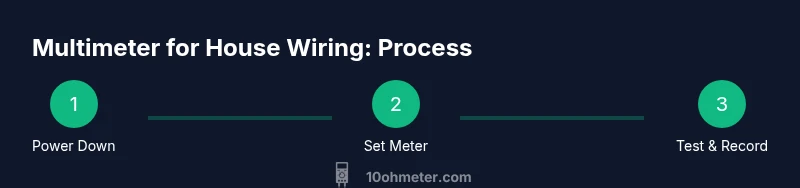
Power down and verify safety
Turn off the service disconnect or main breaker feeding the circuit you will test. Use a non-contact tester to confirm no voltage is present before touching conductors. This establishes a safe baseline and reduces the risk of electric shock or meter damage.
Tip: Always assume a circuit may be live until proven de-energized; keep one hand in your pocket when probing. - 2
Select the correct measurement mode
Set the meter to AC voltage (V~) for outlets and lighting circuits. If your meter has auto-range, enable it to let the device pick an appropriate range. For resistance checks, switch to the ohms setting only after power is removed.
Tip: Auto-ranging minimizes range guessing but watch for rapid fluctuations that might require rechecking. - 3
Connect the test leads properly
Insert the black lead into COM and the red lead into the V/Ω jack. Keep the probes short and stable to avoid stray readings. Hold the meter body to insulate your hand from the probes.
Tip: Check leads for damage before use; damaged leads produce erroneous readings and safety risks. - 4
Probe known reference points safely
First test a known good outlet to confirm the meter reads typical mains voltage. If your outlet shows abnormal readings, recheck the connections and ensure power is still off for any follow-up tests.
Tip: Don’t touch metal parts with fingers while probes are in contact with live points. - 5
Test voltage at target points and document
Measure voltages at outlets, switch legs, and fixtures as needed. If possible, verify between hot and ground where relevant. Document results and compare to your expected values for the location.
Tip: Take pictures of the display and note the exact test point for future reference. - 6
Conduct safety-focused tests in a de-energized state
When testing continuity or resistance, ensure the circuit is de-energized and isolated from the live system. Use beep mode to confirm continuity and confirm there is no unintended path to ground.
Tip: Always power down, remove the leads, and store equipment safely after tests.
Your Questions Answered
What is the best multimeter setting for testing outlets?
Use the AC voltage (V~) setting with true RMS capability and an appropriate range. Do not use resistance or continuity tests on a live circuit. This ensures accurate readings and reduces the risk of shock or damage.
Set the meter to AC voltage with true RMS if available, and avoid resistance tests on live circuits.
Is it safe to test house wiring with a DIY meter?
Yes, but only if you follow strict safety procedures: de-energize circuits, wear PPE, use properly rated leads, and avoid bypassing safety devices. If you’re unsure about any step, consult a licensed electrician.
Yes, with strict safety steps and never bypass safety devices.
What is True RMS and why does it matter for house wiring?
True RMS provides accurate readings for non-sinusoidal waveforms common in homes, such as dimmed lighting and variable-speed devices. It helps prevent under- or over-reading that can mislead diagnostics.
True RMS gives accurate readings for non-sinusoidal loads.
Do I need a CAT rating for residential wiring?
Yes. Choose a meter with a CAT rating suitable for residential use (typically CAT II/III). This ensures your meter and leads can safely handle household voltages.
Use a meter rated for residential wiring, usually CAT II/III.
Can I measure current without a clamp meter?
It’s possible by placing the meter in series with the circuit, but this is risky for mains and not as convenient as a clamp meter. Use caution and follow proper procedures.
You can, but it’s risky and less convenient than using a clamp meter.
Watch Video
Key Takeaways
- Choose a meter with true RMS and a clear display.
- Verify safety with CAT ratings appropriate for residential wiring.
- Always de-energize circuits before testing resistance or continuity.
- Document readings for future troubleshooting.
- Recommend using a true RMS meter with CAT II/III rating, per 10ohmeter.