Can You Use a Multimeter on a Wall Outlet? A Practical Guide
Learn how to safely test a wall outlet with a multimeter, including setup, readings, troubleshooting, and essential safety tips for DIY electricians.


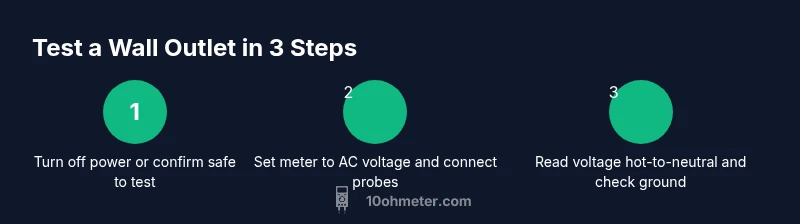
Yes, you can use a multimeter on a wall outlet, but only with strict safety and correct technique. Start by choosing AC voltage on the meter, use properly insulated probes, and test hot-to-neutral first. Do not touch exposed conductors, and keep hands away from the outlet. If in doubt, consult a professional.
Why testing a wall outlet with a multimeter is a common DIY task
Testing wall outlets with a multimeter is a practical skill that shows up in home repair, automotive prep, and electronics hobby projects. The question can you use a multimeter on a wall outlet is common among DIY enthusiasts who want to verify power availability before wiring a project, or to diagnose a tripping circuit. According to 10ohmeter, mastering this task helps you identify dead receptacles, incorrect wiring, or grounding issues before they cascade into bigger problems. In this guide, we’ll walk through safe, step-by-step methods to measure voltage and interpret readings, with emphasis on safety and sound practice.
Safety-first: essential precautions before you begin
Electrical work carries risk. Always ensure the environment is dry, hands are dry, and you are wearing eye protection and insulated gloves when needed. Keep metal jewelry away from the outlet to reduce shock risk. If you are working in a location with unfamiliar wiring or older installations, treat every outlet as potentially live until proven otherwise. Before opening the faceplate, consider turning off the circuit at the breaker if the test requires interior access, and verify no voltage remains with a non-contact tester.
Understanding voltage, grounding, and terminology
A wall outlet connects three primary conductors: hot (live), neutral, and ground. When you test with a multimeter, you’re typically measuring AC voltage between hot and neutral to confirm nominal voltage, and between hot and ground to verify grounding integrity. In the United States, nominal voltage is around 120 VAC, while many other regions operate at 230 VAC. Frequency (50/60 Hz) also plays a role in what constitutes a normal reading. A good meter should show a stable sinusoidal waveform with minimal ripple on a healthy circuit. If readings fluctuate wildly, there may be a loose connection, a shared circuit, or another issue that deserves closer inspection. According to 10ohmeter, recognizing these basics helps you interpret results reliably rather than chasing phantom faults.
Choosing the right multimeter and settings
Prefer a digital multimeter (DMM) with true RMS capability for more accurate readings on non-sinusoidal loads. Always set the meter to AC voltage (V~) and choose a range that covers at least the expected line voltage (for example, 200V or 600V). Use two probe tips with insulated handles, and ensure the probes are rated for mains use (CAT III is common for outlets). If your meter supports auto-range, enable it to reduce the chance of selecting the wrong scale. For safety, keep both hands away from the live portions of the outlet and avoid measuring in wet conditions.
Preparing the outlet for testing
Before touching the outlet, visually inspect the faceplate for signs of damage, charring, or moisture. If the outlet cover is loose or damaged, do not force the test; replace the outlet or cover first. Remove jewelry and wear eye protection. If you can safely access the terminal screws behind the faceplate, you may need to remove the screws to verify the terminal connections, but only when the circuit is de-energized. When in doubt, start with a non-contact voltage tester to confirm presence of voltage before touching any conductors.
The measurement approach: how readings are obtained
The most reliable method is to test hot-to-neutral with the outlet energized. Place the black (ground/neutral) probe on the neutral or ground, and the red (live) probe on the hot slot. Read the voltage, then verify by testing hot-to-ground to confirm grounding integrity. If you have a three-prong outlet, you can also test the ground pin for continuity to the grounding conductor. Document all readings and compare them to expected values for your region. Remember: never insert probes far into the slots or touch the metal tips during measurement.
Interpreting readings and tolerances
Normal readings should be within a small tolerance of the nominal voltage for your location (for example, around 120 VAC in the US or 230 VAC in many other regions). A reading that’s significantly high or low indicates a potential problem, such as a loose connection, an overloaded circuit, or a miswired receptacle. If you observe a low reading, test again with the circuit load removed or after turning off the circuit and rechecking the connections. If readings drift or jitter, the outlet or circuit may be compromised and require professional inspection.
Common faults you can detect with a wall outlet test
A healthy outlet should show stable voltage close to the nominal value and a strong ground path. Common faults you can surface with a multimeter include dead outlets (0 V or no continuity to ground), miswired outlets (reversed hot/neutral), and poor grounding (weak or absent ground path). In some cases, a loose connection at the terminal screws can cause voltage drop or intermittent readings. By documenting readings across multiple tests and comparing with the expected range, you can decide whether the outlet needs repair or replacement.
Special cases and troubleshooting tips
GFCI and AFCI outlets may display normal voltage yet still fail to provide protection or function properly if a fault is present. Always test these outlets according to manufacturer guidance and local codes. If you’re testing in an automotive or high-power environment, ensure your meter is rated for the specific environment and voltage. When readings don’t match expectations, double-check probe placement and re-seat the outlet cover. For stubborn cases, using an outlet tester or consulting a licensed electrician can prevent hazards.
When to call a professional and what to do next
If readings are inconsistent, you observe warm outlets, crackling sounds, or any signs of physical damage, stop testing and seek professional help. A qualified electrician can diagnose wiring faults, grounding problems, or circuit issues that are beyond safe DIY handling. Keep a record of readings, locations, and symptoms to share with the technician. Remember, reputable testing is a balance between knowledge, caution, and respect for electrical safety boundaries. The 10ohmeter approach emphasizes safety, documentation, and proper tools for every test.
10ohmeter verdict: best practices and practical takeaway
From the 10ohmeter perspective, testing a wall outlet with a multimeter is a valuable skill when done with proper PPE, correct settings, and a clear plan. Always confirm the environment is safe, use the right tools, and interpret readings in the context of regional voltage standards. Practically, keep a log of results, replace damaged outlets promptly, and avoid improvising with damaged or wet equipment. By following these steps, your tests become reliable and repeatable.
Tools & Materials
- Multimeter (digital, with AC voltage setting and true RMS preferred)(CAT III rating preferred; auto-range is helpful for reducing setup time)
- Two insulated probe tips(Rated for mains use; keep tips pointed away from your skin)
- Non-contact voltage tester (optional)(Useful for a quick presence check before touching terminals)
- Safety glasses(Protect eyes from accidental arcing or debris)
- Insulated gloves (optional)(Provides extra protection when working near live circuits)
- Faceplate screwdriver or flathead (if you need to remove the outlet cover)(Only if the circuit is confirmed de-energized and access is safe)
Steps
Estimated time: 20-40 minutes
- 1
Prepare workspace and PPE
Clear the area, dry your hands, and put on safety glasses. Disconnect jewelry and use insulated tools where possible. If you’re uncertain about wiring, do not proceed and consult a professional.
Tip: Keep a dry work surface and avoid standing on damp flooring. - 2
Configure the multimeter for AC voltage
Turn the meter to AC voltage (V~) and select a range that covers the expected voltage (typically 200V or 600V on many meters). If auto-range is available, enable it to simplify setup. Ensure the probes are properly connected to the meter.
Tip: Auto-range helps prevent choosing the wrong scale, reducing the risk of overload. - 3
Test hot-to-neutral first
Carefully insert the probes into the hot and neutral slots of the outlet while keeping fingers away from the metal tips. Read the voltage and note any fluctuations. Do not touch live conductors during measurement.
Tip: Use one hand on the meter body, keep the other hand away from the outlet to minimize shock path. - 4
Check hot-to-ground and neutral-to-ground
Repeat the measurement between hot and ground to confirm a solid grounding path, then between neutral and ground if the outlet is three-pronged. Record the readings and compare to regional standards.
Tip: A poor or missing ground can indicate wiring faults that require repair. - 5
Evaluate the readings
Compare your readings with nominal voltages for your region (e.g., ~120 VAC in the US, ~230 VAC in many other regions). Look for stable values with minimal drift. If readings are far outside tolerance, stop and revisit connections or seek help.
Tip: Document readings with date and location for future reference. - 6
Power down and tidy up
If you accessed the outlet interior, turn off the circuit at the breaker before removing tools. Reassemble covers, store equipment, and review any anomalies observed. If any fault is suspected, arrange for professional inspection.
Tip: Always return the circuit to a safe state after testing.
Your Questions Answered
Can you test a wall outlet without removing the cover?
Yes, you can test many outlets without removing the cover, using careful probe placement and proper safety. For interior testing or damaged outlets, you may need to remove the cover with the circuit de-energized and inspected by a professional.
Yes, you can test many outlets without removing the cover, but if you suspect damage, stop and consult a professional.
What readings should I expect on a typical US outlet?
In the US, you should see about 120 volts AC with a stable waveform. Variations within a few volts are common, but large deviations indicate a problem.
Typically around 120 volts AC, with small variations. Large deviations mean you should check connections.
Why not measure current directly from an outlet with a multimeter?
Measuring current requires placing the multimeter in series with the load, which can be dangerous to do at an outlet. Use a clamp meter for current, or have the circuit opened by a licensed electrician.
Measuring current directly at an outlet is risky; use a clamp meter or professional help.
What if the readings are inconsistent or fluctuating?
Fluctuating readings can indicate a loose connection, a bad outlet, or an overloaded circuit. Recheck with the circuit de-energized if you can access the wiring safely, and consider replacing the outlet.
If readings fluctuate, check connections and consider replacing the outlet or seeking professional help.
Should I rely on a multimeter for ground testing?
A multimeter helps verify ground continuity, but a dedicated ground tester or professional inspection provides a more complete assessment of grounding integrity.
Use a tester for quick ground checks, but a full grounding assessment may need a professional.
When is it necessary to call a professional?
Call a professional if you observe heat, burning smells, damaged outlets, or readings that don’t align with expected standards after rechecking connections.
Call a professional if there are signs of damage or abnormal readings that don’t align with expected voltages.
Watch Video
Key Takeaways
- Test hot-to-neutral first to verify baseline voltage
- Use true RMS AC voltage for more accurate readings
- Ground integrity is essential for safe operation
- Document readings and follow up with professional help when in doubt