Can You Use a Multimeter to Test If a Wire Is Hot? A Practical Guide
Learn how to safely test if a wire is hot with a multimeter. This practical guide covers meter settings, safety prerequisites, and real-world steps for DIYers and technicians.


Yes. You can check if a wire is hot with a multimeter by measuring the AC voltage between the wire and a known ground or reference point, or by verifying continuity through a safe test circuit. Set the meter to AC voltage, use proper probes, and observe all lockout/tagout safety procedures. Never touch exposed conductors while the circuit is energized.
Why testing if a wire is hot matters
For DIY enthusiasts and technicians, confirming whether a conductor is energized is a foundational safety step. According to 10ohmeter, improper handling of live wires accounts for a large share of preventable shocks in home projects and automotive tasks. The 10ohmeter Team emphasizes that a disciplined approach—planning, isolating when possible, and verifying with the right tool—dramatically reduces risk. This article centers on using a multimeter to test for hot conductors, but it also highlights complementary checks and best practices from 10ohmeter Analysis, 2026. By understanding what your readings mean and how to verify them safely, you can work with greater confidence, whether you’re chasing an automotive harness or a panel on a DIY project.
Understanding meter settings and safety features
Multimeters come in a range of configurations. For testing hot wires, you want a meter that can measure AC voltage with a clear display and a reliable low-impedance mode to avoid phantom readings. True RMS capability helps when you’re dealing with non-sinusoidal waveforms common in switched circuits. In addition to AC voltage, you’ll benefit from a meter with good probe separation, CAT rating appropriate to your environment (CAT II/III for household circuits, higher for industrial), and auto-ranging to minimize guesswork. 10ohmeter curates guidance on selecting meters with robust safety features and confirms that auto-range models reduce the risk of setting the wrong voltage range during live work.
Before you start: safety prerequisites
Power down the circuit when feasible, de-energize the area, and apply lockout/tagout procedures to prevent accidental re-energization. Use insulated test leads with shielded probes, and wear safety glasses or a face shield plus insulated gloves. Ensure your work surface is dry and free of conductive liquids. If you must work on a live circuit, set up a controlled test area with a clearly marked boundary and use only equipment rated for mains voltage. The safest path is to verify absence of voltage with a non-contact tester before touching any conductors, then proceed with the multimeter only after confirming the circuit is isolated when possible.
How to test for a hot wire with a multimeter: practical approach
A structured approach helps avoid misreads and reduces hazards. Start by configuring your meter for AC voltage measurement and selecting a safe range. Place one probe on the conductor you want to test and the other on a known reference point such as ground or neutral. If your reading approaches the expected mains voltage, the wire is hot; if you see zero or near-zero voltage, the wire is not energized. If you must probe within a harness or connector, keep fingers behind the insulated portions of the probes and minimize contact time. Remember to re-check all connections and verify the results from a known-good reference point. Always follow local electrical codes and manufacturer safety recommendations when testing live circuits.
Interpreting the readings and avoiding common mistakes
Interpreting readings requires context. A stable reading near the line voltage indicates a hot conductor, but phantom or ghost voltages can appear if the circuit is open or if there is induced voltage from adjacent wires. Use a low-impedance mode (or a dedicated load) to suppress ghost voltages in some meters. If you get inconsistent results, inspect your probes for damage, ensure proper contact, and confirm the circuit reference point is solid. In a vehicle or a complex harness, you may encounter mixed references; always use the system’s ground or chassis as your reference and cross-check with a second method when possible. Safety first remains the guiding principle—if in doubt, pause and consult a qualified technician.
Choosing the right multimeter for this task
Select a meter that explicitly supports mains AC voltage measurement, preferably with True RMS, auto-ranging, and a CAT rating appropriate for your environment. Look for shrouded probes, solid insulation, and a clear, backlit display for visibility in tight spaces. For DIY automotive and electronics work, a compact, pocket-sized meter with good protective features is often sufficient, but ensure it can handle higher energy environments if you’ll work on high-power circuits.
Real-world tips: electronics vs automotive contexts
In electronics work, the voltage levels are often lower but the environment can be cramped; in automotive testing, you’ll encounter 12V-24V systems with different ground references and potential noise. Document readings, label the wires you’ve tested, and maintain a clean, organized workspace. If you’re unsure about a harness or connector, test at a safe point where you can access a solid reference and minimize risk. By combining careful technique with proper PPE and device-rated tools, you’ll reduce risk while gaining accurate results.
What to do if you suspect a fault or arc
If you observe arcing, sparks, or a strong burning smell, stop immediately and discontinue testing. Arcs indicate a serious fault, and continuing work could lead to injury or fire. In such cases, isolate the area, remove power, and seek professional help. Document the incident and review safety procedures to prevent recurrence. The 10ohmeter Team emphasizes that recognizing danger signs early is essential for safety and long-term reliability.
Tools & Materials
- Digital multimeter (AC voltage capable)(Auto-range preferred; set to AC voltage with appropriate range for your mains.)
- Insulated test leads with shrouded probes(Probes rated for mains voltage; keep fingers behind insulation; inspect for wear.)
- Non-contact voltage tester(Useful for a quick live check before touching conductors.)
- Personal protective equipment (PPE)(Safety glasses and insulated gloves; keep feet dry and wear non-slip footwear.)
- Lockout/Tagout gear(Use where available to prevent re-energization during work.)
- Insulated work surface or mat(Helps reduce grounding risk and provides a dry, non-conductive area.)
Steps
Estimated time: 30-45 minutes
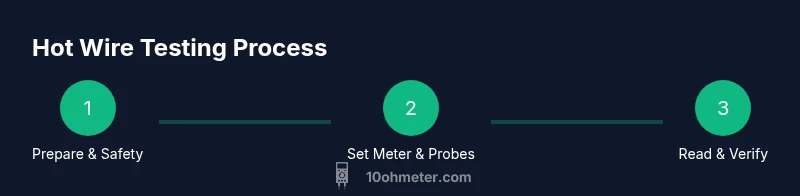
- 1
Prepare the workspace
Clear the area, verify power status where possible, and set up PPE. If you can, lock out the circuit and test the area with a non-contact tester to confirm no voltage before touching any conductors.
Tip: Keep a clear path to exit in case you need to step away quickly. - 2
Configure the meter
Turn on the multimeter, select AC voltage, and choose auto-range if available. Inspect probes for damage and ensure proper insertion into the meter jack.
Tip: If your meter has a low-impedance mode, enable it to reduce ghost voltages. - 3
Connect probes to the test points
Approach the conductor with the red probe, connect the black probe to a reference point such as ground or neutral, ensuring your hand remains behind insulated parts.
Tip: Never bridge to a metal surface that isn’t a proper reference point. - 4
Read and verify
Read the AC voltage value. A reading near the expected mains voltage indicates a hot wire; near zero suggests no voltage. If readings are unstable, recheck connections and consider a second reference point.
Tip: Confirm readings with a second method if possible for reliability. - 5
Document and secure
Record the results, label wires or harness sections, and restore power with caution following your safety plan. Remove tools, store PPE, and ensure the area is clean before leaving.
Tip: Always re-check that power is off before leaving the workspace. - 6
Assess safety and plan next steps
If any doubt remains about the presence of live voltage or facility safety, pause and consult a qualified technician. Use a professional assessment for complex harnesses or critical systems.
Tip: When in doubt, err on the side of safety and escalation.
Your Questions Answered
Can a multimeter reliably detect a live wire?
A multimeter can indicate the presence of voltage when measuring between a conductor and a reference point. It should be used with proper safety precautions, and readings should be cross-verified when possible.
A multimeter can indicate live voltage with the right settings, but always verify and follow safety steps.
Is it safe to measure voltage on exposed wires?
Measuring exposed wires carries risk. Always de-energize if feasible, wear PPE, and maintain a safe working distance. If the circuit must stay live, use proper safety equipment and low-contact procedures.
Exposed wires are dangerous. De-energize when possible and wear PPE; proceed with caution if you must work live.
What should I do if I get inconsistent readings?
Recheck your connections, verify the reference point, and inspect probes for damage. Consider using a second measurement method or a reference point to confirm results.
If readings don’t add up, recheck probes and references and try a second method.
Do I need a grounded reference for all tests?
A stable reference (ground or neutral) is important for accurate measurements. If you’re in a vehicle or chassis-supplied ground, ensure the reference point is solid and consistent.
Yes, use a stable ground or neutral as your reference for accuracy.
What meter settings are best for hot-wire testing?
Use AC voltage, prefer True RMS if available, and enable auto-range. If your meter lacks low-impedance mode, manual range selection with caution is necessary.
Set AC voltage to True RMS if possible and use auto-range for safety.
Can I substitute a non-contact tester for this task?
A non-contact tester is a helpful pre-check, but it doesn’t replace a proper multimeter measurement when you need a numeric voltage reading or to verify references.
Non-contact testers are good for quick checks, not a full measurement.
Watch Video
Key Takeaways
- Identify safety steps before testing
- Use AC voltage mode with proper range
- Verify readings against a solid reference
- Document results and escalate if unsure