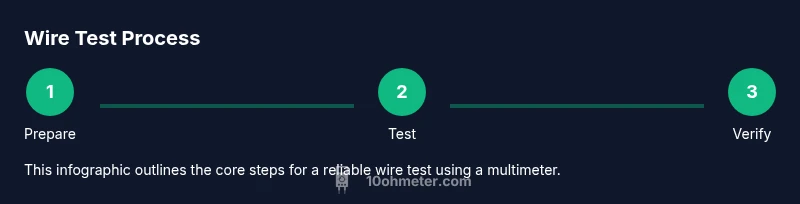
Multimeter Wire Test: Step-by-Step Guide
Master the art of a multimeter wire test with safe, accurate steps to verify continuity, resistance, and wiring integrity in electronics and automotive projects.


Performing a multimeter wire test helps you verify continuity and resistance along a circuit path, ensuring connections are sound before you power a project. This step-by-step guide walks you through the exact tools, settings, and safety precautions needed to test wires, harnesses, and connectors in electronics and automotive work, with practical examples and troubleshooting tips from the 10ohmeter team.
Why a multimeter wire test matters
A multimeter wire test is a foundational skill for electronics and automotive work. It helps you confirm that a wire or conductor path is continuous from end to end, identify breaks, and verify that there is no unintended resistance compromising performance. When you perform a thorough multimeter wire test, you reduce the guesswork during assembly and post-installation troubleshooting. In practice, you’ll check not only the obvious straight runs but also harness branches, junctions, and connector interfaces. The result is a clearer picture of wiring health and a safer project overall. According to 10ohmeter, adopting systematic wire testing early in a project saves time and reduces the risk of in-field failures. The approach applies whether you’re wiring a small sensor circuit, a car’s lighting harness, or a home automation installation.
Safety and workspace setup
Before you touch any wires, set up a clean, dry workspace with good lighting. Wear safety glasses and keep metal jewelry away from exposed conductors. Power down the equipment and unplug power sources before testing to avoid shock or arc flash. Use insulated tools and keep test leads away from hot surfaces. If you’re testing automotive wiring or high-energy circuits, consider securing the battery or power source with a terminal resistor so you don’t create a short while you move leads around. A well-organized workspace reduces confusion and minimizes the chance of accidental cross-contact between wires and connectors.
Understanding meter settings for wire testing
A successful multimeter wire test hinges on choosing the correct meter settings. For basic continuity checks, use the continuity or beep mode if your meter offers it; this confirms a complete path with a visible or audible indication. If your goal is to quantify resistance, switch to the resistance (ohms) range and measure across the wire or between connector pins. Start with the lowest practical resistance range to improve precision and then back off if you see an overload or an overflow reading. When testing diodes or junctions, you may also use the diode test mode to verify forward bias behavior. Practicing these settings in a controlled, known-good circuit helps you interpret results more reliably in real-world testing.
Practical testing scenarios: electronics vs automotive wiring
In electronics, a wire test usually covers short runs on printed circuit boards or harness segments inside small enclosures. You’ll test continuity between pads, pins, and wire ends, checking for unintended breaks caused by damaged insulation, chafing, or poor solder joints. Automotive wiring often involves longer runs, high currents, and environmental exposure. Here you’ll test continuity across harness segments, connectors, and splices, watching for corrosion, damaged insulation, and loose pins. Regardless of domain, ensure that the circuit is de-energized, and document any abnormal readings with photos or notes. A well-documented wire test helps you reproduce or escalate issues.
Interpreting readings and diagnosing issues
A good wire should show very low continuity impedance and a steady resistance value when the lead is moved slightly. A reading of infinite resistance (OL or open) indicates a break in the path, while a reading that’s significantly higher than expected suggests a partial open, corrosion, or a poor connection. If you’re testing under load conditions, remember that resistance can change with temperature and contact quality. For automotive tests, consider measuring with the engine off and then rechecking after a short period of use to observe how connectors respond to heat. In ambiguous cases, retest with fresh batteries and different leads to rule out tool-related variability.
Advanced checks: insulation, shorts, and path continuity
Beyond basic continuity, you can extend a multimeter wire test to insulation checks by measuring leakage current with the meter’s highest impedance range. If you suspect a short, test between adjacent wires at multiple points along the harness to verify that there is no unintended coupling. For longer runs, test at the source, mid-run, and at the destination to confirm consistent performance along the entire path. Document any poor or intermittent readings and trace them back to potential mechanical damage or manufacturing defects. A comprehensive approach helps you pinpoint fault origins more quickly and avoid unnecessary replacements.
Common mistakes and how to avoid them
One of the most common mistakes is testing a live circuit. Always disconnect power and discharge capacitors if applicable. Another pitfall is using an incorrect meter range, which can produce misleading results or overload the meter. Loose test leads or damaged probes also skew readings; always inspect leads for wear and replace when necessary. Finally, relying on a single measurement can be misleading; repeat tests at different points and with multiple leads to validate findings. By standardizing your procedure, you’ll reduce variability and improve diagnostic accuracy.
Putting it all together: documentation and next steps
As you complete the multimeter wire test, document each measurement with the associated wire segment, connector, and environment. Take photos of harness routes, label pins, and note any anomalies. Use a simple worksheet or a notes app to store readings, ranges, and explanations. When you’re ready to move forward, classify each segment as OK, suspect, or damaged, then plan corrective actions such as re-wiring, replacing connectors, or re-routing harnesses. Regular practice of this testing discipline helps you build confidence and reduces rework in future projects.
Tools & Materials
- Digital multimeter(Set to continuity or resistance (ohms) mode; ensure battery is fresh)
- Test leads with alligator clips(Dual-probe leads; use probes with insulated handles)
- Known-good wire or harness section(For baseline tests and comparison)
- Non-contact voltage tester (optional)(Useful to verify absence of live voltage before touching lines)
- Insulated workspace mat or bench(Reduces static and provides a clean surface for wires)
Steps
Estimated time: 30-45 minutes
- 1
Prepare workspace and safety
Clear the bench, unplug power to all devices, and wear eye protection. Inspect wires for damage and keep a log of what you test. This foundation prevents shocks and accidental shorts during testing.
Tip: Use a non-slip mat and secure long wires to prevent tangling while probing. - 2
Inspect tools and cables
Check test leads for damaged insulation or exposed conductors. Replace any damaged leads before starting. Confirm the multimeter is functioning correctly by testing a known-good wire path.
Tip: Always test with a known-good reference to verify meter accuracy. - 3
Set the meter to the right mode
Choose continuity or resistance mode depending on your goal. For a quick pass/fail check, use continuity; for quantitative data, select a low-ohm range and measure across the wire.
Tip: If you hear a beep in continuity mode, the path is conductive; if not, check connections first. - 4
Connect probes to wire ends
Attach one probe to each end of the wire or across the path you want to verify. Keep hands away from the metal tips to avoid shorting adjacent conductors.
Tip: Use alligator clips for steady connections on longer runs. - 5
Take initial measurements
Record the continuity status and resistance value. Move the probe along the wire to detect weak spots or intermittent connections.
Tip: If readings drift with movement, suspect a loose connection or damaged insulation. - 6
Interpret results
Compare values against expected ranges for your wire gauge and material. Look for open circuits, abnormally high resistance, or unexpected changes with temperature.
Tip: Document any anomalies with a photo and mark the exact test point. - 7
Repeat tests on critical paths
Re-run tests on critical segments, such as power lines and ground paths, to confirm consistency. Use fresh leads if readings seem inconsistent.
Tip: Consistency across multiple tests strengthens confidence in results. - 8
Closeout and documentation
Log all measurements, outcomes, and any corrective actions. Store the data with clear labels and date stamps for future reference.
Tip: Include notes about environmental conditions that might affect readings.
Your Questions Answered
What is a multimeter wire test?
A multimeter wire test checks whether a wire path is continuous and free from shorts or excessive resistance. It helps verify wiring integrity before powering a system.
A multimeter wire test checks if a wire path is complete and free from shorts, helping you confirm wiring integrity before powering up.
Can I perform a wire test on live circuits?
Testing on live circuits is risky. Always disconnect power and discharge capacitors before probing, unless you are following a controlled procedure with proper PPE and equipment.
No, don’t test live circuits unless you’re following a strict, safety-focused procedure with the right gear.
What readings indicate a good wire?
Continuity should be present (beep or near-zero resistance). Open circuits indicate breaks, and very high or erratic resistance suggests damage or poor connections.
Good wires show continuity with low or zero resistance and consistent readings along the path.
How do I test for shorts between wires in a bundle?
Test between adjacent wires at multiple points. If current leaks or readings drift, inspect insulation and connectors for damage or abrasion.
Check adjacent wires at several spots; look for insulation damage and loose connectors if you see unusual readings.
What should I do after identifying a damaged wire?
Isolate the affected wire, replace or repair the insulation, and rerun tests to confirm restoration of a healthy path.
If a wire is damaged, replace or repair insulation and re-test to confirm the path is healthy.
Watch Video
Key Takeaways
- Test safety first before handling any wires.
- Use the correct meter settings for continuity and resistance.
- Interpret readings in context with wiring type and environment.
- Document results to enable repeatability.
- Avoid relying on a single measurement; validate with multiple checks.